 Leaders of the Hanoi Department of Construction presented a letter of appreciation to leaders of TOPES Group.
Early Results and Data Value from AI Technology
On March 30, the Hanoi Department of Construction, in coordination with TOPES Group, held a ceremony to review the pilot implementation of a traffic monitoring camera system on Vo Chi Cong and Pham Van Dong roads. The event marked six months of testing one of the AI technology applications in urban traffic management in Hanoi.
The project was implemented based on proposals from the Korea Institute of Science and Technology (KIST), TOPES Joint Stock Company, and the Hanoi Department of Construction. On June 26, 2025, the Hanoi People's Committee issued Document No. 9645/VP-LSLT approving the pilot implementation of a traffic monitoring camera system on the two roads.
Accordingly, the system included 21 AI-powered cameras developed and provided by TOPES Joint Stock Company. The system supports lane violation detection and penalties, detects and penalizes two-wheeled vehicles traveling in lanes designated for cars, collects traffic information, and counts vehicle flow across all lanes for monitoring and traffic analysis.
With the goal of developing Hanoi into a green, smart, and sustainable city, the project is expected not only to serve as a technology pilot but also to become a long-term data platform for traffic management and operations.
During implementation, a total of 21 traffic violation monitoring cameras were installed. The system included nine cameras on Pham Van Dong road and 12 cameras on Vo Chi Cong road. The entire system was installed and operated over six months, from August 27, 2025, to March 15, 2026. According to the project review, the system is currently operating stably and meets technical requirements.
 Tran Huu Bao, Deputy Director of the Hanoi Department of Construction, speaks at the program.
Speaking at the event, Tran Huu Bao, Deputy Director of the Hanoi Department of Construction, emphasized the role of technology in modern urban traffic management. He acknowledged the results achieved during the pilot phase, especially in accuracy and data processing capabilities.
"We installed 21 devices, and by applying artificial intelligence, the accuracy of recognition and analysis in many aspects, such as license plate recognition, has been rated very high," Bao said.
According to the Hanoi Department of Construction, the AI camera system not only supports traffic violation monitoring but also provides a large amount of valuable data for ongoing traffic projects in Hanoi. This serves as an important basis for authorities to develop appropriate policies and improve traffic management efficiency.
"You have contributed a large amount of data, information, and useful insights for traffic projects currently being implemented in Hanoi. This will help improve traffic order and traffic policies on these two roads," he continued.
From a management perspective, data collected from the system has supported traffic flow analysis, violation behavior identification, and the development of more appropriate traffic organization solutions.
He also expressed appreciation for the cooperation and technical support provided by the implementing company. "We highly appreciate the cooperation and technical support your company provided throughout installation and operation. What impressed me most was the dedication and enthusiasm of the TOPES technical team," he said.
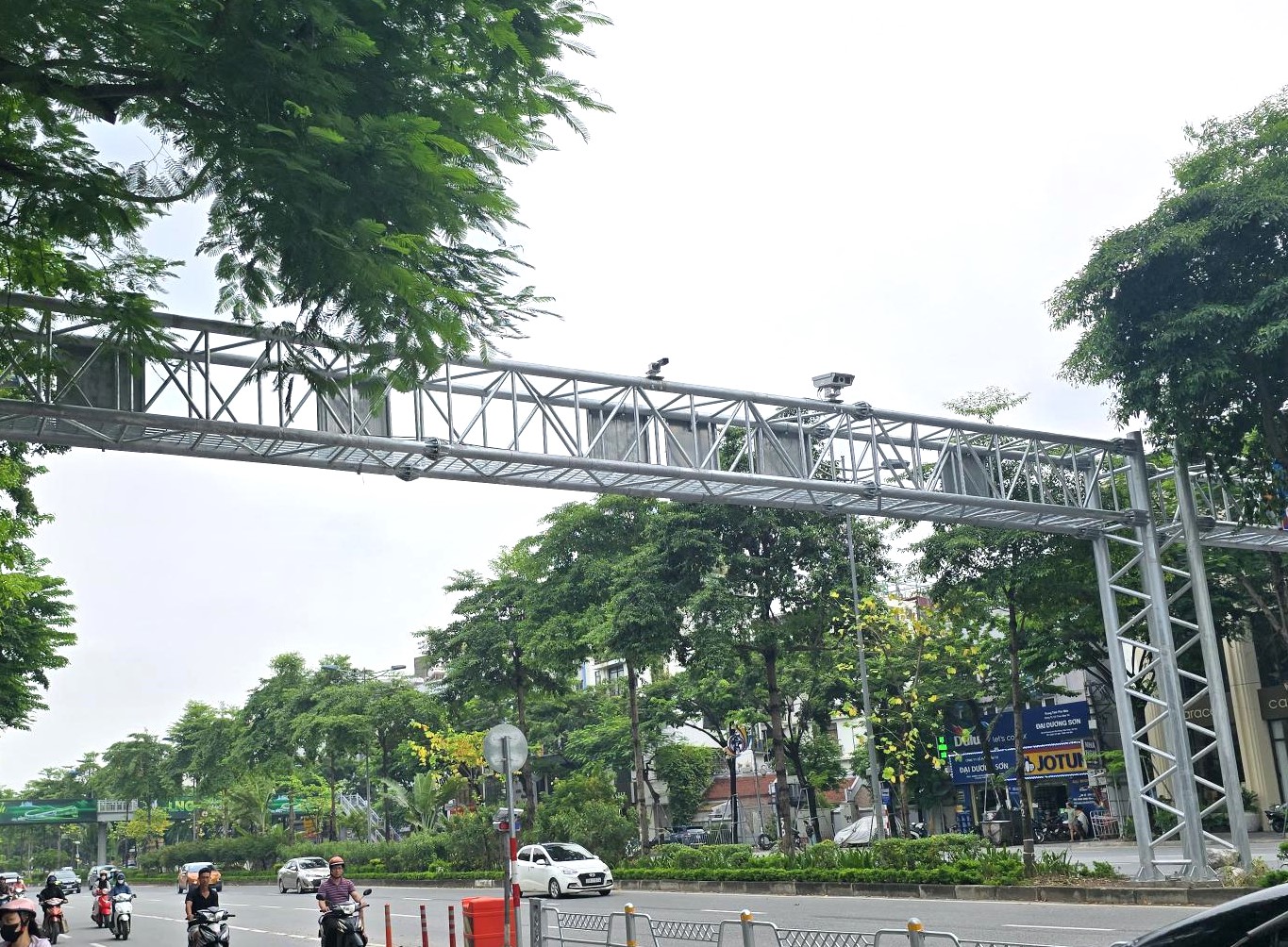 AI camera installed on Vo Chi Cong road.
Opening a New Direction for Urban Traffic Digital Transformation
From the company's perspective, Lee Kang Bon, Chief Executive Officer of TOPES Group, said the pilot project in Hanoi was significant in testing the technology in real-world conditions.
"As a result, the law enforcement acceptance rate reached 98.6% during the day and 98.1% at night. This is a significant and excellent result even compared with domestic and international standards," Lee said.
According to him, the AI traffic camera system demonstrated its ability to adapt to Hanoi's unique traffic conditions, where vehicle density is high and different types of transport share the road.
Lee said these results open up broader prospects for applying AI technology in urban management. "We believe this will create opportunities for TOPES' AI traffic camera technology to contribute to establishing a new traffic culture through digital transformation in Vietnam."
He also expressed hope that the pilot project would serve as a foundation for expansion into other areas. "We hope this achievement will be a catalyst for expanding AI camera and AI technology projects in traffic, emergency response, disaster management, and security in Hanoi and across Vietnam," he said.
Providing further details on the system structure and operation, Lee Dong Bom, Chief Strategy Officer of TOPES, said the entire solution was designed based on Hanoi's traffic conditions and tested directly on real roads.
"This system has been applied and tested directly on actual roads and was designed to fit Hanoi's traffic environment," he said.
According to him, the system was deployed rapidly over about seven months, focusing on major traffic routes. Core functions include violation detection, license plate recognition, traffic flow management, and penalty reporting.
One of the notable features is real-time data processing capability. "Violation information processed in real time can be checked through the operating system, and in case of violations, motorcycle images, license plates, and video footage are stored for evidence management," Lee Dong Bom said.
The system also integrates vehicle classification, traffic flow measurement, and a map-based interface, allowing operators to easily monitor and use data.
"Finally, all violation data can be compiled into reports, and the structure is designed so that license plates, video clips, and violation information are stored together, allowing immediate use for administrative processing," he added.
Overall, the pilot traffic camera project on Vo Chi Cong and Pham Van Dong roads has shown positive signals in applying AI technology to traffic management in Hanoi.
From the perspective of government agencies, the system provides important data to improve traffic management and operations. From the company's perspective, the project demonstrates technological capability under real-world conditions.
The cooperation between government agencies and a technology company in this project shows a new approach in which data and technology play a central role. When solutions are implemented systematically and evaluated in practice, expansion is entirely feasible.
Speaking at the event, Bao expressed hope that Hanoi would continue expanding cooperation with TOPES to apply advanced technology more deeply in urban traffic management, aiming to build a modern, safe, and efficient traffic system.
In the context of rapid urbanization and increasing traffic pressure, pilot projects like this AI camera system can be seen as a necessary step, creating a foundation for a smart traffic ecosystem where data becomes "soft infrastructure" supporting management decisions.
From a pilot road project, the technology story is gradually expanding into a broader urban governance issue, where each camera is not only a monitoring device but also a "data point" contributing to shaping the future of Hanoi's traffic system.
In the coming period, after the pilot phase, the camera system will complete necessary procedures to be transferred and integrated into the Hanoi Police Department's management system. The system will then continue operating in a synchronized manner to support monitoring, supervision, violation handling, and traffic safety management in the capital.
TOPES Group is a technology company headquartered in South Korea, established in 1984, specializing in solutions for intelligent transportation, urban security, and infrastructure management. With more than 40 years of experience, TOPES has developed core technologies using artificial intelligence and big data analytics for traffic monitoring, violation enforcement, and urban operations optimization. The company operates widely across South Korea and has implemented international projects in the United States, Mongolia, Rwanda, Angola, Turkmenistan, and Vietnam.
In Hanoi, TOPES participated in the AI traffic camera pilot project on Vo Chi Cong and Pham Van Dong roads, demonstrating technological capability in real traffic conditions and expanding cooperation in smart city development in Vietnam.