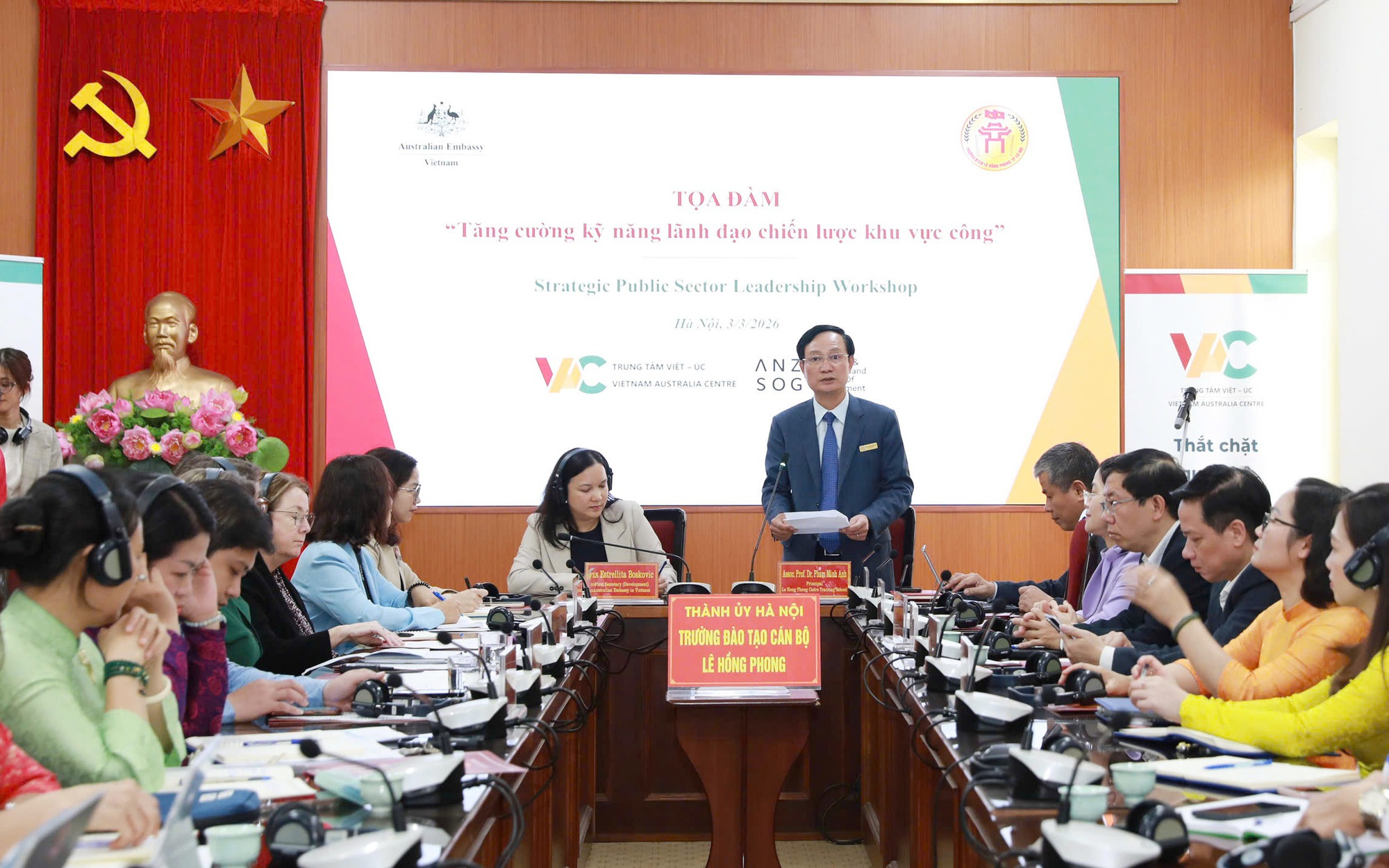
 Delegates attend the dialogue "Strengthening Strategic Leadership Skills in the Public Sector."
Participants included Estrellita Boskovic, First Secretary of the Australian Embassy in Vietnam; Kim Cleary, International Director of the Vietnam Australia Center (VAC); Dr. Anneke Schmider, Director of the Global Initiatives Program at the Australia and New Zealand School of Government; Annmarie Carroll, Senior Advisor of the Global Initiatives Program at the Australia and New Zealand School of Government; Dr. Bui Phuong Dinh, Deputy Director of the Academy of Public Administration and Governance; Nguyen Hoang Son, Deputy Head of the Hanoi Party Committee's Commission for Information, Education and Mass Mobilization; and Associate Professor Dr. Pham Minh Anh, Secretary of the Party Committee and Principal of the Le Hong Phong Training School for Officials of Hanoi, among others.
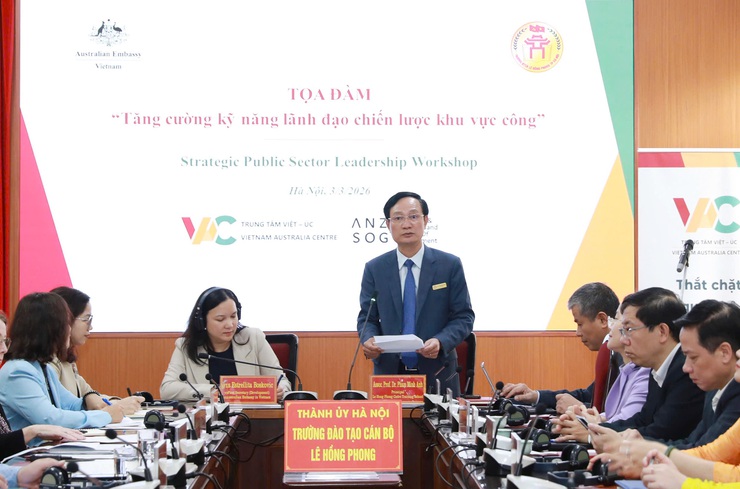 Associate Professor Dr. Pham Minh Anh, Secretary of the Party Committee and Principal of the Le Hong Phong Training School for Officials of Hanoi, delivers the opening remarks.
In his opening remarks, Associate Professor Dr. Pham Minh Anh said that with the mission of training and developing high-quality human resources for the political system and the public sector of Hanoi, as well as mid-level officials of central agencies located in the city, the Le Hong Phong Training School for Officials always attaches importance to updating and enhancing modern leadership skills.
He noted that as Vietnam and Hanoi enter a new era with strong socio-economic development goals, comprehensive digital transformation and deeper international integration, strengthening strategic leadership skills is not only a necessity but also a key factor in building an effective, transparent and citizen-oriented public administration.
According to the principal, the dialogue provided a valuable opportunity to exchange and learn from experts, particularly international experts from Australia, in order to apply these experiences in the practical context of Hanoi and Vietnam.
"This cooperation not only opens a new chapter of collaboration between the Le Hong Phong Training School for Officials and its partners based on the friendship between the two countries but also creates new directions in public sector leadership training for the capital Hanoi," Anh emphasized.
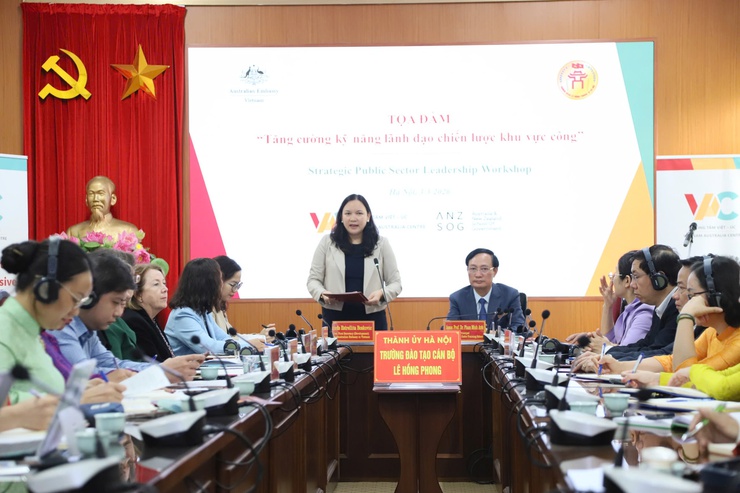 Estrellita Boskovic, First Secretary of the Australian Embassy in Vietnam, speaks at the dialogue.
Speaking at the dialogue, Estrellita Boskovic said improving the capacity of public officials is a key foundation for sustainable development. Cooperation in public sector training has been a central pillar in the strategic partnership between Australia and Vietnam over the past two years.
Australia is committed to supporting Vietnam through cooperation initiatives, with the Vietnam Australia Center (VAC) playing a core role in bilateral collaboration through leadership capacity building and the promotion of people-to-people diplomacy. The center serves as a platform for organizing high-quality training programs and these efforts are designed as long-term cooperation rather than one-time activities.
She also stressed that in the context of rapid advances in digital transformation and science and technology, public officials must meet increasingly demanding requirements. Strengthening capacity therefore, plays a vital role as Hanoi takes on a leading and spreading role nationwide.
Boskovic expressed hope that participants would share their views openly and that the results of these training activities would soon be visible.
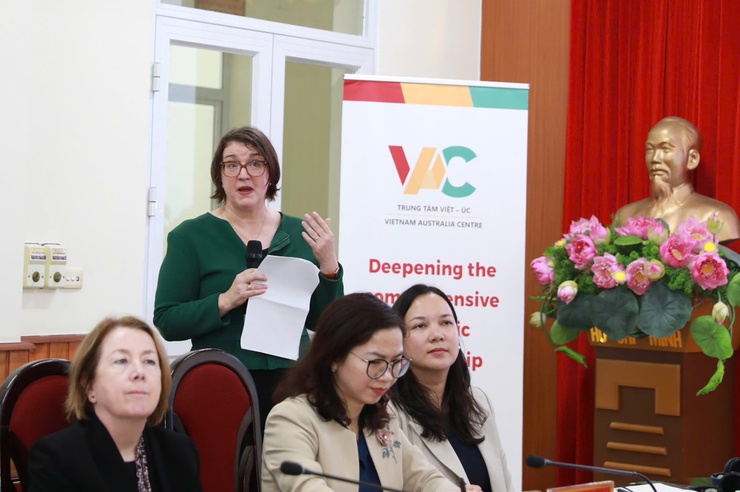 Dr. Anneke Schmider, Director of the Global Initiatives Program at the Australia and New Zealand School of Government, presents at the dialogue.
Presenting two topics titled "From Data to Trusted Policy Advice in Complex Systems: Analytical Frameworks and Core Advisory Models" and "Approaches to Policy Implementation, Monitoring and Reporting in Conditions of Change and Increased Accountability," Dr. Anneke Schmider said data plays a role at every stage of the policy process in most countries.
Data is collected from multiple sources within policy systems and beyond, ranging from ministries and agencies and socio-economic statistics from national statistical organizations to academic research and many other sources. Establishing systems that bring these data sources together can generate significant value.
However, data alone is not sufficient. Data must be used to generate evidence and serve as input for research and knowledge development throughout the policy process. Policy advisors must understand how to combine data with other sources of knowledge to apply them across policy cycles. In addition, establishing national key datasets to monitor major policy innovations helps ensure that policy processes from design to implementation and evaluation always have sufficient information.
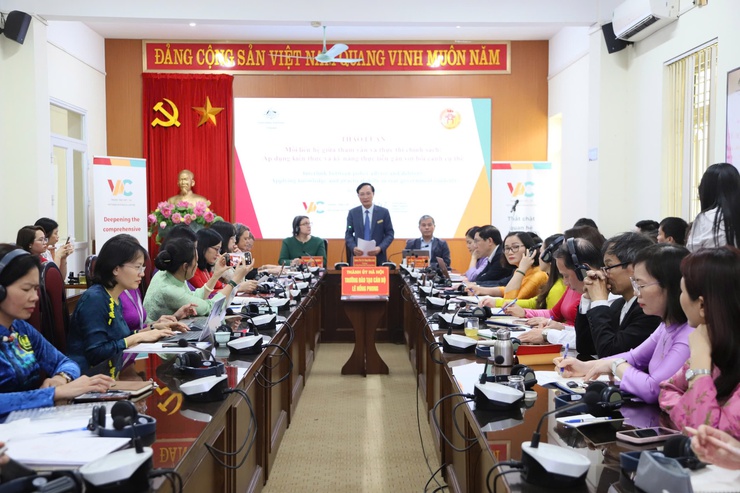 Delegates participate in the discussion session.
During the roundtable discussion titled "The Link Between Policy Advice and Policy Implementation: Applying Knowledge and Practical Skills in Specific Contexts," participants exchanged views on many issues related to urgent challenges in major urban areas.
Topics included why many policy models fail when implemented and what solutions could address this problem; experiences in addressing major challenges in modern cities and how such experiences could be applied in Hanoi to tackle five major bottlenecks, including traffic congestion, flooding, environmental sanitation, food safety and urban order; the role of scientists in policy making; and challenges in expanding universal healthcare coverage.
In his concluding remarks, Associate Professor Dr. Pham Minh Anh thanked the Australian experts for their valuable and practical insights that could be referenced and applied in Hanoi.
He noted that the issues raised were complex and large in scale but they represented important initial steps and provided practical experiences for those involved in policy advice for the capital Hanoi.
Anh expressed confidence that the dialogue would open new positive directions for cooperation between the Le Hong Phong Training School for Officials and the Vietnam Australia Center (VAC).
He emphasized that the success of the dialogue came from the enthusiasm, dedication and professionalism of the experts, as well as the efforts of the organizing committee and the close coordination between the two countries. He expressed his appreciation to the Australian Embassy in Vietnam, the Australian experts and the leaders of Hanoi city agencies for their meaningful contributions to the dialogue.
The Vietnam Australia Center (VAC) is a central initiative in developing the bilateral partnership and a symbol of trust between Australia and Vietnam, as highlighted in the joint statement of the two prime ministers in August 2019.
VAC is a dynamic hub for education research and dialogue. The center brings together leading experts from both countries and supports the development of Vietnam's future leadership through leadership development programs, policy research services, and collaborative research activities.
VAC carries out its activities in line with national priorities through close partnerships with the Ho Chi Minh National Academy of Politics (HCMA), the Ministry of Foreign Affairs (MOFA), the Government Office (OOG) and the Australian Embassy in Vietnam.