At the meeting, on behalf of Hanoi's delegation, Phung Thi Hong Ha congratulated Atsaphangthong Siphandone on his election as Chairman of the Vientiane People's Council.
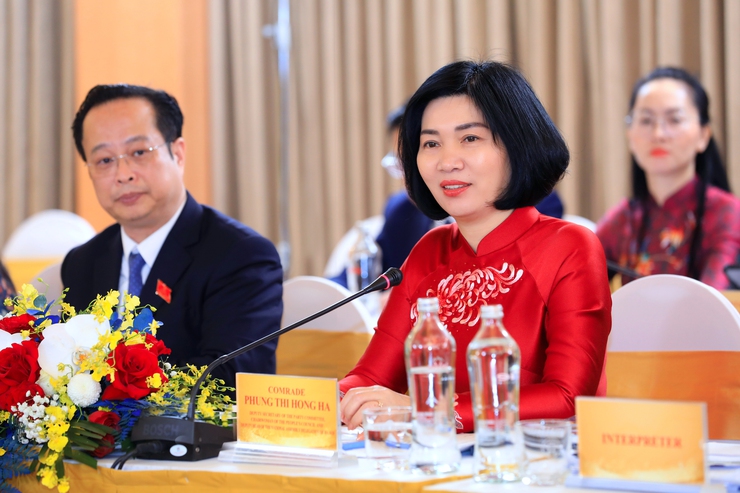 Hanoi People's Council Chairwoman Phung Thi Hong Ha speaks during the talks.
Expressing her pleasure at welcoming the high-level delegation from Vientiane, Ha emphasized that the close and loyal friendship and cooperation between Vietnam and Laos had become a model relationship over the years.
She noted that the People's Councils of Hanoi and Vientiane had maintained regular exchanges and shared experience, contributing to improved operations of elected bodies and strengthening friendship between the two countries.
During the period from 2022 to 2025, relations between the two councils were developed comprehensively under the cooperation agreement between the two capitals. Both sides actively exchanged experience in key areas, such as drafting legal documents, supervision, questioning activities, and training programs for officials, especially full-time delegates.
According to Ha, these results not only improved the effectiveness of elected bodies but also contributed to deepening the special friendship between the two nations.
Providing an update on the Hanoi People's Council, Ha said the council had gone through 16 terms of operation. Entering its 17th term, the council strengthened its organizational structure with an increase in the number of full-time delegates and council members.
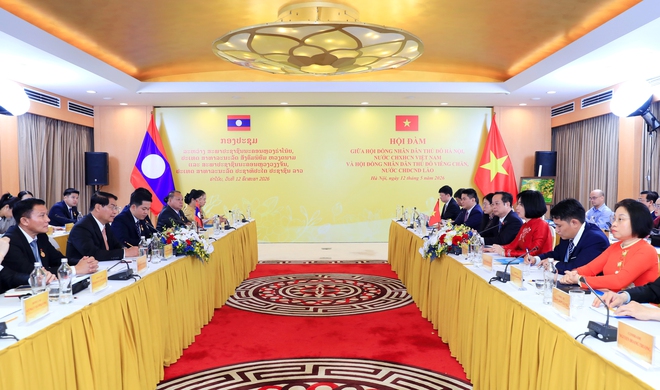 Delegates attend the talks.
Ha highlighted that the 2026 Capital Law, which will take effect on July 1, 2026, grants Hanoi more than 190 additional responsibilities.
Many tasks previously under the authority of the National Assembly and the National Assembly Standing Committee have now been delegated to Hanoi, including powers to issue major policy decisions shaping the capital's development in the new period.
According to Ha, in recent years, the Hanoi People's Council has been highly praised by central authorities and the National Assembly, becoming a national model for elected body operations.
Under the two-tier local government system, the council has played a major coordinating and guiding role for grassroots elected bodies.
The Hanoi People's Council has also organized practical and decisive supervisory and explanatory sessions focused on pressing public concerns. Structured explanatory meetings have helped resolve many long-standing and unresolved issues, contributing to removing bottlenecks facing the city.
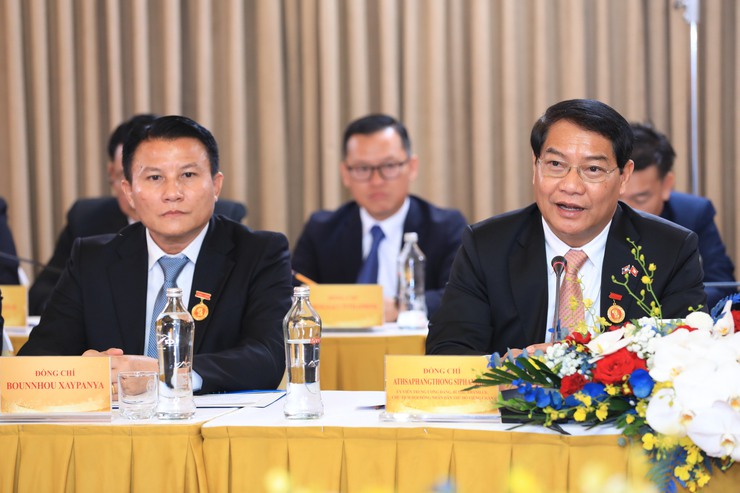 Atsaphangthong Siphandone, Secretary of the Vientiane Party Committee and Chairman of the Vientiane People's Council, speaks during the talks.
Council sessions have continued to innovate and issue policies closely aligned with practical needs, including many important resolutions focused on socioeconomic development, public investment, technical and social infrastructure development, and improving living environment quality.
At the talks, Ha proposed that during the 2026-2030 period, the two councils continue signing cooperation agreements to further deepen practical and sustainable cooperation between the two capitals.
She suggested enhancing exchanges on modern urban governance, digital transformation, environmental management, green and smart urban development, and improvements to local institutional frameworks.
Ha also proposed stronger coordination in promoting socioeconomic cooperation between Hanoi and Vientiane, creating favorable conditions for businesses and organizations from both sides to explore investment and business opportunities.
She added that the two councils should maintain regular connections and strengthen information sharing and professional exchanges between leaders and specialized committees.
Ha said the Hanoi People's Council has already implemented software systems for elected body operations, including specific KPI assignments for individuals as a basis for evaluating work performance. Hanoi is ready to share its experience with the Vientiane People's Council in this field.
Speaking at the meeting, Atsaphangthong Siphandone congratulated Phung Thi Hong Ha on her election as Chairwoman of the Hanoi People's Council for the 17th term, 2026-2031, and praised the council's achievements in recent years.
He said the two councils had strengthened exchanges and shared lessons through visits, workshops, conferences, seminars, and cooperation agreements.
Regarding future directions, Atsaphangthong Siphandone expressed hope that both sides would continue sharing experience in drafting legal and sub-law documents, improving supervisory capacity, particularly mechanisms for monitoring state budget revenues and expenditures and national target programs on rural development and poverty reduction.
He also emphasized the importance of strengthening citizen reception mechanisms and handling public complaints and denunciations, while accelerating information technology applications to build "paperless meetings," modernize archival systems, and increase online interaction with residents.
Siphandone expressed confidence that during the 2026-2030 period, the two sides would soon finalize and sign a new memorandum of understanding to strengthen the special friendship between the two capitals and improve the effectiveness of elected body operations in the new context.
Agreeing with the views shared by the Chairman of the Vientiane People's Council, Ha affirmed that Hanoi would continue strengthening cooperative and friendly ties between the two capitals through regular information exchanges and the signing of new cooperation agreements between the two councils.