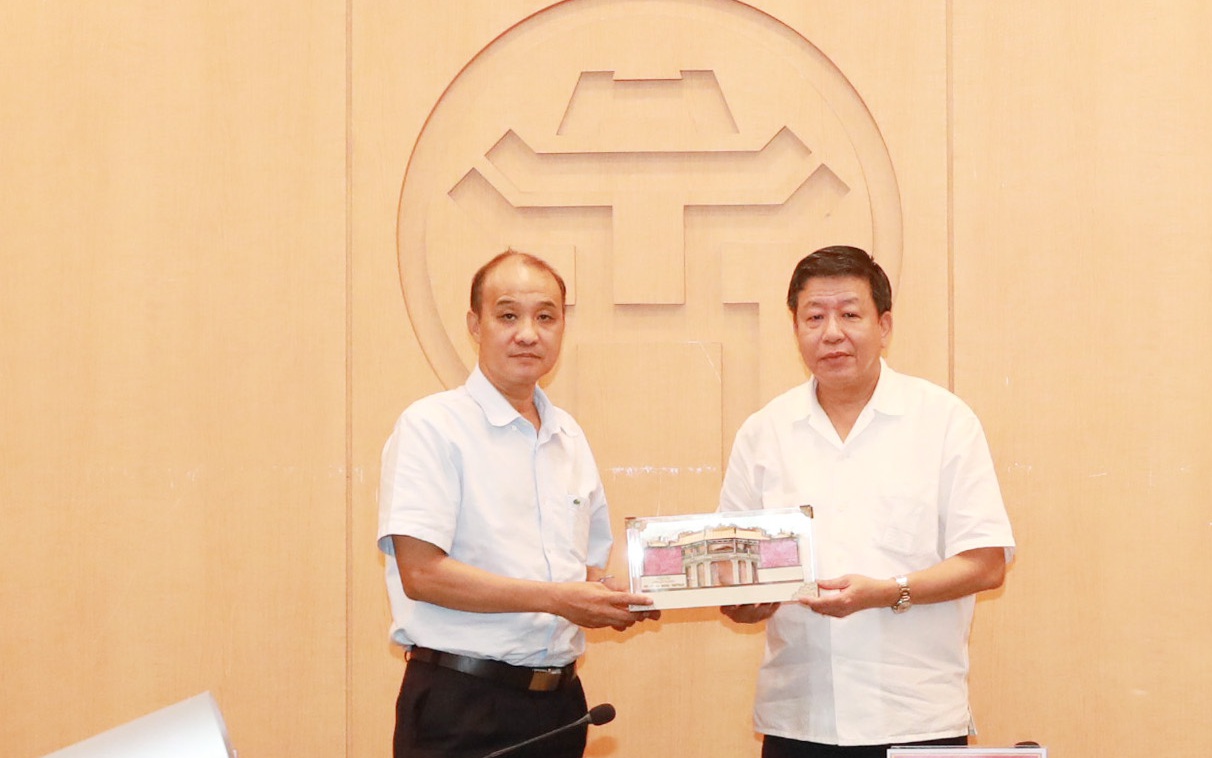
 Vice Chairman of the Danang People's Committee Le Quang Nam presents a souvenir to Permanent Vice Chairman of the Hanoi People's Committee Duong Duc Tuan.
In his opening remarks, Permanent Vice Chairman of the Hanoi People's Committee Duong Duc Tuan said Hanoi and Ho Chi Minh City are the two northern and southern growth poles and key drivers of national development.
Recently, Hanoi has had three core strategic products: Politburo Resolution No. 02-NQ/TW dated March 17, 2026, on building and developing Hanoi Capital in the new era; the amended 2026 Capital Law; and the Hanoi Capital Master Plan with a 100-year vision. Among them, the 100-year Capital Master Plan serves as a long-term blueprint, shaping the city's development space and synchronized growth roadmap.
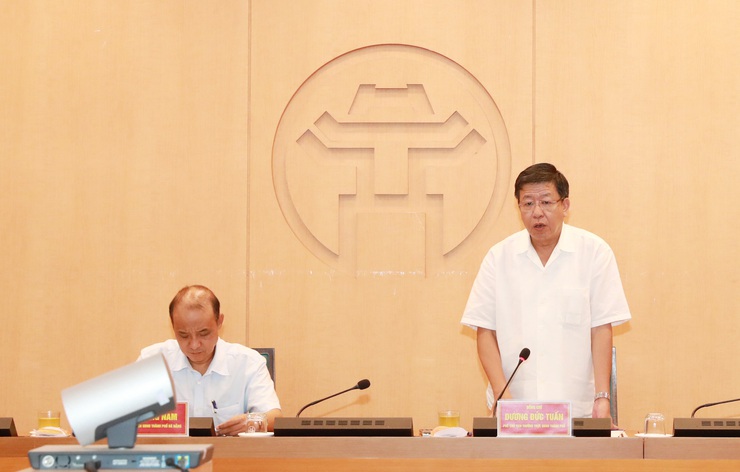 Permanent Vice Chairman of the Hanoi People's Committee Duong Duc Tuan speaks at the conference.
Tuan expressed his hope that through the conference, agencies from the two cities, including the Department of Planning and Architecture, the Department of Construction, the Institute of Construction Planning, and the Institute for Socio-Economic Development Research, would exchange views frankly and responsibly, while taking a deeper look at difficulties and obstacles in developing Hanoi's 100-year Capital Master Plan.
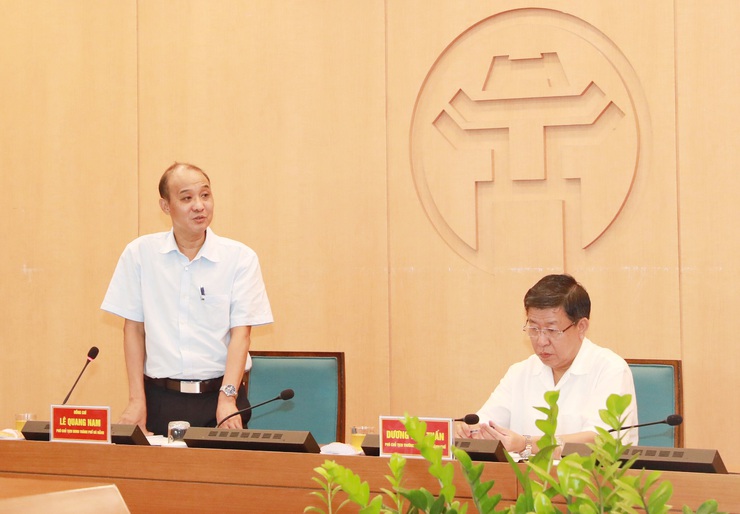 Vice Chairman of the Danang People's Committee Le Quang Nam speaks at the conference.
Vice Chairman of the Danang People's Committee Le Quang Nam said Hanoi has recently developed its Capital planning with a very long-term vision, helping address many long-standing issues related to transport, infrastructure, and the environment, while reassessing the entire structure of sectoral development toward a modern and long-term direction.
Emphasizing that Hanoi and Danang share many similarities, Nam said Danang has always viewed Hanoi as a major model with strategic thinking, vision, and many areas worth studying and learning from.
Regarding development orientation, Nam said Danang previously focused on eastward development, a direction that has continued until now, with an overall planning vision covering about 830 square kilometers. Within that area, planning has concentrated on around 40 square kilometers, accounting for about 35% of the area but accommodating 2.5 million people out of a total population of 3 million.
The remaining area, about 65% in the west and south, has fragmented terrain and is now home to only around 500,000 people, mainly ethnic minority communities.
Danang currently has 94 commune-level administrative units, including 23 wards, 70 communes, and one special zone, many of which remain poor or especially poor. This is a major issue for Danang as it seeks ways to develop in a more balanced and sustainable manner.
Danang has completed its provincial planning. However, some content still needs to be adjusted and supplemented. Nam said he hoped that through the conference and professional experience shared by Hanoi's departments and agencies, Danang would gain more materials to improve its planning projects.
At the conference, Nguyen Trong Ky Anh, Director of the Hanoi Department of Planning and Architecture, reported on special mechanisms and policies, practical difficulties and obstacles, and solutions during the development of long-term planning.
The report clarified shortcomings and limitations in administrative management during planning implementation, overlaps among planning systems, and bottlenecks in technical infrastructure and the environment. It also shared solutions for long-term planning, the development of a unified and shared database system, international experience, expert participation in the development of Hanoi's planning, and the application of digital transformation in consultation and interregional coordination.
Luu Quang Huy, Director of the Hanoi Institute of Construction Planning, then presented an overview of orientations, viewpoints, goals, and experience in developing the Capital's 100-year Master Plan.
During the discussion, the Vice Chairman of the Danang People's Committee and members of the delegation expressed their wish to exchange views on remaining issues related to population scale and provincial planning; experience in coastal zone management and development philosophy; Danang's brand and identity; challenges linked to planning timelines and infrastructure-led development; Hanoi's experience and lessons in the principle that "infrastructure must move one step ahead" and play a leading role in development; regional connectivity and airport urban development; north-south and east-west axis connections; digital transformation; and smart urban governance.
Permanent Vice Chairman of the Hanoi People's Committee Duong Duc Tuan and representatives of Hanoi departments and agencies discussed and clarified the issues raised by the Danang delegation.
Sharing more about Danang's development aspirations, Vice Chairman of the Danang People's Committee Le Quang Nam further discussed and clarified issues of interest to the delegation.
Expressing his sincere thanks for Hanoi's frank and responsible comments and sharing, Nam said the discussions helped Danang gain a deeper understanding and a broader vision of urban planning. This would support the city in taking more structured steps and adopting a more rigorous approach to its development and planning work.