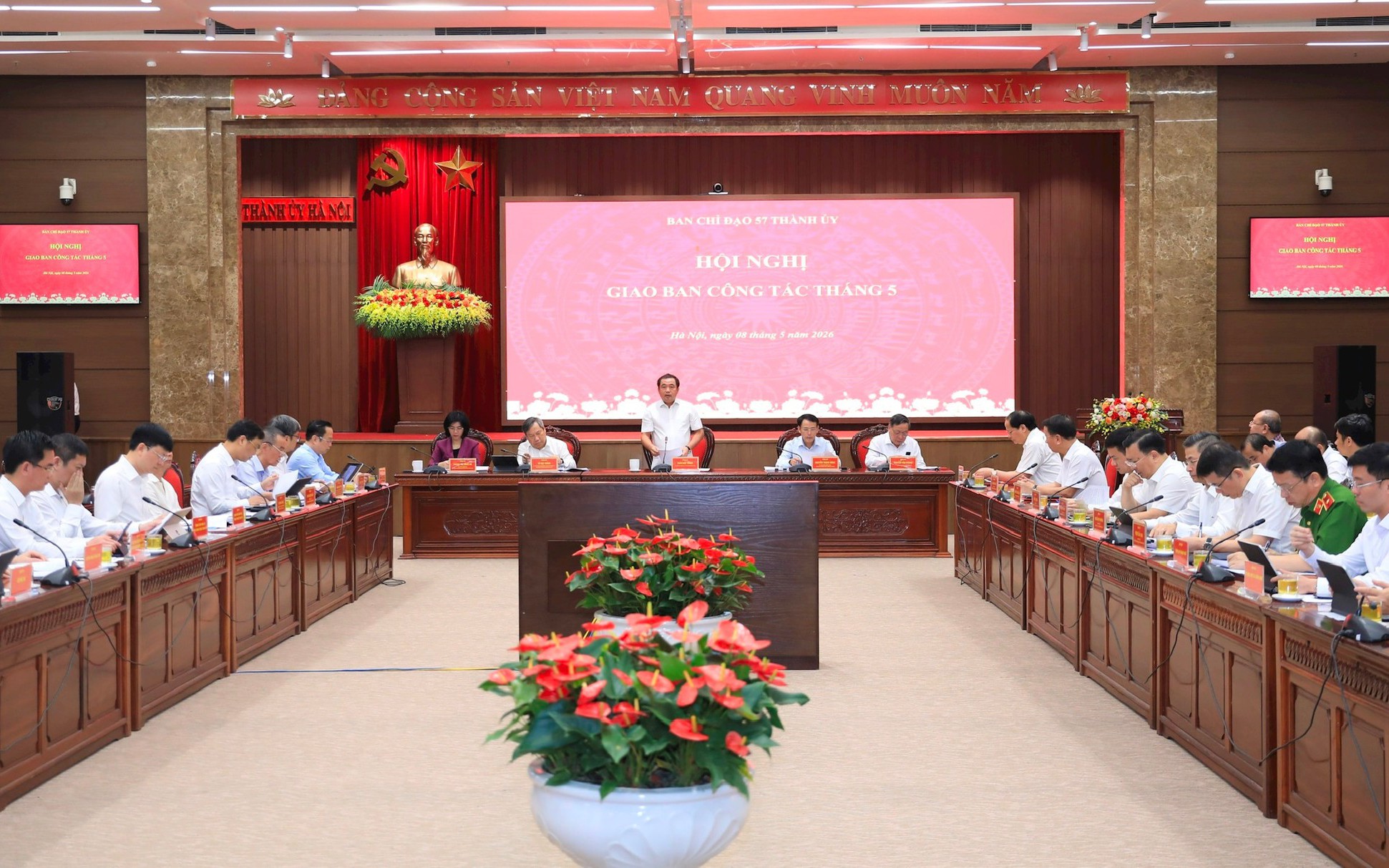
Hanoi Party Secretary Tran Duc Thang, Head of Steering Committee 57, chairs the meeting.
Attending the meeting were Party Central Committee members Nguyen Trong Dong, Standing Deputy Secretary of the Hanoi Party Committee; Vu Dai Thang, Deputy Secretary of the Hanoi Party Committee and Chairman of the Hanoi People's Committee; Phung Thi Hong Ha, Deputy Secretary of the Hanoi Party Committee and Chairwoman of the Hanoi People's Council; and Deputy Secretary of the Hanoi Party Committee Nguyen Van Phong.
Also present were members of the Standing Board of the Hanoi Party Committee, including Nguyen Doan Toan, Head of the Hanoi Commission for Publicity, Education, and Mass Mobilization; Tran Dinh Canh, Head of the Internal Affairs Commission; Tran The Cuong, Permanent Vice Chairman of the Hanoi People's Council; Truong Viet Dung, Vice Chairman of the Hanoi People's Committee; members of Steering Committee 57; and representatives of city departments, agencies, and sectors.
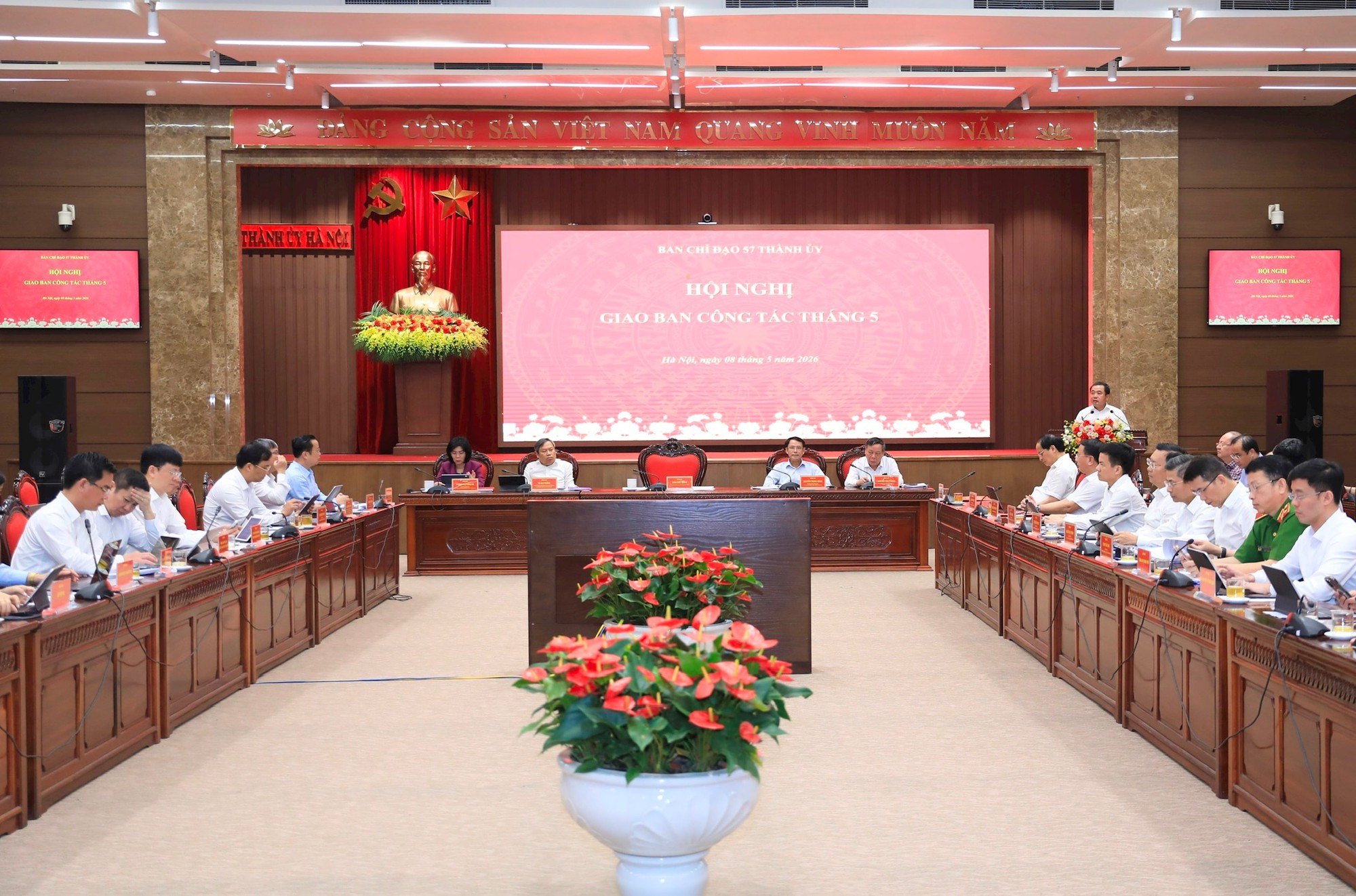 Overview of the April review meeting of Steering Committee 57.
Continuing the implementation of Resolution No. 57-NQ/TW and the tasks assigned to Steering Committee 57, Hanoi has recently made significant progress. These include shifting from document-based directives to task management based on responsible agencies, deadlines, deliverables, and evidence; establishing a unified leadership structure for science, technology, innovation, and digital transformation; initially operating a monitoring, warning, and task supervision mechanism based on implementation status.
The city also gradually forms core databases and shared digital platforms, while transitioning from support for individual science and technology projects to commissioning large-scale challenges and developing the technology market and innovation ecosystem.
Under Plan No. 20-KH/BCĐ57, Steering Committee 57 identified 20 priority task groups, 30 major programs, projects, and works, implemented across four pillars of the city's political system. So far, all four pillars, all five Party committees and the Party Committee Office, all 17 departments and sectors, and all 126 communes and wards have developed implementation plans. Of the 125 tasks outlined in Plan No. 20-KH/BCĐ57, 23 have been completed and 102 are underway.
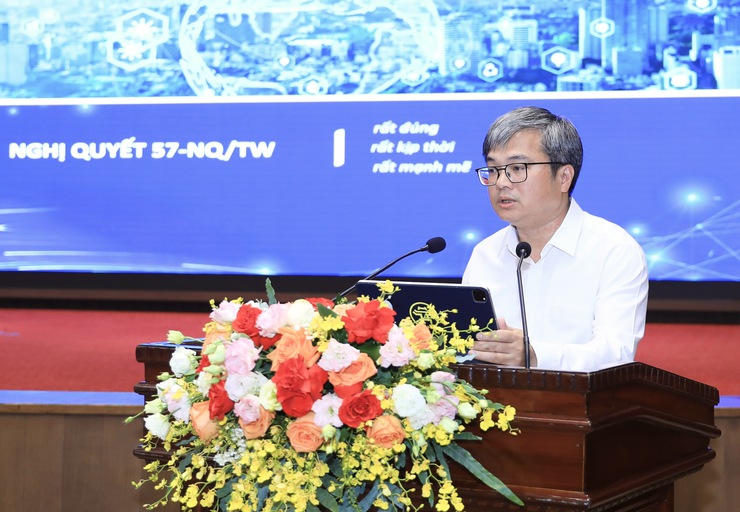 Vice Chairman of the Hanoi People's Committee Truong Viet Dung presents a report at the meeting.
One notable achievement is that the city's digital transformation infrastructure has continued operating steadily, gradually meeting requirements for connectivity, management, and system operation from the city level down to local communities.
The HanoiWork digital workspace platform has been deployed to 153 units, with workspaces established and 37,300 user accounts created. The platform has begun forming a unified work management system to support task assignment, progress monitoring, task management, and integration with OKR and KPI systems.
Regarding cybersecurity, information security, and state secrets protection, the city's Security Operations Center (SOC) infrastructure has largely been established and put into operation at the municipal police headquarters. A permanent task force has also been formed to coordinate and handle incidents, while the incident response team has been strengthened.
The city is also focusing on building databases under the principles of "accurate, sufficient, clean, live, unified, and shared," considering data a foundational resource for modern governance.
In the healthcare sector, electronic health records have continued to improve, particularly through data cleansing and integration with VNeID. Regarding land data, Hanoi continues operating an interconnected system linking the city's Public Administrative Service Center, the Land Registration Office, and tax authorities, while reviewing, reconciling, and cleaning data for synchronization with the national population database.
As of May 6, 2026, Hanoi had basically completed the delivery and installation of infrastructure for all 126 communes and wards.
Regarding public services, process reform, and digital transformation within the city's political system, among 2,063 administrative procedures, 661 have been delegated under 11 forms of authorization. This has strengthened decentralization, increased autonomy, restructured electronic processes, reduced pressure on upper-level authorities, and shortened processing times.
The city identified the full digital issuance of official documents as a key task linked to standardizing workflows, digitizing records, and improving administrative discipline. As of May 2, 2026, 92 out of 126 communes and wards had achieved a rate of over 90% for fully digital document issuance.
By the end of the first quarter of 2026, Hanoi maintained several advantages in science and technology enterprises, digital technology firms, and the innovation startup ecosystem.
Hanoi currently has 204 science and technology enterprises, the highest number nationwide. Its innovation startup ecosystem includes more than 1,000 startups.
In addition, the city is home to 10,996 digital technology enterprises, accounting for around 4.6% of all active businesses. This serves as an important foundation for Hanoi to develop the technology market, digital economy, and mechanisms for commissioning technology products to support governance and urban development.
Regarding the 30 major challenges, the city views them as a tool to reform the way science, technology, and innovation projects are commissioned, shifting from a model in which scientists propose topics themselves to one where the city sets problems based on development, governance, and public service needs.
After announcing the list of major challenges, Hanoi received 108 proposals. The city plans to classify, evaluate, and select proposals with clear deliverables and strong potential for testing, application, and scaling, ensuring that the 30 major challenges move beyond being only a list of tasks.
In terms of the digital economy, Hanoi aims for the digital economy to account for 22% of GRDP in 2026 and at least 40% by 2030. Initial assessments show the current digital economy share in Hanoi's GRDP is about 17.34%.
Regarding resources, the city allocated a total estimated budget of VND9.090 trillion (US$349.6 million) for science, technology, innovation, and digital transformation in 2026. So far, VND2.544 trillion ($97.9 million) has been allocated, equivalent to about 28% of the total estimate.
The Steering Committee also noted that despite progress, several key tasks remain behind schedule and have not met requirements. Of the 637 monitored tasks, 284 have been completed and 353 are underway, while 30 overdue tasks remain unfinished. These tasks require continued review, classification, clarification of causes and responsibilities, identification of deliverables, and revised deadlines.
In the coming period, Steering Committee 57 will focus on major objectives, key results, and tasks with spillover effects that influence the city's overall progress. Lead agencies were also instructed to proactively manage regular tasks based on deliverables, timelines, and implementation evidence.
After listening to the discussion of opinions at the meeting, Hanoi Party Secretary Tran Duc Thang, Head of Steering Committee 57, highly praised the implementation results achieved so far.
Alongside the achievements, Thang also pointed out several shortcomings and limitations. These include overdue tasks, the continued existence of multiple software systems, accounts, and reports despite limited interoperability and effectiveness, and the repeated re-entry of some data.
Although resources for science, technology, innovation, and digital transformation have received greater attention, disbursement and the conversion of resources into concrete products remain slow. Communes and wards have been provided with digital operation conditions, but usage efficiency remains uneven.
Regarding upcoming tasks, Thang emphasized 11 key priorities.
First, the Hanoi Party Committee Office, serving as the Standing Agency of the Steering Committee, was assigned to coordinate with relevant agencies to review all 30 overdue tasks, classify the causes, identify lead and coordinating agencies, determine delayed stages and missing deliverables, establish new deadlines, and propose solutions if necessary.
Second, the Hanoi People's Committee was tasked with directing departments and sectors to finalize 20 key documents implementing the 2026 Capital Law in science, technology, innovation, digital transformation, and high-tech zone development.
Third, for foundational tasks related to data, digital infrastructure, shared platforms, and information security, the Hanoi People's Committee, the Department of Science and Technology, the Hanoi Party Committee Office, and related agencies were instructed to define minimum deliverables for May and June, deliverables for the end of the third quarter, and deliverables to be completed by year-end, along with responsible agencies, implementation resources, and evaluation criteria.
Fourth, regarding land data, the Department of Agriculture and Environment was assigned to coordinate with the Public Administrative Service Center, the Department of Science and Technology, tax authorities, and related units to complete land data by June 30, 2026, ensuring it is "accurate, sufficient, clean, live," unified, and shared.
For the 25 priority online public services, the city's Public Administrative Service Center was instructed to shift from reviewing plans to configuring workflows, testing, operational implementation, and measuring reductions in paperwork, processing time, and compliance costs for citizens and businesses.
Fifth, for the project to build a shared database from digitized documents, the Department of Science and Technology was tasked with coordinating with related agencies to review and finalize the implementation plan.
Sixth, the Hanoi People's Committee was assigned to review and refine the system of digital transformation tasks, targets, and products based on three pillars: digital government, digital economy, and digital society. Digital transformation assessments must be linked to practical impacts on citizens and businesses, including reductions in paperwork, time, and compliance costs, rates of digital service usage, data reuse rates, public satisfaction, contributions of the digital economy, and the spread of digital skills across society. The work must produce tangible and measurable results while avoiding waste.
Seventh, the Hanoi Party Committee Office, the Hanoi People's Committee, and the Department of Science and Technology were tasked with conducting a comprehensive review of software systems, platforms, databases, and implementation reports across the city's political system. Based on this review, agencies are expected to propose solutions to reduce the number of accounts, eliminate repetitive data entry, reduce manual reporting, increase data sharing, and gradually establish automated reporting based on data platforms.
Eighth, the Hanoi People's Committee was instructed to review and refine the development model for high-tech zones and innovation centers in alignment with the city's development needs. In 2026, the city must clearly define expected deliverables, the number of pilot models, application potential, selection and evaluation mechanisms, and expansion capacity.
Ninth, the Hanoi People's Committee directed the Department of Finance to review projects and tasks with large budgets but slow disbursement, clarifying obstacles at each stage. Resource reporting must shift from merely reflecting allocated and distributed capital to clarifying disbursed funds, completed products, operational systems, and generated effectiveness.
Tenth, the Hanoi Police Department was tasked with coordinating with relevant agencies to accelerate the deployment of the SOC cybersecurity monitoring infrastructure, cybersecurity center, centralized server management center, and AI camera systems, while also reviewing, supervising, and approving information security classifications for the city's information systems.
Eleventh, members of the Steering Committee and heads of agencies and units were instructed to directly supervise, inspect, and resolve difficulties, rather than leaving tasks entirely to advisory divisions or allowing responsibilities to drag on without clear causes or accountability.