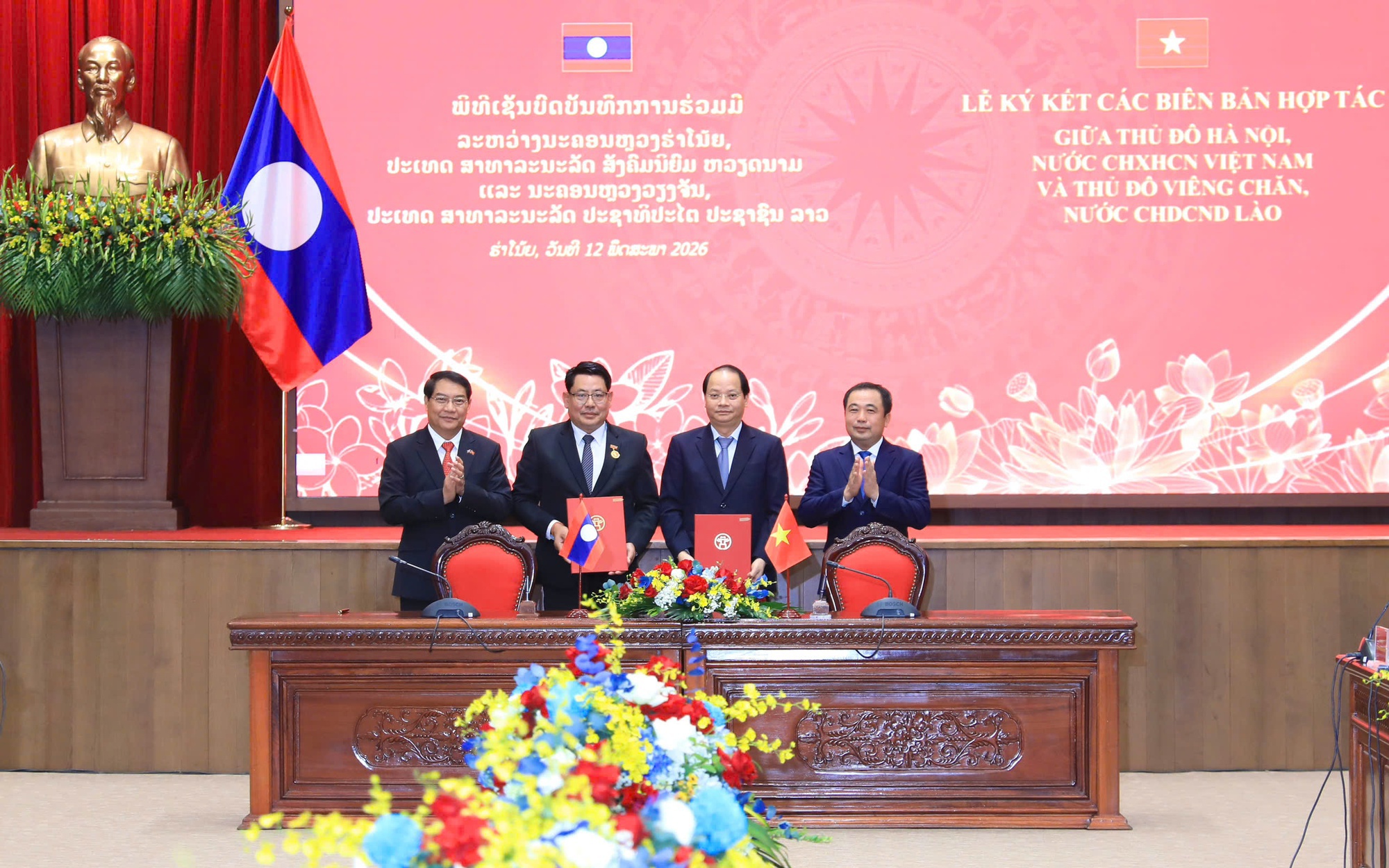
 Hanoi Party Secretary Tran Duc Thang and Vientiane Party Secretary and People's Council Chairman Athsaphangthong Siphandone witness the signing of a cooperation memorandum between the Hanoi Party Committee's Commission for Communication, Education and Mass Mobilization and the Vientiane Party Committee's Propaganda and Training Board for the 2026-2030 period.
Attending the talks was Deputy Foreign Minister Ngo Le Van.
Representing Hanoi were Vu Dai Thang, Central Committee member, Deputy Secretary of the Hanoi Party Committee, and Chairman of the Hanoi People's Committee; Nguyen Van Phong, Deputy Secretary of the Hanoi Party Committee; along with city leaders and representatives from departments and agencies.
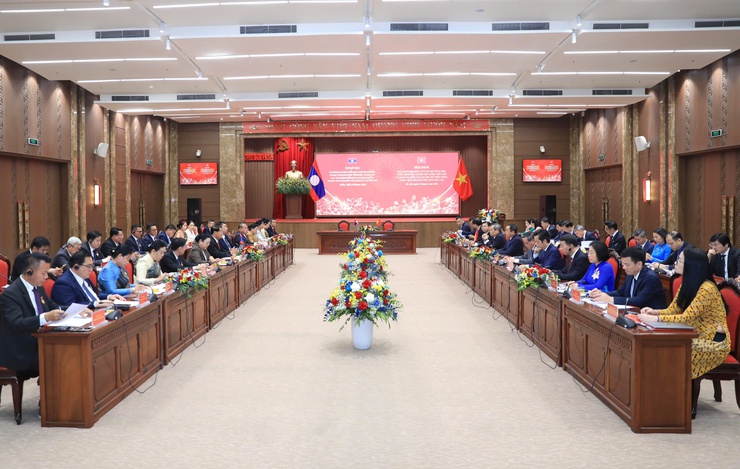 Overview of the talks.
In his welcoming remarks, Hanoi Party Secretary Tran Duc Thang expressed his pleasure at welcoming Athsaphangthong Siphandone, Secretary of the Vientiane Party Committee and Chairman of the Vientiane People's Council, along with the high-level delegation, to Hanoi.
Thang said that since the beginning of 2026, senior leaders of the two parties and countries have maintained high-level exchanges marked by several important milestones. These activities continued to reaffirm the high level of political trust and the loyal and transparent relationship between the two parties, states, and peoples, while creating new momentum and opening new directions for bilateral cooperation in the coming period.
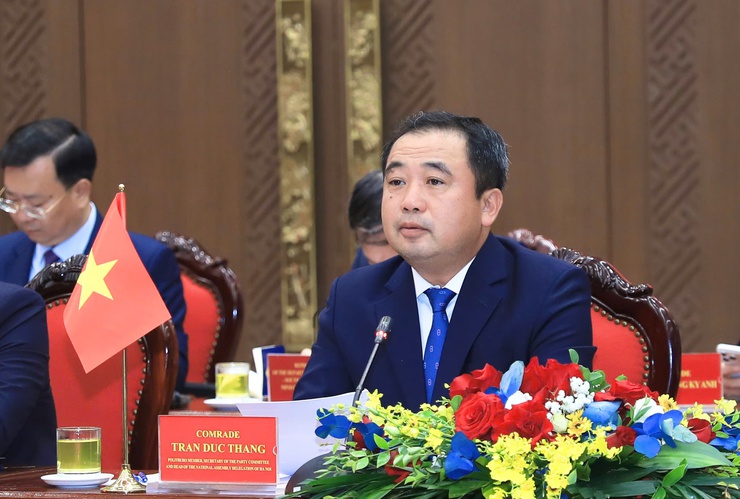 Hanoi Party Secretary Tran Duc Thang speaks during the talks.
Emphasizing that Vietnam-Laos relations represent a great friendship, special solidarity, and comprehensive cooperation, Thang said the cooperation between Hanoi and Vientiane had always been regarded by both sides as one of the key pillars in concretizing the ties between the two parties and states.
He expressed confidence that, based on the achievements already made and the new cooperation framework established for 2026-2030, relations between the two capitals would enter a more comprehensive and effective stage of development.
With the strengths and advantages of each side and the strong political determination of both capitals' leadership, cooperation areas are expected to continue expanding and deepen further, creating tangible results that contribute to the socioeconomic development of each locality while strengthening the great friendship, special solidarity, and comprehensive cooperation between Vietnam and Laos.
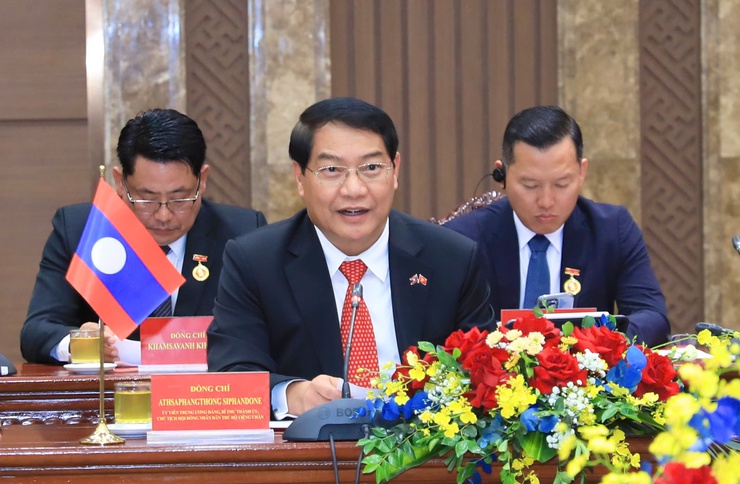 Athsaphangthong Siphandone, Secretary of the Vientiane Party Committee and Chairman of the Vientiane People's Council, speaks during the talks.
Speaking at the talks, Secretary of the Vientiane Party Committee and Chairman of the Vientiane People's Council Athsaphangthong Siphandone congratulated Hanoi on its recent achievements.
He said the visit aimed to strengthen friendship, special solidarity, comprehensive cooperation, and strategic ties between the two parties, states, and peoples. It also reflected the solidarity and close relationship between the Party organization, government, and people of Vientiane and those of Hanoi.
Praising Hanoi's efforts and accomplishments, Siphandone also shared information on Vientiane's development situation and urgent issues the Lao capital is addressing, including traffic congestion, urban sanitation, and the building of ward- and commune-level administrative units, as well as future development orientations.
Commending the comprehensive cooperation between the two capitals in recent years, he expressed hope that both sides would continue strengthening cooperation in defense and security, political system building, and grassroots administrative development.
He also called for the continued implementation of practical and effective cooperation projects and invited Hanoi Party Secretary Tran Duc Thang and the Hanoi delegation to visit Laos and Vientiane at an appropriate time.
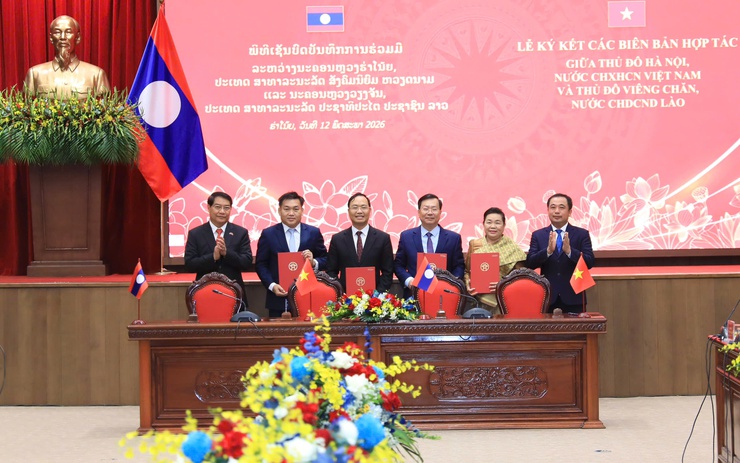 Hanoi Party Secretary Tran Duc Thang and Vientiane Party Secretary and People's Council Chairman Athsaphangthong Siphandone witness the signing of a memorandum of understanding between the Hanoi People's Committee Office and the Vientiane Department of Foreign Affairs for the 2026-2030 period.
On this occasion, Thang shared several major and comprehensive achievements Hanoi recorded in 2025 and the first months of 2026 in Party building, political system development, and socioeconomic growth.
He said Hanoi's economy accelerated strongly in 2025, with GRDP growth reaching 8.16%, compared with 6.52% in 2024. The city's GRDP was estimated at US$63.5 billion, accounting for 12.5% of Vietnam's GDP, while GRDP per capita reached US$7,200.
In the first four months of 2026, Hanoi's GRDP rose 7.87% year-on-year, higher than the national average, while state budget revenue reached VND319 trillion (US$12.3 billion), equal to about 49.2% of the annual target.
The city is also finalizing preparations to implement a development model reform project associated with establishing a double-digit growth model, aiming to maintain annual GRDP growth above 11% during the 2026-2030 period and increase GRDP to US$113 billion by 2030. Looking ahead to 2065, Hanoi aims to become a global city.
Hanoi is accelerating urban development under a multi-center model linked with green, smart, and sustainable urban development, while focusing on human development, improving workforce quality, and preserving the capital's distinctive cultural values.
The city places special importance on strengthening cooperation with Vientiane in digital transformation, urban development, education and training, and human resource quality improvement.
Assessing cooperation between Hanoi and Vientiane during the 2022-2025 period, Thang said bilateral ties had continued developing comprehensively and achieved important results across many sectors.
Economic relations between the two capitals have gradually strengthened, especially in trade. Hanoi's exports to Laos reached US$269.6 million in 2025, while imports from Laos totaled US$554.3 million.
One notable highlight was Hanoi's support for Vientiane in implementing the construction project for the headquarters of the Department of Justice and the People's Procuracy, funded at approximately VND70.5 billion (US$2.7 million). The project was completed and inaugurated in April 2024, demonstrating Hanoi's practical support and solidarity.
Looking ahead, Thang proposed several major cooperation orientations for the two sides.
First, both capitals should continue strengthening political trust and cooperation between their political systems through delegation exchanges and sharing experience in Party building and urban governance, while enhancing coordination among agencies and mass organizations.
Second, the two capitals should promote economic, trade, and investment cooperation linked with business connectivity and market expansion.
Third, both sides should strengthen cooperation in social sectors directly serving human development and improving the quality of life.
Fourth, Hanoi and Vientiane should expand exchanges on urban planning, green and smart urban management, and digital transformation, while strengthening cooperation in agriculture, environmental protection, and climate change response toward sustainable development goals.
Fifth, both sides should effectively implement development support programs and practical cooperation initiatives. Hanoi is ready to coordinate with Vientiane in studying and implementing suitable development support projects, including infrastructure, governance capacity building, administrative reform, and public service delivery, while ensuring transparency and effectiveness.
Sixth, the two capitals should establish close coordination mechanisms, maintain regular information exchanges, periodically review implementation progress, and promptly address difficulties to ensure cooperation projects remain on schedule and deliver practical results.
Seventh, both sides should promote sectoral cooperation through the signing of memorandums of understanding during the current talks.
Thang noted that within the framework of the talks, the two sides would sign seven memorandums of understanding covering communication and mass mobilization, women's affairs, youth affairs, foreign affairs, industry and trade, education, and healthcare.
He stressed that these are practical areas directly contributing to strengthening the political and social foundations of both capitals, developing human resources, promoting economic cooperation, and improving people's quality of life.
The signing of these memorandums not only concretizes the contents of the 2026-2030 cooperation agreement but also creates an important foundation for deeper, more practical, and more effective cooperation in the coming years.
Thang expressed confidence that, based on the special Vietnam-Laos relationship, the established cooperation framework, and the strong political commitment of leaders from both capitals, the cooperation orientations would be effectively implemented, elevating Hanoi-Vientiane relations to a new level that is increasingly substantive, sustainable, and effective.