The program drew a large number of international delegates, members of the Bangladesh community in Vietnam, as well as faculty members and students of the College. It created a vibrant international cultural exchange space in the heart of Hanoi.
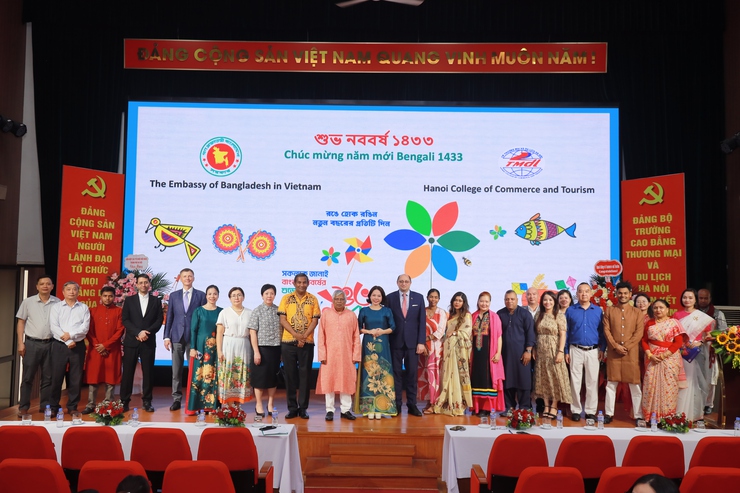 Delegates attend the Bangladesh traditional New Year celebration
Pohela Boishakh, the first day of the Bengali calendar year, is not only a time of new beginnings but also a symbol of renewal, hope, and community spirit. Recreating this festival in Vietnam helps introduce the distinctive features of South Asian culture, while strengthening mutual understanding and connection between the people of the two countries.
As a co-organizer, Hanoi College of Commerce and Tourism actively created a diverse experiential space, where students not only observed but also directly participated in cultural activities. This also reflects the College's practical-oriented training approach, aimed at developing human resources with integration capacity and a global mindset in commerce, tourism, and communications.
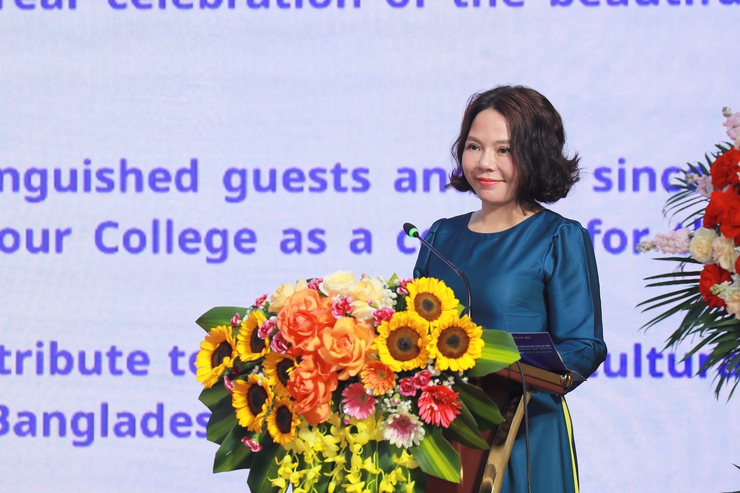 Dr. Trinh Thi Thu Ha, Rector of Hanoi College of Commerce and Tourism, speaks at the event
Speaking at the program, Dr. Trinh Thi Thu Ha, Rector of Hanoi College of Commerce and Tourism, emphasized that Pahela Boishakh is not only the first day of the Bengali New Year but also a symbol of renewal, hope, solidarity, and aspirations for prosperity and happiness.
She noted that the College consistently identifies cultural education as a core foundation in training high-quality human resources for the tourism, service, and commerce sectors. In the context of global integration, understanding international cultures is essential for students to confidently enter the global workforce. In recent years, the College has gradually become a cultural bridge, promoting international values within the academic environment.
"I believe that through this program, with its rich and diverse activities, participants will gain a deeper understanding of Bangladesh and its people, while fostering meaningful connections and lasting cross-cultural memories," Dr. Trinh Thi Thu Ha stressed.
At the event, Lutfor Rahman, Ambassador of Bangladesh to Vietnam, expressed his appreciation to the leadership, faculty, and students of Hanoi College of Commerce and Tourism for their support in organizing the program, noting that it reflects the growing friendship and cultural ties between the two countries.
The Ambassador said that Pohela Boishakh is one of the largest and most vibrant festivals in Bangladesh, marking the first day of the Bengali New Year and symbolizing renewal, hope, and transformation. On this occasion, people across the country, regardless of religion or social background, participate in parades, artistic performances, and family gatherings.
He also highlighted similarities between Pohela Boishakh and Vietnam's Lunar New Year, as both celebrate unity, tradition, and optimism for the future. A key highlight of the festival is Mangal Shobhajatra, a symbolic procession representing the triumph of good over evil, which has been recognized by UNESCO as an Intangible Cultural Heritage of Humanity.
According to Ambassador Lutfor Rahman, the event in Hanoi partly recreated this festive spirit through artistic performances, traditional costumes, and the enthusiastic participation of faculty members and students.
He affirmed that culture serves as a vital bridge between nations, helping to overcome geographical distances and foster mutual understanding and respect. Bangladesh and Vietnam share many similarities in history, culture, and development aspirations. Cultural exchange activities like this contribute to deepening bilateral relations, particularly through people-to-people exchanges.
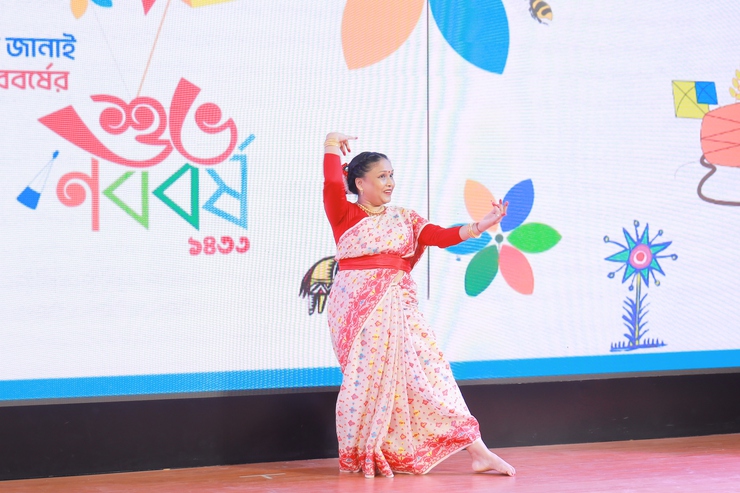 Art performances introducing Bangladesh culture at the event
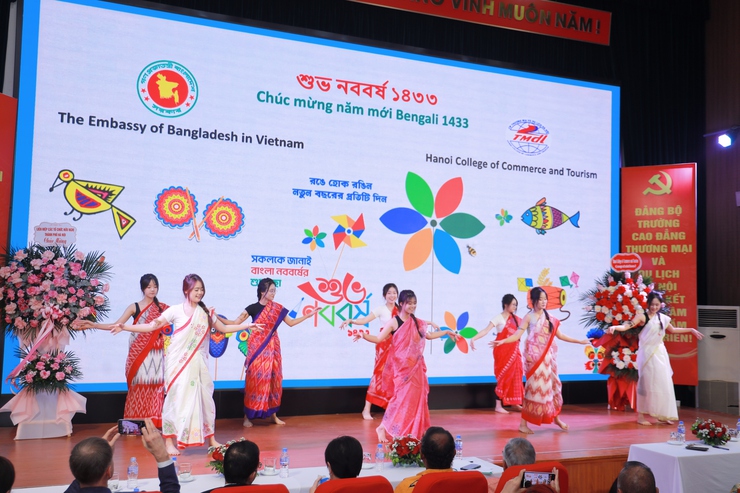
The program featured a wide range of activities, from a formal opening ceremony to presentations introducing Bangladeshi culture through visual materials and displays. A highlight was a series of international cultural performances. Students performed a dance to the Bengali New Year song “Eso He Boishakh Eso Eso,” wearing traditional saree costumes, creating a vivid showcase of cultural exchange.
Members of the Bangladesh community in Vietnam also performed music and traditional dances, helping recreate the festive atmosphere of their homeland.
A traditional Bengali fashion show, featuring representatives from Bangladesh and Vietnamese students, offered a visual showcase of saree attire alongside modern-inspired designs.
In addition, the experiential area on the sidelines, featuring cuisine, handicrafts, and folk games, attracted a large number of participants, creating an open and interactive cultural space.
 Delegates visit a photo exhibition introducing Bangladesh
Beyond a cultural exchange event, the Pohela Boishakh 1433 celebration also served as an “open classroom,” enabling students to learn through hands-on experiences, interaction, and direct engagement with the international community on campus.
Through collaboration with the Embassy of Bangladesh in Vietnam, Hanoi College of Commerce and Tourism aims to build a modern educational environment where academic training is closely linked with practical experience and multicultural exposure. This approach aligns with global integration, laying a strong foundation and equipping students with cross-cultural competencies to meet the evolving demands of both domestic and international labor markets.