Attending the ceremony were Vu Dai Thang, member of the Party Central Committee, Deputy Secretary of the Hanoi Party Committee, and Chairman of the Hanoi People's Committee, along with representatives from city departments and agencies, leaders of Chuong Duong and Thuong Phuc communes, and executives from Phu My Group and Hoa Phu Invest Co., Ltd.
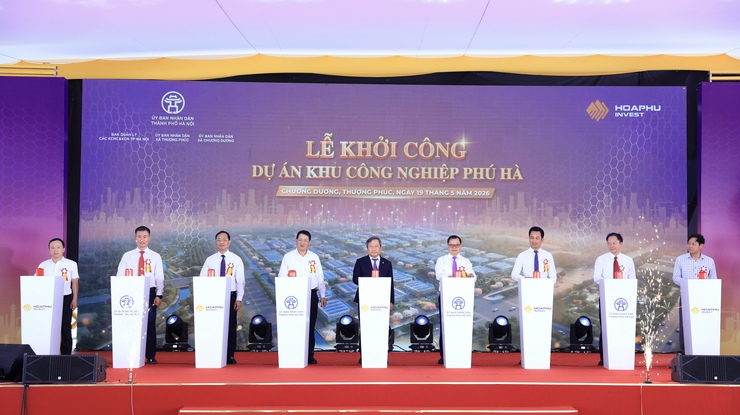 Delegates perform the groundbreaking ceremony for the project. Photo: Le Hai
Creating a major industrial and logistics growth hub
Speaking at the ceremony, Chairman Vu Dai Thang said the project was not simply the launch of another industrial development, but a concrete step in Hanoi's broader strategy to restructure its industrial development space and attract more private investment into manufacturing, high technology, clean industry, supporting industries, modern logistics, and high-value-added sectors.
Thang said Hanoi is entering a new development phase that requires faster, more sustainable, and deeper growth. The capital can no longer rely solely on urban expansion or existing advantages, but must create new production drivers, new industrial spaces, and new value chains based on science and technology, innovation, digital transformation, and the green economy.
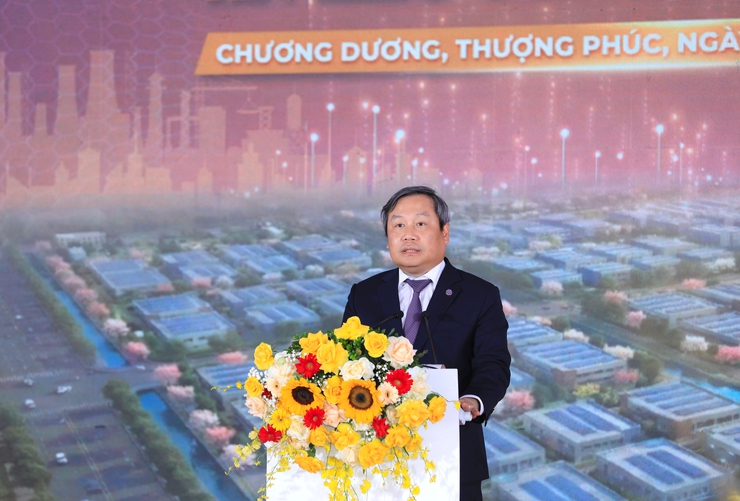 Hanoi People's Committee Chairman Vu Dai Thang speaks at the groundbreaking ceremony. Photo: Le Hai
He stressed that Hanoi's approach is clear: the city is not developing industrial parks simply to fill land, but to create new technologies, higher productivity, new value chains, and stronger competitiveness.
In the coming years, Hanoi must compete on the quality of its planning, infrastructure, institutions, workforce, and innovation capacity. This, he said, would strengthen internal economic resilience, contribute to national self-reliance, and deepen integration into regional and global value chains.
Thang noted that Phu Ha Industrial Park must be viewed within Hanoi's broader long-term development strategy. Spanning about 174.88 hectares in Thuong Phuc and Chuong Duong communes, the project is expected to attract biotechnology industries serving high-tech agriculture, high-quality food and agricultural processing, mechanical engineering, electronics, supporting industries, logistics, and other modern low-emission manufacturing sectors.
Under Hanoi's master plan with a 100-year vision, the southern area of the capital is expected to become a key industrial and logistics growth corridor linked to an integrated transportation and regional connectivity network. Within that structure, Phu Ha is envisioned as a next-generation industrial park that is more modern, greener, smarter, and more socially and environmentally responsible.
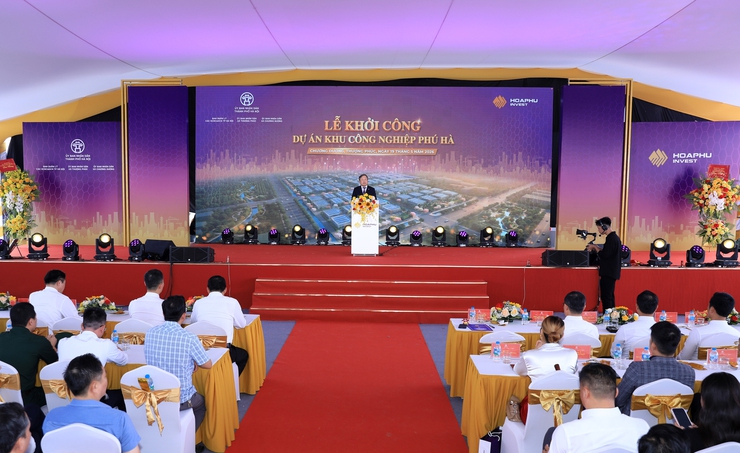 Chairman Vu Dai Thang says Phu Ha Industrial Park is an important first step in Hanoi's strategy to create a new industrial development space. Photo: Le Hai
The city chairman said Hanoi expects the project to drive three major shifts: moving from land-based growth to growth driven by knowledge, technology, and productivity; transitioning from simple processing to deep processing, supporting industries, high technology, and modern logistics; and creating higher-quality jobs, better incomes, and more sustainable development opportunities for local residents.
"That is true sustainable and responsible development, and reflects the spirit of a capital city developing for people, businesses, and the country's long-term future," Thang said.
According to the chairman, Phu Ha Industrial Park marks an important starting point in Hanoi's plan to establish a new industrial development space. In 2026, the city aims to begin construction on six industrial parks with a combined area of nearly 1,400 hectares, while preparing medium-term land reserves through 10 additional industrial parks currently under planning, totaling about 3,455 hectares.
He described the move as a concrete step toward restructuring Hanoi's production landscape and channeling long-term capital into real manufacturing, real technology, and real economic value.
"The city highly appreciates the efforts of the Management Board of Hanoi High-Tech Parks and Industrial Parks, city departments, local authorities, and investors throughout the project preparation process," Thang said.
The signing of a cooperation agreement between the investor and Emergent Capital Partner to develop logistics systems, warehouses, factories, and office facilities with an estimated investment of around US$90 million was described as a positive signal. It demonstrates Hanoi's ability to attract high-quality capital flows when supported by strong planning, solid infrastructure, and a transparent, stable investment environment.
Thang emphasized that the most important task after the groundbreaking ceremony is ensuring real progress, synchronized infrastructure development, strict investment selection standards, environmental protection from the outset, and tangible benefits for local residents.
He called on the investor to focus maximum resources on implementing the project in a professional and systematic manner while ensuring construction progress, quality, labor safety, and environmental protection. The project must also develop synchronized technical, digital, and logistics infrastructure.
"There must not be situations where land is available but lacking connecting infrastructure, where investors are present but operational conditions are incomplete, or where industrial parks are managed below modern standards," he said.
City departments and local authorities were also urged to continue supporting investors under a service-oriented administration model, while closely supervising project progress, quality, environmental standards, and land-use efficiency.
The city, he stressed, would not pursue investment at all costs, trade environmental quality for short-term growth, or accept outdated, high-emission technologies and inefficient land use.
Local authorities were also asked to strengthen communication, dialogue, site clearance, resettlement work, and social welfare support for residents.
"Sustainable development can only succeed when local people understand it, support it, and see themselves as part of that future," Thang said, adding that Phu Ha Industrial Park reflects Hanoi's determination to pursue a greener, smarter, more efficient, and more responsible industrial development model.
A model industrial park for a new era
Speaking at the ceremony, Luu Quoc Khanh, Chairman of Hoa Phu Invest Co., Ltd., pledged to mobilize all necessary resources to ensure the Phu Ha Industrial Park project is completed on schedule, or ahead of schedule, in line with the investment approval decision issued by the Prime Minister.
He said all project components would be built in accordance with approved planning, design standards, and technical specifications, with particular attention to wastewater and waste treatment systems, fire prevention measures, and environmental landscaping.
The company aims to ensure the industrial park remains "Bright, Green, Clean, and Beautiful," while becoming a model industrial park for Hanoi in the new era and "a reliable and successful destination for domestic and international investors, especially strategic and leading investors."
Construction activities at the site, he added, would strictly comply with labor safety and environmental protection regulations. The company would also continue coordinating closely with local authorities to complete site clearance work in line with the city's directives.
Phu Ha Industrial Park spans 174.88 hectares with a total investment exceeding VND2.9 trillion (US$111.5 million). Located in Chuong Duong and Thuong Phuc communes, the project occupies a strategic position at Hanoi's southern gateway, directly connected to National Highway 1A, one of Vietnam's key north-south transport corridors.
The industrial park also has convenient access to the Phap Van - Cau Gie Expressway, is adjacent to the Ngoc Hoi - Phu Xuyen southern railway route, and is expected to benefit from the future North-South high-speed railway project.