Joining the delegation were Vice Chairman of the Hanoi People's Committee Bui Duy Cuong, leaders of city departments and agencies, officials from Vat Lai Commune, and representatives from related units.
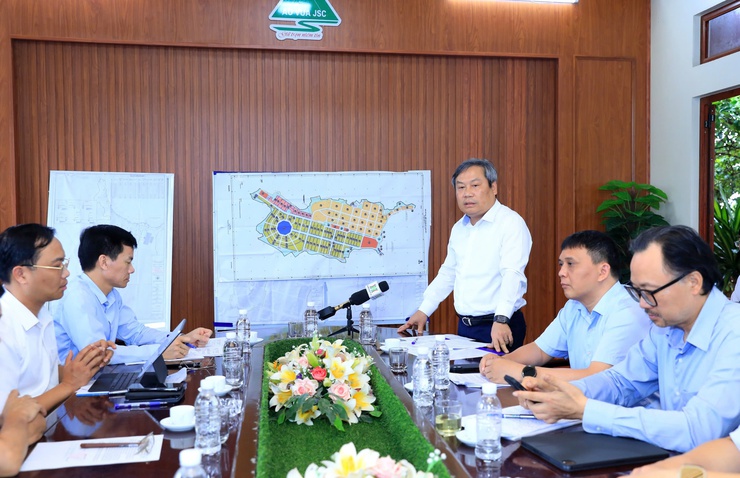 Hanoi People's Committee Chairman Vu Dai Thang chairs the working session.
Three city-level cemeteries no longer accept traditional burials
According to a report from the Hanoi Department of Home Affairs, the city's cemetery system is divided into cemeteries managed by the city and those managed by commune and ward authorities, including former district-level regional cemeteries.
The city currently manages four cemeteries through the Hanoi Funeral Services Board under the Department of Home Affairs. They include Van Dien Cemetery, covering 18.2 hectares; Yen Ky Cemetery, 35.928 hectares; Thanh Tuoc Cemetery, 7.7 hectares; and the 14-hectare section of Vinh Hang Cemetery Park managed by the city.
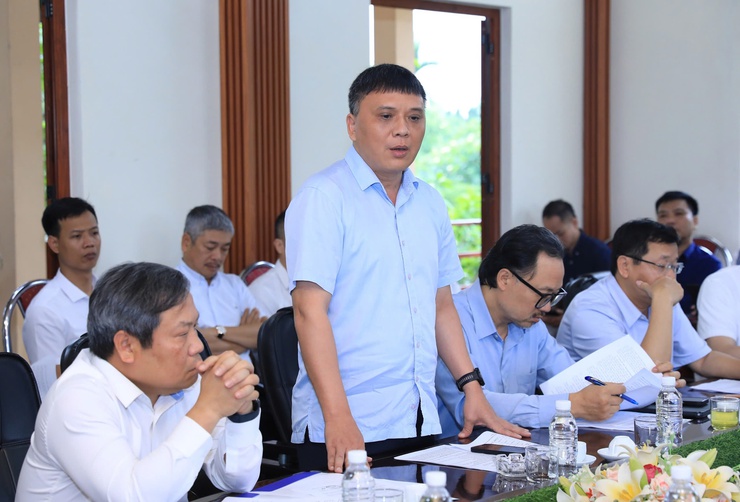 Nguyen Minh Long, Director of the Hanoi Department of Home Affairs, speaks at the meeting.
The report said the old Yen Ky Cemetery and Thanh Tuoc Cemetery have run out of burial space and now only provide grave maintenance and transfer services for plots previously purchased by residents. Van Dien Cemetery has been converted into a cemetery park model and now only provides cremation and ash storage services.
Regarding cemetery expansion projects, Vinh Hang Cemetery has completed both expansion phases. In 2025, phase two handed over nine hectares to the city, equivalent to more than 18,000 burial plots of various types.
The Department of Home Affairs is coordinating with Ao Vua Joint Stock Company to accelerate infrastructure construction, including 4,400 burial plots, to meet demand for grave relocation linked to major city projects.
For the expanded Yen Ky Cemetery Park project, phase one, the Hanoi People's Committee approved the investment policy for a 203.18-hectare project originally scheduled for implementation between 2016 and 2019. The project is currently undergoing investment policy adjustments.
Construction and operations are expected to be completed within 36 months from the date land is officially allocated, during the 2026-2028 period.
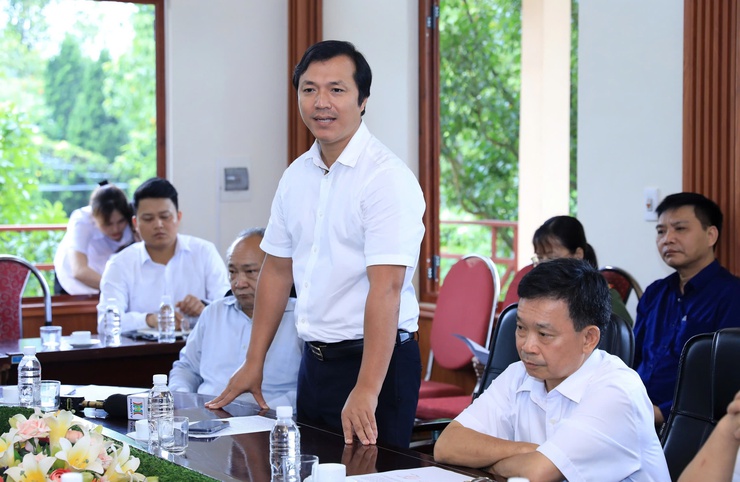 Leaders of Vat Lai Commune report at the meeting.
At present, the city's three cemeteries - Van Dien, Yen Ky, and Thanh Tuoc - can no longer accept additional traditional burial graves. For now, most available burial space is concentrated at Vinh Hang Cemetery Park.
Authorities said 5,200 graves have already been arranged there, including 800 from phase one. At the current pace, the site is expected to accommodate 18,000 graves by the end of 2027, including 15,000 in 2026 and another 3,000 in 2027.
To ensure sufficient burial space in the coming years, the Department of Home Affairs asked local authorities to continue reviewing and reporting grave relocation needs tied to major site clearance projects.
The department has also requested 16 communes and wards, including Hong Ha, O Dien, Thuong Cat, Dong Ngac, Phu Thuong, Linh Nam, Thanh Tri, and Bat Trang, to provide information on cemeteries affected by the planned Red River landscape boulevard project.
During the inspection, representatives from relevant agencies discussed ongoing difficulties, particularly land clearance challenges and accelerating burial construction to support upcoming major city projects.
First-phase land clearance target set for June 15
Speaking at the meeting, Vice Chairman of the Hanoi People's Committee Bui Duy Cuong stressed that cemetery planning and management are important tasks that both serve residents' needs and support land clearance and grave relocation for major development projects.
Regarding Vinh Hang Cemetery, Cuong said the project no longer faces major obstacles and instructed relevant units to speed up implementation.
The four percent land reserve handed over to the city must be tightly managed and prioritized for grave relocation needs in areas that no longer have available local burial land, he said.
The vice chairman also instructed Ao Vua Joint Stock Company to focus manpower and financial resources on completing the infrastructure needed by the city. Hanoi will facilitate land handover in parallel with the company's financial obligations to help shorten the project timeline.
For the Yen Ky Cemetery Park project, city departments and local authorities were told to urgently complete land clearance and land allocation procedures in accordance with regulations.
Hanoi aims to complete the first phase of land clearance covering 96 hectares before June 15, 2026, while the remaining 100 hectares must be cleared before August 30, 2026.
The investor was asked to ensure sufficient financial resources for compensation payments and work closely with local authorities to maintain progress. Officials described this as the final timeline adjustment for the project.
Concluding the session, Chairman Vu Dai Thang emphasized the need for a new approach to burial planning, describing it as an important part of Hanoi's urban development strategy and the city's goal of becoming a "civilized, modern, and culturally rich" capital under Resolution No. 15-NQ/TW.
With Hanoi's population currently around 10 million and expected to continue growing, annual burial demand remains very high, he said. Without proper planning, the city could face land waste, environmental pressure, and obstacles to sustainable urban development.
"The city needs a burial model that ensures environmental hygiene, saves land resources, and still meets residents' legitimate needs for final resting places in accordance with standards," Thang said.
He stressed that funeral and burial services are not only humanitarian issues but also an important part of urban governance.
Hanoi will limit the development of large-scale cemeteries, especially large commercial cemetery models, while prioritizing renovation, upgrading, and reasonable expansion of existing cemeteries in a more synchronized, civilized, and land-efficient manner.
Local authorities were also instructed to tighten management and strictly control cemetery construction standards to prevent spontaneous and scattered burials that could complicate long-term planning and site clearance efforts.
For phase one of the Yen Ky Cemetery Park project, Chairman Thang instructed departments, agencies, and local authorities to fully resolve remaining obstacles and accelerate land clearance according to the established schedule while ensuring balanced interests among the state, investors, and residents.
"Relevant units must complete the required milestones as soon as possible so the project can begin serving residents' burial and grave relocation needs and support the implementation of the city's key projects," the chairman said.