The activities include the "500-day-and-night campaign to search for, gather and identify martyrs' remains," as well as the renovation, upgrading and repair of martyrs' graves and memorial works.
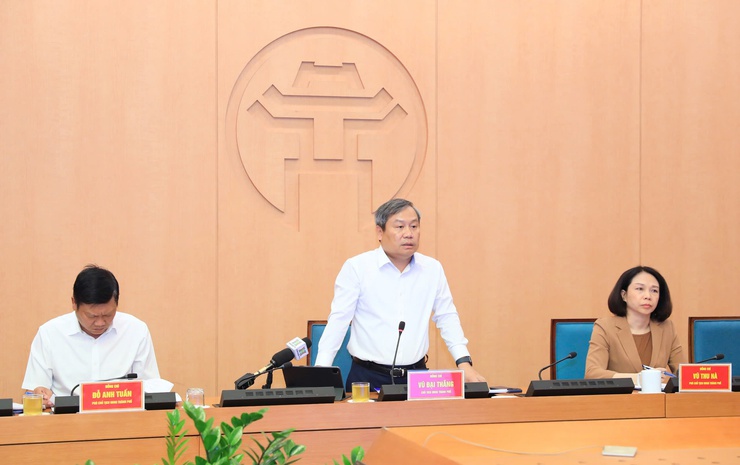 Hanoi People's Committee leaders chair the meeting.
Attending the meeting were Vice Chairman of the Hanoi People's Committee Do Anh Tuan; Vice Chairwoman of the Hanoi People's Committee Vu Thu Ha; Major General Luu Nam Tien, Political Commissar of the Hanoi Capital Command; and representatives of relevant city departments and agencies.
More than 8,000 graves need DNA sampling
Reporting at the meeting, Hanoi Department of Home Affairs Deputy Director Nguyen Tay Nam said the management, renovation and upgrading of martyrs' cemeteries and memorial works across the city are being carried out in a coordinated manner, in line with regulations and the requirements of honoring people with meritorious service.
Hanoi currently has 340 martyrs' cemeteries, including three directly managed by the city, including Mai Dich Cemetery, Nhon Martyrs' Cemetery and Ngoc Hoi Martyrs' Cemetery. The Hanoi Funeral Service Board, under the Department of Home Affairs, manages these three cemeteries. The remaining 337 cemeteries are managed by communes and wards.
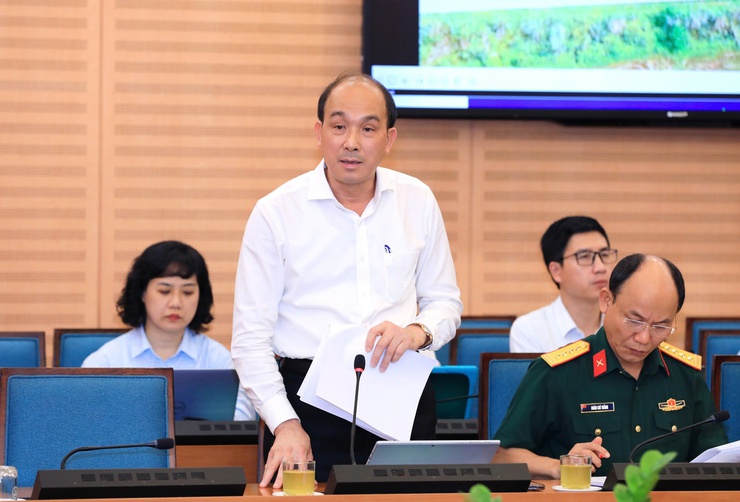 Hanoi Department of Home Affairs Deputy Director Nguyen Tay Nam reports at the meeting.
The Department of Home Affairs has advised the Hanoi People's Committee to issue several directives to improve the management, repair and upgrading of memorial works.
The department is leading the renovation and upgrading of Nhon Martyrs' Cemetery, a key project commemorating the 80th anniversary of War Invalids and Martyrs Day. The project is scheduled for implementation from the second quarter of 2026 through June 2027.
Communes and wards have also been assigned to complete the upgrading, repair and beautification of martyrs' cemeteries in their areas before April 2027.
Mai Dich Cemetery covers about 60,000 square meters, with 1,227 martyrs' graves and two collective graves. Nhon Martyrs' Cemetery covers more than 22,800 square meters, with 2,205 graves, including 41 graves of Vietnamese Heroic Mothers. Ngoc Hoi Martyrs' Cemetery covers nearly 9,000 square meters, with 1,315 martyrs' graves.
The cemeteries have been equipped with fences, trees, surveillance cameras and strengthened security forces. Authorities also coordinate closely with local governments to ensure security, order and environmental sanitation.
Nam said the division of management responsibilities between the city and commune- and ward-level authorities has improved accountability while ensuring consistent and effective tribute activities across the capital.
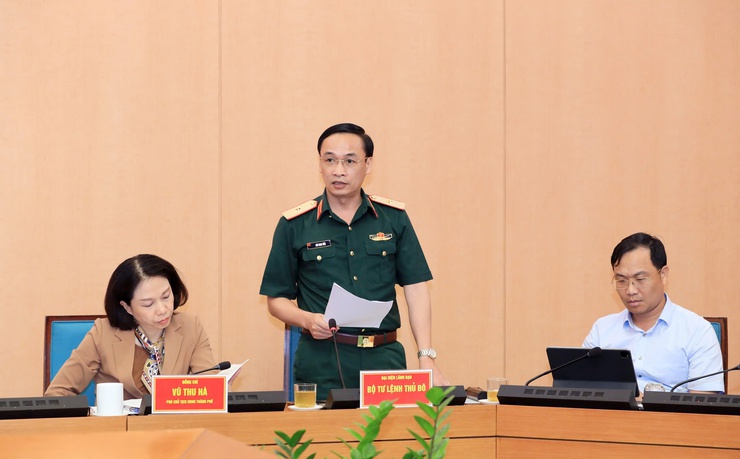 Major General, Political Commissar of the Hanoi Capital Command, reports at the meeting.
Major General Luu Nam Tien said the Hanoi Steering Committee has strictly implemented Politburo Directive No. 24-CT/TW dated May 15, 2013, on strengthening the search for, gathering and identification of martyrs' remains. It has also carried out central directives on the 500-day-and-night campaign.
Hanoi has consolidated its Steering Committee for the search for, gathering and identification of martyrs' remains. The committee now has 17 members, two more than before, to meet new requirements.
The city has held a conference to launch the campaign and issued Notice No. 230/TB-BCD dated May 18, 2026, guiding departments, agencies and localities in implementation.
It has also issued key documents, including the Steering Committee's working regulations, a work program, a campaign implementation plan, a plan for surveying and collecting samples from martyrs' remains for DNA testing and a 25-member interagency task force to guide local implementation.
So far, all 126 communes and wards have completed updates to martyrs' information, including names, hometowns, units, dates of death, Fatherland Merit Certificate details and grave data.
The Hanoi Capital Command, in coordination with the Department of Home Affairs, has provided records for DNA testing in three cases, identified one set of martyrs' remains with missing information, corrected files in 64 cases, extracted martyr information in 49 cases and decoded military unit codes in 161 cases.
However, Tien said the campaign still faces many challenges. Hanoi has more than 54,200 martyrs' graves, including more than 8,000 graves that require DNA sampling. Most unidentified graves date back to the resistance wars against France and the United States, making survey, assessment and classification difficult.
Strengthening the search for and identification of martyrs' remains
Speaking at the meeting, Hanoi Vice Chairwoman Vu Thu Ha said activities marking the 80th anniversary of War Invalids and Martyrs Day will be carried out on a large scale and across many fields, requiring coordinated participation from departments, localities and relevant units.
Ha said the Department of Home Affairs has submitted a draft master plan for the commemorative activities. Departments and agencies must continue reviewing their assigned tasks and implementation schedules before the plan is finalized and submitted to the Hanoi People's Committee for approval.
Regarding investment and renovation of city-level martyrs' cemeteries, Ha said the Hanoi Funeral Service Board is currently implementing renovation projects at cemeteries managed by the city. Previous works were mostly small- and medium-scale repairs and partial upgrades.
At Mai Dich Cemetery, renovation has been largely completed and is expected to finish in June 2026.
For Nhon Martyrs' Cemetery and Ngoc Hoi Martyrs' Cemetery, Hanoi has already directed investment preparation steps and is completing procedures to implement the projects on schedule.
The works at the two cemeteries are expected to be completed in May 2027 if implementation proceeds as planned, Ha said.
She added that all tasks related to the "500 Days and Nights" emulation campaign have been incorporated into the master plan for the 80th anniversary. Hanoi will continue reviewing, refining and completing assigned tasks to ensure their effective and coordinated implementation.
Hanoi Vice Chairman Do Anh Tuan said the remaining time for the campaign is limited. Departments and localities must urgently detail their tasks and clearly assign responsibilities to meet the central Steering Committee's schedule.
He asked the Hanoi Capital Command to review and finalize its action program, with specific assignments for each task force and each commune and ward, including names, addresses and phone numbers of contact points.
"Tasks must be specified by timeline, locality and task force to ensure completion two months ahead of the schedule set by the central Steering Committee," Tuan said.
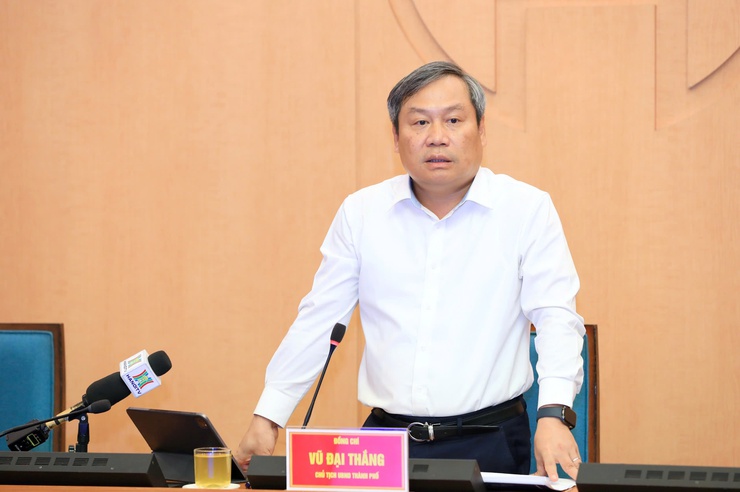 Hanoi Chairman Vu Dai Thang delivers concluding remarks.
Concluding the meeting, Hanoi Chairman Vu Dai Thang stressed that the search for, gathering and identification of martyrs' remains is a task of special political importance. It reflects the responsibility, moral tradition and deep gratitude of the Party, the State and the people toward heroes and martyrs who sacrificed their lives for national independence and freedom.
Thang said the Government and the national Steering Committee have actively carried out many tasks related to searching for and gathering martyrs' remains both inside and outside Vietnam, including in Laos and Cambodia. However, as the war has long passed, verification, recovery and identification have become increasingly difficult.
On the occasion of the 80th anniversary of War Invalids and Martyrs Day, the central government launched the 500-day-and-night campaign with the goal of basically completing the review, recovery and identification of martyrs with missing information before July 27, 2027.
Thang said the task carries profound humanitarian meaning and requires the participation of the entire political system, including Party agencies, authorities, mass organizations, armed forces, localities, social organizations and the people of Hanoi.
He noted that Hanoi still has more than 8,000 unidentified martyrs' graves. Most remains were gathered from different battlefields and historical periods, making verification and DNA testing highly challenging.
"We have developed a very detailed implementation plan for the 500-day-and-night campaign. The Hanoi Capital Command, together with departments, agencies and localities, must coordinate closely to carry it out in a synchronized, methodical, timely and effective manner," Thang said.
He also noted that the work involves spiritual and cultural traditions. Excavation and sample collection must therefore be conducted seriously, solemnly and in accordance with proper procedures, while observing appropriate rituals in line with Vietnamese customs.
Regarding the renovation of martyrs' cemeteries, Thang basically agreed with the investment policy to upgrade both city-level cemeteries and those managed by communes and wards.
He said cemetery renovation is not only an act of gratitude to fallen heroes but also contributes to creating historical and revolutionary heritage sites for educating younger generations about patriotism and revolutionary traditions.
The chairman urged that renovation and upgrading must be carried out in a synchronized and systematic manner, avoiding fragmented repairs that drag on for years and affect spiritual spaces and long-term management.
"Once we do it, we must take a comprehensive approach, renovate everything in a coordinated way for long-term use, solemnity, greenery, cleanliness and beauty, while preserving historical values and the educational value of revolutionary traditions," Thang said.