At the meeting, the two sides shared experience on a range of issues, including mechanisms and policies for science and technology development, innovation, and digital transformation.
They also discussed policies to attract resources; organizational and operational models for innovation ecosystems; innovation centers and high-tech parks; digital transformation in state agencies and businesses; resource allocation and implementation methods; as well as monitoring and evaluating the effectiveness of science, technology, innovation, and digital transformation programs.
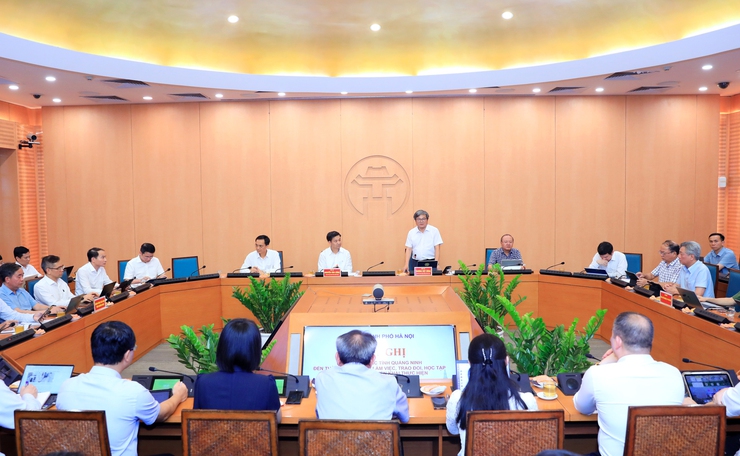 Overview of the meeting
Speaking at the meeting, Vice Chairman of the Hanoi People's Committee Truong Viet Dung stressed that Hanoi's consistent approach is to conduct practical exchanges and openly share both achievements and difficulties encountered during implementation.
He said science and technology, innovation, and digital transformation are not tasks solely for the science and technology sector, but represent a transformation in governance methods aimed at better serving residents and businesses and must be "embedded" across all sectors and fields.
Dung said Hanoi allocated more than VND9 trillion (US$346 million) in 2026 for science and technology, innovation, and digital transformation. The increase in investment scale creates significant pressure in implementation, but also opens up new development opportunities.
"The city's viewpoint is not to chase achievements or invest in a scattered manner. Every expenditure must be carefully considered to ensure it delivers real value, whether in governance efficiency, social value, or tangible economic benefits," he said.
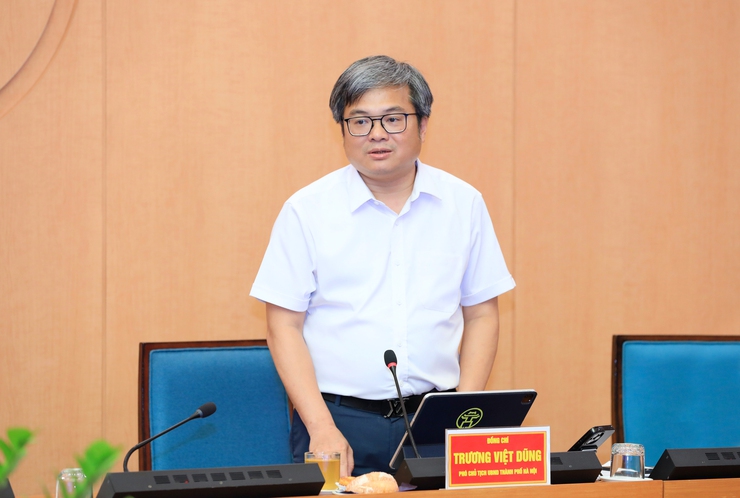 Vice Chairman of the Hanoi People's Committee Truong Viet Dung speaks at the meeting
Since the beginning of the year, Hanoi has issued a plan to implement Resolution No. 57-NQ/TW, outlining key task groups and specific deliverables, while continuously reviewing and updating the plan to align with practical conditions.
Notably, Hanoi is implementing several new models, including the Hanoi Innovation Center operating under a joint-stock company model rather than as a public non-business unit, allowing enterprises to operate according to market principles while the state plays a guiding and supportive role.
At the same time, the city is establishing a venture capital fund with participation from the state and technology enterprises to mobilize socialized resources for innovation projects.
"Hanoi's viewpoint is not to work only for Hanoi. We hope to build effective models and mechanisms that, once proven successful, can be shared with other localities so provinces and cities do not have to start from scratch," Truong Viet Dung emphasized.
In addition, Hanoi is promoting technology applications in urban governance, healthcare, education, and culture. The city is implementing plans to install cameras for urban data governance, security, traffic, and environmental management, while integrating socialized camera systems and applying artificial intelligence in data analysis.
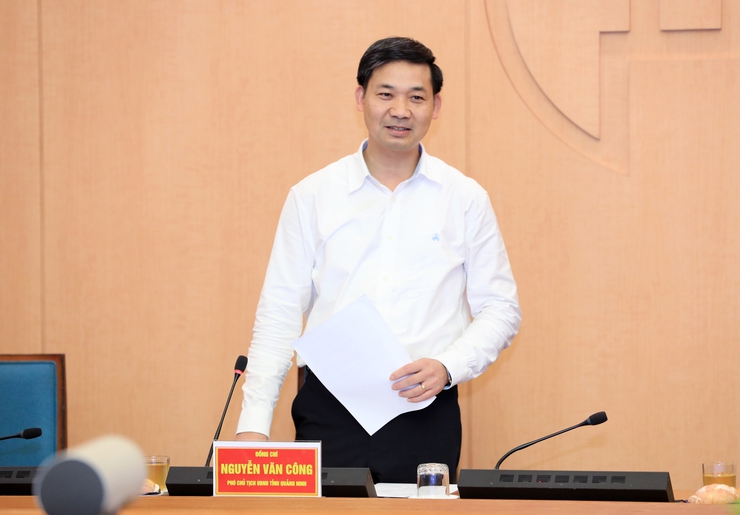 Vice Chairman of the Quang Ninh People's Committee Nguyen Van Cong speaks at the meeting
Thanking Hanoi leaders and municipal departments for their exchanges and insights, Vice Chairman of the Quang Ninh People's Committee Nguyen Van Cong said the Quang Ninh delegation was interested not only in specific models, but also in leadership thinking, implementation approaches, organizational methods, and solutions for addressing challenges during digital transformation.
"I am particularly impressed with the viewpoint of not working only for Hanoi, but toward building mechanisms and models that can spread and be shared with other localities," Nguyen Van Cong said.
He added that Quang Ninh considers Resolution 57 a key driving force for sustainable socio-economic development and continues its implementation in a proactive and synchronized manner, closely linked to development demands in the new period.
According to Cong, Hanoi's practical experience in implementing Resolution No. 57-NQ/TW, especially in governance, resource mobilization policies, resource allocation, breakthrough mechanisms, and data development, offers highly practical lessons for Quang Ninh to study and adapt to local conditions.
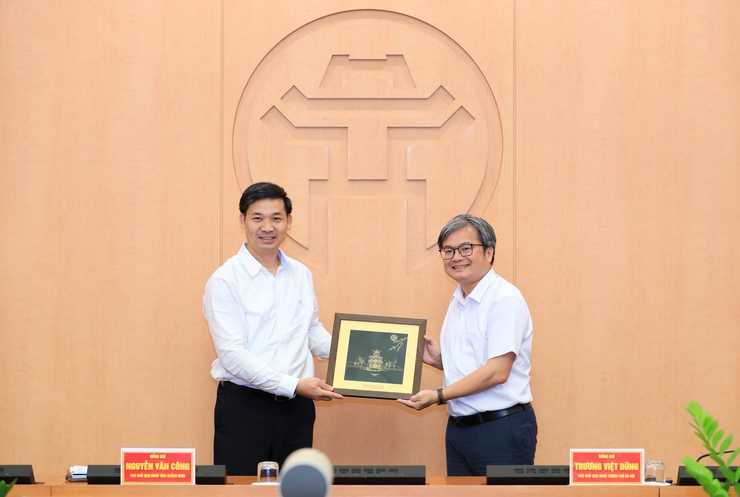 Vice Chairman of the Hanoi People's Committee Truong Viet Dung presents a commemorative gift to the Quang Ninh delegation.
"What impressed the delegation most was not only the effective models and practical experience, but also Hanoi's spirit of innovation, determination, and inspiration in organizing implementation. This will be an important factor in changing Quang Ninh's mindset and working methods in the coming period," Cong said.
Following the meeting, Quang Ninh identified two immediate priority areas for further study. The first is developing data centers, databases, and digital-based governance methods, with the mindset that digital transformation should not merely digitize documents but fundamentally change governance methods.
The second is developing a digital society, especially through artificial intelligence applications, initially through pilot and experimental models before broader expansion.
"Although development conditions differ between the two localities, the practical experience, approaches, and thinking shared by Hanoi will serve as an important basis for Quang Ninh to adapt appropriately and effectively implement Resolution No. 57-NQ/TW in the coming period," Cong affirmed.