The conference was co-chaired by Politburo members National Assembly Chairman Tran Thanh Man, Permanent Member of the Party Secretariat Tran Cam Tu and Permanent Vice Chairman of the National Assembly Do Van Chien; Party Central Committee Secretary and Deputy Prime Minister Pham Thi Thanh Tra; and Party Central Committee member and Vice Chairwoman of the National Assembly Nguyen Thi Thanh.
Also attending were National Assembly vice chairpersons, leaders of National Assembly committees and the National Assembly Office, as well as representatives of the Standing Committee of the Vietnam Fatherland Front Central Committee and several ministries and central agencies.
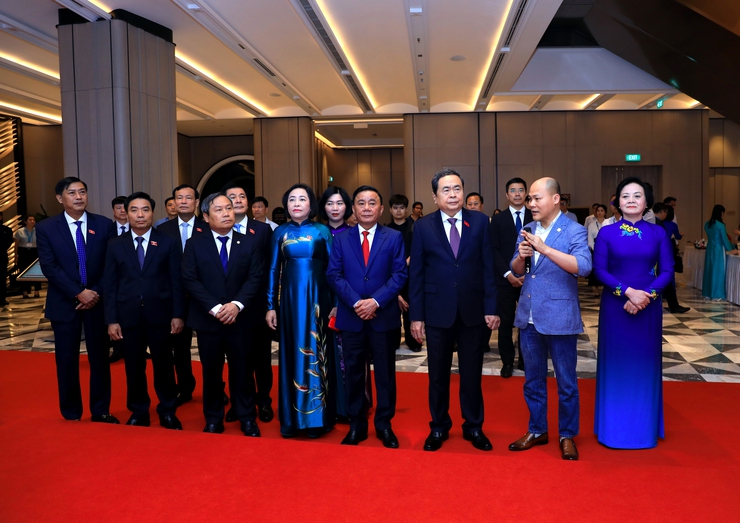 Participants at the opening session of the National People's Council Conference on priorities and tasks for the 2026-2031 term.
Representing Hanoi were Party Central Committee member, Deputy Secretary of the Hanoi Party Committee and Chairman of the Hanoi People's Committee Vu Dai Thang; Deputy Secretary of the Hanoi Party Committee, Chairwoman of the Hanoi People's Council and Deputy Head of Hanoi's National Assembly delegation Phung Thi Hong Ha; and Standing Committee member of the Hanoi Party Committee and Permanent Vice Chairman of the Hanoi People's Council Tran The Cuong.
The conference was held in person in Hanoi and connected online to People's Council offices in all 33 provinces and centrally governed cities.
In his opening remarks, National Assembly Chairman Tran Thanh Man said the conference carried special significance. It not only reviewed the performance of People's Councils at all levels during the current term but also provided an opportunity to reassess the role of local elected bodies in the country's new stage of development.
The conference would evaluate achievements, shortcomings and lessons learned while identifying priorities for the 2026-2031 term amid efforts to streamline the political system and build a modern, professional and people-centered local government.
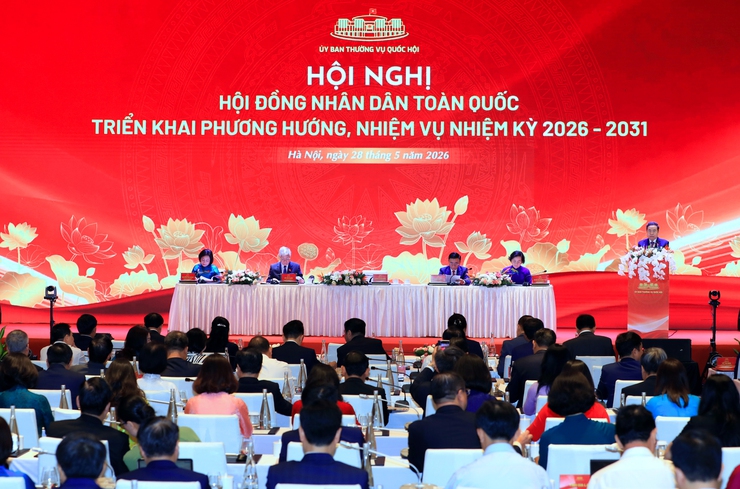 Overview of the conference.
The 2021-2026 term, he noted, had been one of the most challenging periods in the history of local People's Councils. Vietnam faced unprecedented difficulties, including the COVID-19 pandemic, natural disasters and climate change impacts, while the global environment became increasingly volatile and unpredictable.
At the same time, the Party and State introduced a series of strategic reforms related to growth model transformation, national digital transformation, administrative restructuring, decentralization and the reorganization of administrative units.
Against this backdrop, and under the close leadership of the Party Central Committee, the Politburo and the Secretariat, along with guidance from the National Assembly Standing Committee and coordination with the Government, the Vietnam Fatherland Front and local Party committees, People's Councils at all levels continued to affirm their role as local state power bodies representing the will, aspirations and ownership rights of the people.
"However, we must also acknowledge that implementing the two-tier local government model continues to face many challenges. Administrative areas are larger, workloads are heavier and requirements are higher. The capacity of officials in some localities remains limited and there are still difficulties in handling tasks. Infrastructure and information technology systems are not yet fully synchronized. These issues require continued attention and solutions," Man said.
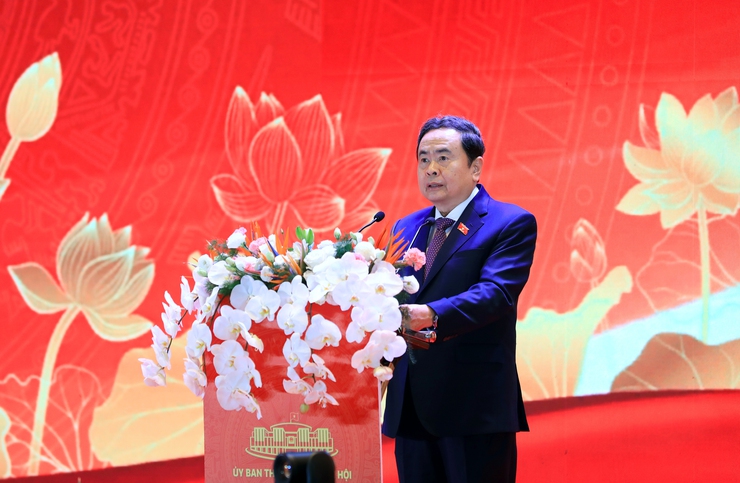 National Assembly Chairman Tran Thanh Man addresses the conference.
The National Assembly Chairman said the Standing Committee hoped to hear assessments and practical experiences from localities regarding the implementation of tasks during the 2021-2026 term, along with proposals for new objectives, solutions and approaches for 2026-2031.
The conference would also examine working relationships between the National Assembly Standing Committee, National Assembly agencies and provincial People's Councils, as well as coordination among People's Council standing bodies, Party committees, People's Committees and Fatherland Front organizations at the local level.
Particular attention would be given to experiences in developing breakthrough policies to support double-digit economic growth, power control under the two-tier government model and the application of science, technology, digital transformation and artificial intelligence in People's Council operations.
Man specifically encouraged delegates to study Hanoi's experience in digital transformation and AI applications so that successful practices could be adapted and implemented in other localities.
Speaking at the conference, Chairman of the Hanoi People's Committee Vu Dai Thang said the event was not only an opportunity to comprehensively review the performance of People's Councils during the past term but also an important forum for localities to exchange ideas and develop common approaches to improving the effectiveness of elected bodies in the years ahead.
The conference, he said, would contribute to translating the resolutions of the 14th National Party Congress into practical development outcomes across localities, sectors and fields.
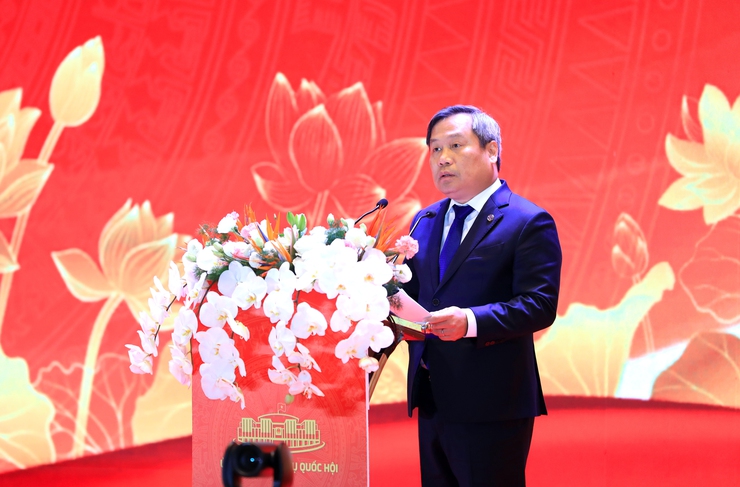 Hanoi People's Committee Chairman Vu Dai Thang speaks at the conference.
Entering the 2026-2031 term, Hanoi has identified the need for a stronger transformation in development thinking while maximizing the city's potential, advantages and special mechanisms granted by the central government.
"Hanoi's spirit is to dare to think, dare to act and dare to take responsibility. We remain committed to the principle: once we make a commitment, we follow through, quickly, correctly, effectively and to completion. Every program and plan must be translated into clear timelines, tangible outputs and measurable results. The quality of services delivered to citizens and businesses will be the benchmark for evaluating government performance at all levels," Thang said.
The Hanoi chairman said the city would focus on several key priorities, including strengthening Party-building efforts and the political system, improving urban governance and enhancing the quality of public officials.
The city would also firmly address avoidance of responsibility and bureaucratic delays while fostering a cadre of officials willing to think creatively, take action and assume responsibility for the common good. Hanoi will accelerate digital transformation and the development of the digital economy, digital society and digital citizenship, with the goal of becoming a leading center for innovation in Vietnam and the region.
The city will also focus on removing bottlenecks related to infrastructure, land clearance and investment procedures while developing an integrated network of major transportation systems, urban railways, digital infrastructure, green infrastructure and new development spaces.
At the same time, Hanoi will promote its cultural values and the image of a civilized and elegant capital, improve education, healthcare and social welfare services and expand social housing, rental housing and worker-support facilities in line with central government directives and the capital's sustainable development goals.
The city will continue advancing decentralization alongside stronger power-control mechanisms, improve the performance of People's Councils at all levels, strengthen dialogue with citizens and build greater public trust and consensus. Hanoi also aims to modernize urban governance through a leaner, more transparent and data-driven model while developing a substantive digital government that enhances accountability and improves public services.
"With the spirit of 'Hanoi for the nation, together with the nation,' we believe today's conference will create new momentum for People's Councils across the country to continue reforming their organization and operations, strengthen cooperation and experience-sharing and jointly build a modern, effective and people-centered system of local governance," Thang said.