The conference was attended by members of the Politburo, members of the Party Central Committee, Deputy Prime Ministers, leaders of ministries, central agencies, provinces, cities, and state-owned economic groups and corporations.
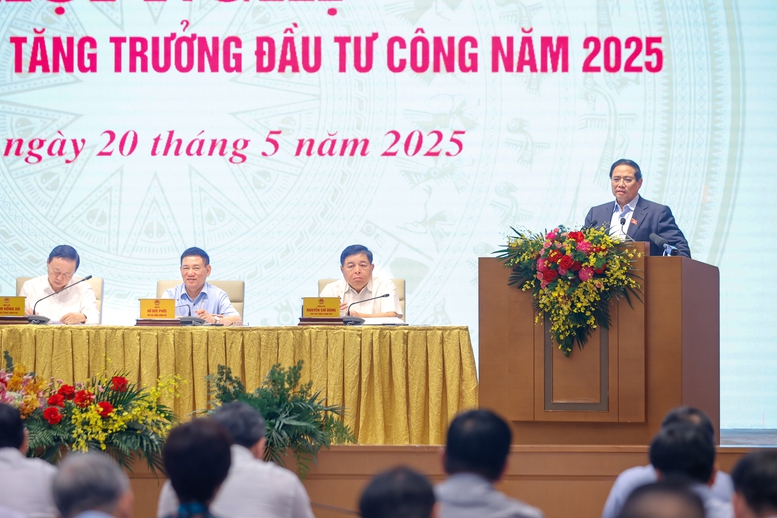
Overview of the meeting.
Reports and opinions at the conference evaluated that in terms of leadership, direction, and administration, right from the beginning of the year, the Government and the Prime Minister had provided drastic, close, and synchronous instructions on the allocation and disbursement of public investment capital, considered a key and urgent task to stimulate growth and ensure major economic balances.
This includes a focus on institutional improvement for public investment, with a key highlight being the submission and approval by the National Assembly of the Law on Public Investment No. 58/2024/QH15 on November 29, 2024, and its immediate implementation starting January 1, 2025, with many new, breakthrough, and strongly reformative provisions aimed at enhancing decentralization and authority delegation.
Specifically, this includes separating compensation, support, resettlement, and site clearance as independent projects; authorizing the Prime Minister to assign a provincial People's Committee as the lead agency to implement projects spanning two or more provincial-level administrative units; allocating local budget funds to entrust the implementation of preferential credit policies through the Vietnam Bank for Social Policies at the local level.
On boosting decentralization and delegation, the authority to adjust the medium-term public investment plan funded by the central budget between ministries, central agencies, and localities is delegated from the National Assembly Standing Committee to the Prime Minister; the authority to extend the allocation time of central budget capital is delegated from the Prime Minister to the investment policy decision-making level; for local budget capital, the authority is transferred from the provincial People's Council to chairpersons of People's Committees at all levels; and the authority to extend the implementation and disbursement duration of local capital plans is also delegated from the provincial People's Council to the chairpersons of People's Committees.
In terms of improving quality and diversifying investment capital sources, it is permitted to use recurrent expenditure sources and other lawful capital sources for project preparation; state-owned enterprises are allowed to act as managing agencies to implement public investment projects as decided by the Prime Minister.
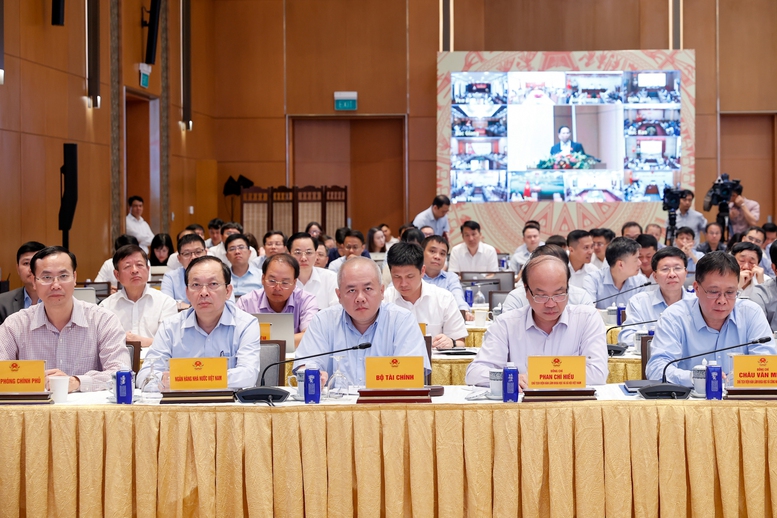
Delegates at the meeting.
On January 8, 2025, the Government issued Resolution No. 01/NQ-CP, which emphasized the need for "stronger, more decisive, and timely solutions to accelerate the disbursement of public investment capital right from the beginning of 2025, especially for national key projects, major works, and national target programs."
Since the beginning of the year, the Prime Minister has issued one directive, three official telegrams, and numerous other directives to accelerate public investment capital disbursement. Furthermore, other directives and telegrams from the Prime Minister aimed at promoting growth have integrated public investment disbursement acceleration solutions. Additionally, four meetings of the State Steering Committee for national important and key projects in the transport sector and the Steering Committee for important projects in the railway sector have been held.
Public investment issues are consistently included in the working agenda of Standing Government meetings, regular Government meetings, and meetings of ministries and sectors, reflecting continuity and consistency in leadership and administration.
Along with this, the seven working groups of the Prime Minister have actively conducted inspections, urged progress, resolved difficulties and obstacles, and accelerated the disbursement of public investment capital at ministries, agencies, and localities. At the same time, ministries, agencies, and localities have also proactively established their own working groups to promote public investment capital disbursement.
According to reports and comments at the conference, as early as December 4, 2024, the Prime Minister assigned the 2025 state budget investment plan with a total capital of nearly $32.59 billion (VND 829.4 trillion) to ministries, agencies, and localities, achieving 100% of the capital plan allocated by the National Assembly to ensure a strong push for public investment disbursement from the beginning of 2025.
As of April 30, 2025, total estimated disbursement nationwide was $5.05 billion (VND128.5 trillion), reaching 15.56% of the plan assigned by the Prime Minister—lower than the same period in 2024 (16.64%) but $708 million (VND18 trillion) higher in absolute value.
10 out of 47 ministries and central agencies and 36 out of 63 localities have disbursement rates above the national average. Among these, several units with large allocated capital and high disbursement rates include:
Ministry of National Defense: allocated $907 million, disbursed 16.3% Ministry of Public Security: allocated $161 million, disbursed 27.3% Ministry of Agriculture and Environment: allocated $880 million, disbursed 16.6% Thanh Hoa: allocated $525 million, disbursed 39.2% Ha Nam: allocated $419 million, disbursed 38.4% Lam Dong: allocated $286 million, disbursed 30.1% Ba Ria–Vung Tau: allocated $544 million, disbursed 26.6%
Disbursement of national target programs reached 21.4% of the plan assigned by the Prime Minister, higher than the same period in 2024 (19.5%).
Many projects, especially national key projects across the country, were urgently implemented with the construction spirit of "overcoming sun, defeating rain, not losing to storms", "seizing moments to eat, rushing sleep", "3 shifts, 4 crews", "working through holidays and Tet", "only discuss execution, not retreat"... Key and important projects in expressways, high-speed railways, airports, seaports, educational, medical, and social infrastructure have been prioritized in funding and focused on implementation.
Especially nationwide, 80 key and strategic infrastructure projects were simultaneously started or inaugurated to commemorate the 50th anniversary of the Liberation of the South and National Reunification, including the operation of Tan Son Nhat Terminal T3 and the opening of main routes of 5 component projects of the North-South Expressway...
Many contractors and managing agencies have strongly applied and mastered modern technologies, accelerating construction progress and improving work quality, such as the Long Thanh International Airport project, Berths 3, 4, 5, and 6 at Lach Huyen Port, and large tunnels along the North-South Expressway.
In his concluding remarks, Prime Minister Pham Minh Chinh fundamentally agreed with the reports and statements that highlighted notable achievements, clearly identified difficulties and obstacles, and proposed many specific and feasible solutions to promote the disbursement of public investment capital in the coming period.
The Prime Minister assigned the Government Office and Ministry of Finance to fully absorb the comments, promptly finalize, and submit to the Prime Minister a Conclusion that ensures "clear responsibilities, clear tasks, clear timelines, clear results, clear authorities", serving as a foundation for determined, synchronized, and effective nationwide implementation.
Summarizing some prominent results, the Prime Minister, on behalf of the Government, acknowledged, praised, and highly appreciated the efforts of ministries, sectors, and localities—especially the 10 ministries/agencies and 36 provinces with above-average disbursement rates.
The Prime Minister especially commended officials, workers, and laborers on construction sites; and thanked the people for giving up land, homes, livelihoods, and sacred places for projects, reflecting their trust in the Party and State, contributing significantly to growth promotion, macroeconomic stability, strategic infrastructure development, and national construction and development in the new era.
Alongside the achievements, the Prime Minister also pointed out that public investment disbursement still has many shortcomings that must be seriously addressed.
As of now, 17 ministries and central agencies, along with 21 provincial authorities, have yet to fully allocate the public investment capital assigned by the Prime Minister, with a remaining total of nearly VND 8 trillion (approximately USD 320 million), which must be allocated by the end of May. Among them, 37 out of 47 ministries and agencies, and 27 out of 63 localities have disbursement rates below the national average. Some entities, despite being allocated large amounts of capital, have recorded low disbursement rates.
The disbursement progress for several nationally significant projects, key transport infrastructure initiatives, and inter-regional transportation projects managed by local authorities remains slow. Notable examples include: the Tuyen Quang – Phu Tho expressway connecting to the Noi Bai – Lao Cai expressway; the Hoa Binh – Moc Chau – Son La route; Gia Nghia – Chon Thanh; Ho Chi Minh City Ring Road 4; Tan Phu – Bao Loc; and Bao Loc – Lien Khuong segments.
According to the Prime Minister, public investment disbursement continues to face various challenges, including land clearance, technical standards, the supply of construction materials, and the disbursement of ODA funds. Monitoring and supervision efforts have at times been lax. Some ministries, agencies, and localities have not demonstrated proactiveness or decisiveness; in some cases, there is a tendency to avoid responsibility and wait for instructions. The implementation of government and Prime Ministerial directives has been slow in certain areas. Moreover, capacity constraints in managing and executing national target programs at the local level are still evident, adversely affecting policy effectiveness at the grassroots level.
Analyzing the root causes, the Prime Minister noted that discipline and administrative order have not been strictly enforced in some cases. Investment preparation for several projects remains superficial. In areas where Party Committee Secretaries are not deeply involved and the political system is not fully mobilized, land clearance tends to be delayed. The capacity of some project management units, technical staff, consulting firms, and contractors remains weak. There is also a persistent issue of fear of making mistakes, avoidance of responsibility, and lack of coordination among agencies and localities.
Drawing on lessons learned from practice, the Prime Minister emphasized the need for thorough understanding, serious implementation, and resolute, effective execution of resolutions and directives issued by the Central Committee, the Politburo, the Secretariat, the National Assembly, the Government, and the Prime Minister regarding public investment disbursement.
Leadership and direction must be strengthened, with a clear emphasis on decentralization, delegation of authority, and individual accountability. Localities must be self-reliant, proactive, and willing to take responsibility. A high level of determination, major efforts, and decisive actions are required. Difficulties, bottlenecks, and procedural obstacles must be promptly identified and resolved, following the principle: "leadership and direction from the top, but implementation and problem-solving from the ground up," and adhering to the "6 clarities": clarity of people, tasks, responsibilities, authority, timelines, and outcomes.
The entire political system must be mobilized. Land clearance should be conducted swiftly and decisively, ensuring the legitimate rights and interests of the people and safeguarding their livelihoods. Decentralization must be promoted, unnecessary administrative procedures reduced, and accountability strengthened. The right contractors must be selected, and anti-corruption and anti-waste efforts rigorously enforced. Periodic reviews and assessments must be conducted, and praise, rewards, disciplinary actions, and sanctions should be carried out in a timely, transparent, and public manner.