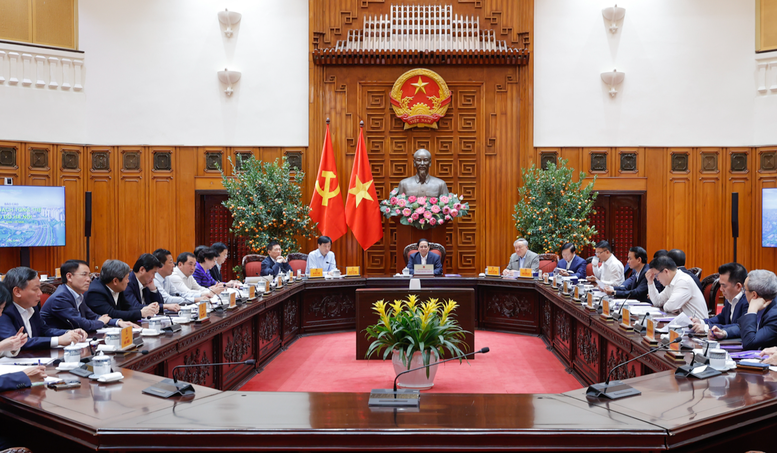
 Prime Minister Pham Minh Chinh chairs a working session of the Government Standing Committee with leaders of Hanoi to continue giving comments and feedback on the Hanoi Capital Master Plan with a 100-year vision.
Attending the meeting were Nguyen Duy Ngoc, Politburo member and Secretary of the Hanoi Party Committee; Deputy Prime Ministers; and leaders of ministries, sectors, central agencies and Hanoi.
According to reports and opinions presented at the working session, Hanoi previously developed two planning systems in parallel: the Capital Plan under the 2017 Planning Law and the General Capital Plan under the 2024 Urban and Rural Planning Law.
This created overlap and a lack of synchronization between socio-economic development strategy and spatial organization. It also meant there was still no thorough solution to existing bottlenecks such as traffic congestion, flooding and environmental pollution, and no fully established development model or plan, leading to wasted resources.
Now, to align with the two-tier local government model, the trend toward smart cities and open regional, national and international linkages, concentrating on building a single Capital Master Plan with a long-term sustainable 100-year vision, in order to create a unified legal foundation and generate breakthrough development momentum in the nation's new era of rise, has become an urgent requirement.
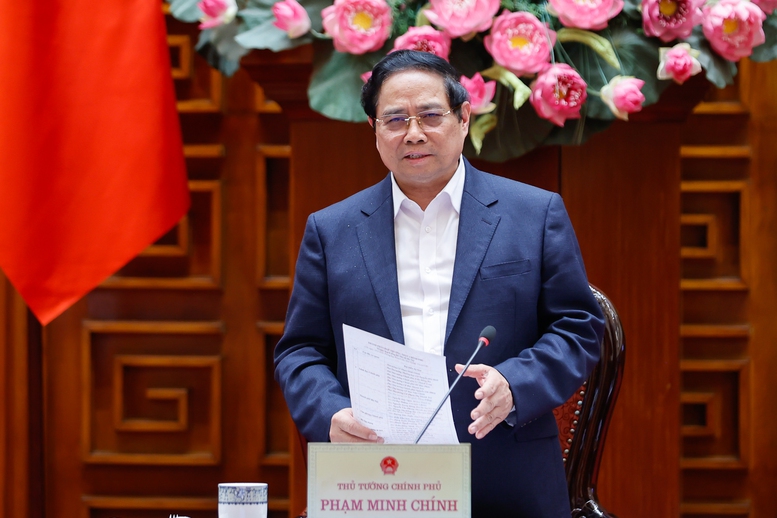 The Prime Minister says the Capital Master Plan is of great importance to the development of the capital, the region and the country.
On December 11, 2025, the National Assembly passed Resolution No. 258/2025/QH15 on piloting several special mechanisms and policies to implement large and important projects in the capital. This allows the formulation of an overall Capital Master Plan based on specifying the national plan and regional plan and integrating the contents of the Capital Plan and the General Capital Plan.
The planning dossier has now been completed. It has fully incorporated directions and comments from the Politburo, the General Secretary, the Prime Minister, the Government Standing Committee, the Hanoi Party Committee, ministries and sectors, provinces and cities, experts and scientists.
It has been integrated in accordance with Resolution No. 258 of the National Assembly, aligned with the draft Politburo Resolution on building and developing the capital in the new era and designed to ensure implementation in the draft revised Capital Law.
The planning timeline includes a short-term phase to 2035, a medium-term phase to 2045, a long-term phase to 2065 and a strategic vision of 100 years.
The plan identifies new and breakthrough directions with 11 groups of transformative solutions, including regional linkages and the development of a "Core - Satellite" model for the Capital Region. In this model, Hanoi serves as the core urban center, the hub of spillover development and the leading force for the entire Capital Region, the Red River Delta, the Northern Key Economic Region and the whole country.
Another key focus is on breakthroughs in urban railway development and TOD-based urban development, along with institutional innovations at growth poles to ease pressure on the inner-city population. The plan also emphasizes building a smart, green and sustainable urban model, combined with comprehensive and selective urban redevelopment.
In addition, the plan promotes the exploitation of multi-layered and multi-level space, while aiming to turn the Red River into a development symbol of the capital to create a new leap forward. Airport development and solutions to fundamentally improve and address environmental pollution are also highlighted, alongside the identification of land reserve funds.
To ensure effective implementation, the plan will be carried out through specific action plans and programs. All spatial orientations are closely linked to resource-balancing models and special, superior mechanisms under the Capital Law.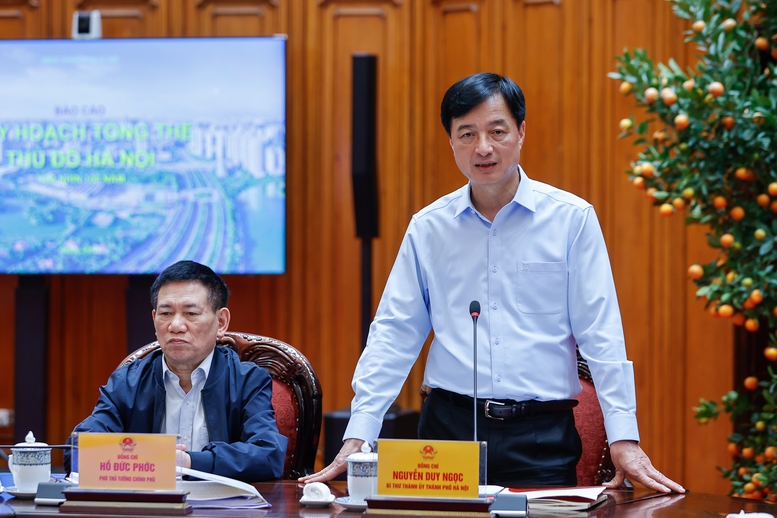 Hanoi Party Secretary Nguyen Duy Ngoc speaks at the working session.
The plan specifically identifies nine development poles, nine major centers and nine driving axes, together with beltways and corridors, to promote regional and national linkages and connections to border areas, seaports and international gateways; cultural, historical and landscape heritage spaces along the Da River, the Red River and the Duong River; and a western green belt of natural, cultural, historical, spiritual and tourism heritage linking a chain of scenic landscapes and historical sites.
Opinions at the working session proposed that ministries and sectors should soon complete the formulation and adjustment of national sectoral plans, including studying relevant contents of the Capital Master Plan for coordinated, integrated and unified implementation, avoiding overlap and ensuring a long-term vision.
Ministries and sectors were also urged to soon study, review, develop and issue new systems of standards and technical regulations in line with development capacity comparable to international levels, including green cities, smart cities, sustainable cities and multi-level, multi-layer urban models.
The People's Committees of provinces surrounding Hanoi, within the Hanoi Capital Region, when studying and formulating provincial plans, should strengthen coordination and synchronized integration with the Capital Master Plan to ensure common orientation and a shared vision and to facilitate the implementation of infrastructure investment projects linked with Hanoi according to a clear roadmap and plan.
Hanoi proposed support for allowing the city to proactively study, develop and issue a set of specific planning and architectural standards and regulations, different from current national standards, in order to create a legal tool for managing and implementing the plan under the special conditions of the capital set out in the Hanoi Capital Master Plan with a 100-year vision.
After hearing the reports and opinions, Prime Minister Pham Minh Chinh concluded the meeting by commending Hanoi for inheriting and promoting traditions and achievements from previous periods and for decisively, urgently, synchronously and effectively carrying out three important and strategic tasks, both immediate and long-term, with a far-sighted vision and bold thinking: drafting a Politburo Resolution on building and developing the capital in the new era; drafting a revised Capital Law for submission to the National Assembly; and formulating the Hanoi Capital Master Plan.
Among these, the Politburo Resolution is the political foundation, the revised Capital Law is the legal foundation and the Capital Master Plan is the spatial development foundation. These drafts have been prepared carefully and thoroughly, with high intellectual content and strong practical value, and with very high determination and great effort. At the same time, land clearance work has been accelerated with public support, helping advance many major projects and remove bottlenecks.
The Prime Minister said the Capital Master Plan is of great importance to the development of the capital, the region and the whole country. He said it reflects Vietnamese intelligence, Vietnamese culture, Vietnamese identity, Vietnamese people and society and Vietnam's development in the new era.
He asked for continued concretization and incorporation of all relevant resolutions and conclusions of the Party Central Committee, the Politburo and the Secretariat, as well as the directions of General Secretary To Lam, while also taking in the constructive comments made at the meeting to further improve the plan.
Emphasizing several more points, the Prime Minister said the philosophy of the plan is to place people at the center and as the main actors; to build a prosperous, civilized, thriving, distinctive and modern urban area with a 100-year vision, developing in a multi-polar, multi-level, multi-layer, multi-center, multi-directional and multidimensional way, with digital, bright, green, clean, beautiful and cultured development; harmonizing people, culture, society and nature, with "villages within the city and the city within villages," while preserving, inheriting and developing. The breakthroughs, he said, are urban redevelopment, rural modernization, smart services and advanced industry.
The Prime Minister asked Hanoi to study and find a location for a planning exhibition palace to publicize the plan, monitor the plan, promote investment and also serve as a tourism product.
The Prime Minister stressed several additional points, including planning for low-altitude, high-altitude and space economic development, as well as underground planning to relocate electricity, water, telecommunications and transport infrastructure below ground.
He also called for a review of sectors and fields to optimize above-ground space, especially in southern areas and in Xuan Mai, Ba Vi, Son Tay and Soc Son. Other priorities include developing the airport economy, tapping the potential of the West Lake center and strengthening the capital’s ecosystem in connection with surrounding localities.
The Prime Minister emphasized the need to build a secure and safe capital, make effective use of five modes of transport, and enhance climate change adaptation. Efforts should also focus on restoring green rivers and addressing environmental pollution, traffic congestion and flooding.
In addition, he highlighted the importance of preserving and promoting Hanoi’s culture and identity, including the Old Quarter and historical and cultural relics, while planning development space and taking the lead in developing cultural and entertainment industries. Smart urban governance and management were also identified as key priorities.
The Prime Minister said the plan must closely combine the framework and the details, fully leverage Hanoi's unique potential, outstanding opportunities and competitive advantages and strictly implement the plan, ensuring that each task is carried out properly and completed thoroughly. To ensure feasibility and implementation, priorities must be selected, especially those with strong spillover effects and large driving force.
Regarding standards and regulations, the Prime Minister agreed in principle with Hanoi's proposal, stressing that they should both reflect the specific nature of the capital and have general applicability while ensuring connectivity with the rest of the country when necessary.
He also said it is necessary to diversify resources, optimize state resources, promote public-private partnerships and build policies to mobilize resources through forms such as BT and BOT, policies for the TOD model, bond issuance and the establishment of funds such as a social housing fund, with internal resources serving as the basic, strategic, long-term and decisive source and external resources as the important and breakthrough source in implementing and realizing the plan.