The workshop gathered officials including Pham Dai Duong, Member of the Party Central Committee and Deputy Head of the Central Policy and Strategy Commission, and Le Quan, Deputy Minister of Education and Training, along with representatives of central agencies and the city, scientists, experts, research institutes, universities and business leaders.
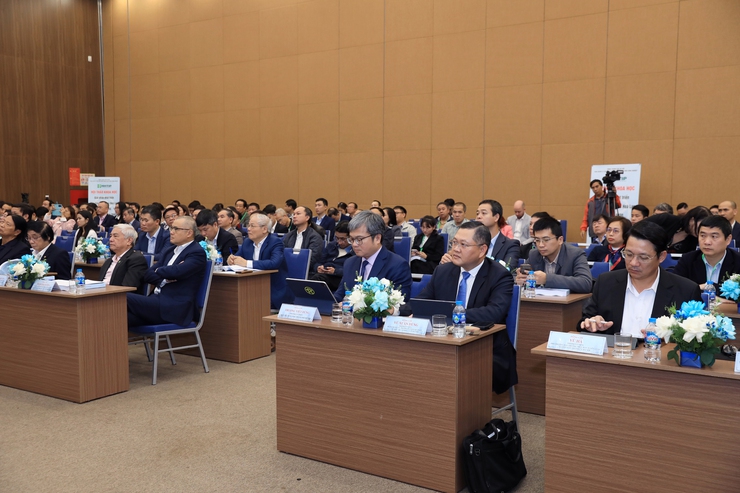
Overview of the event.
Hoa Lac Hi-Tech Park was established in 1998 under the management of the Ministry of Science and Technology and was transferred to Hanoi in 2023.
It is the country's first hi-tech park and carries the mission of becoming a national center for advanced research, development and high tech applications that can drive knowledge based growth and innovation for both the capital and the country.
After more than twenty five years, the park has attracted more than 109 projects with total registered capital of VND116 trillion (US$4.7 billion). Major corporations such as Viettel, FPT, Vingroup, VNPT, Nidec of Japan and Hanwha Aerospace of Korea operate there alongside several large research and training institutions.
According to Vu Xuan Hung, Head of the Management Board for Hanoi's Hi-Tech and Industrial Parks, Hoa Lac Hi-Tech Park has made progress but still falls short of expectations. Many constraints continue to limit its development, especially those related to infrastructure.
Hung said the first challenge lies in the institutional framework. He noted that the park still lacks a strong enough policy mechanism to address the wide set of issues it faces.
He added that social infrastructure remains insufficient and technical and transport connections are still not convenient. Scientific and technological infrastructure has seen investment from a few large enterprises and the park currently has only around 80 laboratories.
The park now has about 29,200 people working and studying on site. Under its development plan, the park is expected to accommodate about 99,000 residents and around 230,000 people working, researching and studying there by 2030.
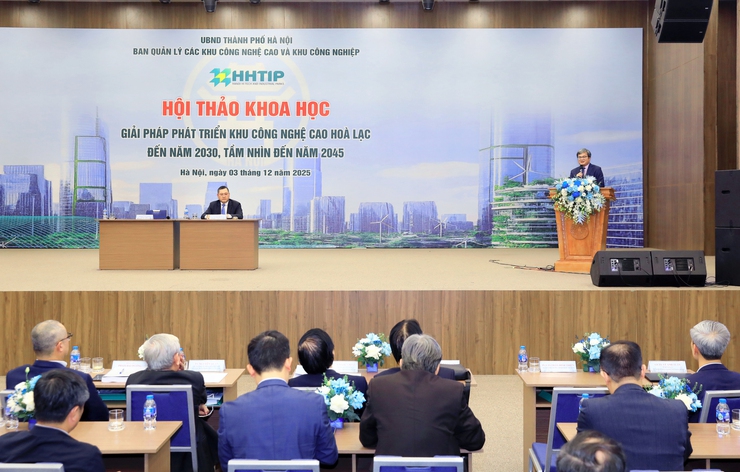
Vice Chairman of Hanoi People's Committee Truong Viet Dung speaks at the event.
Hung said the hi-tech workforce is mostly hired on short term contracts and the park faces shortages in both personnel and senior experts who can guide and shape innovation.
He stressed that the biggest bottleneck is the absence of a functioning ecosystem. The most critical part is the link between universities, research institutes and businesses, and this connection has yet to generate spillover effects or lead to specialized laboratories and pilot facilities in the park.
At the workshop, Nguyen Tu Quang, CEO of BKAV Group, said the park has not met expectations since its establishment in 1998 because its underlying ecosystem has not been fully formed. He observed that successful models around the world often showcase impressive buildings and global corporations, yet those elements are not where success begins.
He noted that Silicon Valley grew out of small garages where companies like HP, Intel and later Google emerged, while Zhongguancun in China started from the efforts of a lone researcher trying to establish the country's first private tech firm.
Although each context differs, he said successful ecosystems share four core elements: a chief architect who has vision and connects universities, businesses and government; a leading technical university that anchors talent and technological thinking; enterprises that rise from the academic environment and are willing to commit fully to technology; and venture capital funds that help early stage ideas survive their most difficult phase.
Comparing these factors with the situation in Hoa Lac, Quang said the park lacks a strong connection with a major technical university. He added that Hoa Lac should be linked with the Cau Giay area, which serves as Hanoi's technology business hub, to form a model smart city that offers continuous creative space before expanding across the capital and the country.
He expressed confidence that with the right approach and coordinated action from the political system, Hoa Lac can become Vietnam's Silicon Valley.
Duong Kieu Oanh, Head of Digital Transformation and Digital Operations at FPT Software, said FPT's more than ten years of operations in Hoa Lac show the clear potential of the area. FPT Software grew from about 1,500 employees in 2013 to nearly 6,000 across three facilities today, which she said demonstrates the park's ability to attract tech firms and skilled workers when policy and investment are aligned.
She emphasized that people remain the decisive factor for success. She said it is urgent to完善incentive policies for high tech labor, because the current definitions of "expert" and "high tech personnel" are too narrow and make it difficult to implement income or tax support in practice.
She proposed preferential loan programs and reduced interest rates for young workers, most of whom are under 35, to help them settle in Hoa Lac. Good housing and stable schooling, she said, will naturally attract more talent.
Regarding innovation, Oanh said the government should recognize R and D spending as eligible expenses so research teams can test ideas and accept risks without restrictive financial procedures.
She said it is also important to create major research challenges and strong academic and technology communities to draw top talent from inside and outside the country. Only then can Hoa Lac become a true destination for high quality human resources and a national center for innovation.
Former Minister of Science and Technology Nguyen Quan shared the view that the park's long standing limitations stem mainly from the incomplete high tech ecosystem and the absence of venture capital, which is essential to every technology valley worldwide.
"The 2008 High Technology Law referred to venture funds, but Vietnam still has not developed a full system of such funds after nearly twenty years," said Quan.
He said large tech enterprises and breakthrough products cannot emerge without venture capital. He noted recent progress as Resolution 57 and the new Law on Science, Technology and Innovation have provided a legal foundation for venture investment, and Decree 24 has created an initial framework for fund operations.
He welcomed Hanoi's decision to establish a municipal venture capital fund and hoped Hoa Lac would become a magnet for national, local and foreign funds in the future. Without those funds, he said, the park will struggle to become a true science city.
Speaking at the workshop, Vice Chairman Truong Viet Dung thanked the experts for their thoughtful and constructive insights, which he said reflected the strong support of the scientific and innovation community for the development of Hoa Lac Hi Tech Park. He described the park as one of Hanoi's key innovation spaces in the coming period.
He said Hanoi considers the development of Hoa Lac not only an investment in a hi tech zone but also a step toward realizing the city's ambition to build a Science and Innovation City that gathers core technologies, advanced knowledge economies and models of creative development. He said the goal is to turn Hoa Lac into the innovation heart of Hanoi with strong links across research, production, startups and commercialization.
To achieve this vision, the city has begun restructuring creative spaces, adopting selective investment focused on core technologies, improving policy frameworks that enable innovation, and expanding transport, digital and smart urban infrastructure.
He said these strategies show that Hoa Lac is envisioned not as a traditional industrial park but as a scientific and technological city that can become a leading national and regional innovation center and a driver of knowledge based growth for the entire Hanoi Capital Region.
He said Hanoi is committed to allocating strong resources and maintaining the highest political determination to develop Hoa Lac. In 2026, the city will dedicate up to 4 percent of its total budget expenditure, equivalent to VND9 trillion (US$360 million) per year, to science, technology, innovation and digital transformation, with a target of fully disbursing approved tasks.
With clear direction, firm solutions and significant resources, he said Hoa Lac stands before a turning point. He stressed that the park now enjoys strong support from the central legal framework, determination from the city government and broad backing from businesses, universities, experts and residents. He said the aspiration to turn Hoa Lac into Vietnam's Silicon Valley is being advanced through concrete and steady steps.