
Vice Chairwoman of the Hanoi People's Committee Vu Thu Ha chairs the meeting.
The meeting was chaired by Vu Thu Ha, Vice Chairwoman of the Hanoi People's Committee and Standing Deputy Head of the city's Steering Committee for Food Safety.
Positive changes reflected in the numbers
Reporting at the meeting, Vu Cao Cuong, Deputy Director of the Hanoi Department of Health, said that after a period of concerted efforts, food safety management across the Capital has seen significant improvements. One of the clearest results has been tighter control over slaughterhouses and a crackdown on informal street markets. So far, 173 out of 231 business points encroaching on roads and sidewalks have been cleared, reaching 75%.
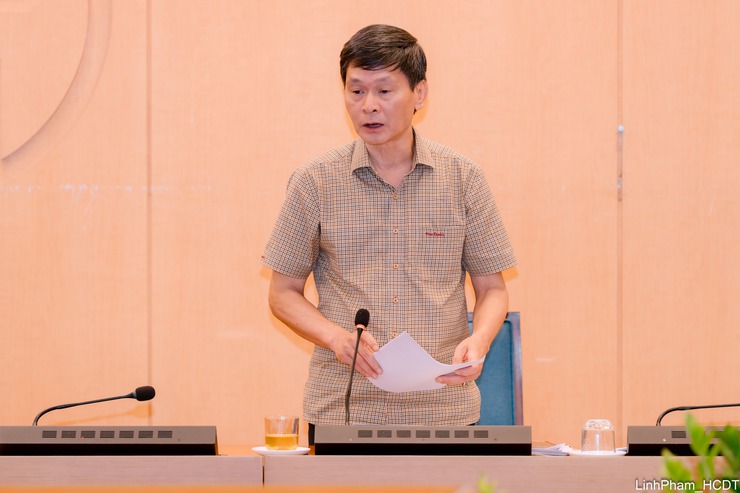
Deputy Director of the Hanoi Department of Health Vu Cao Cuong reports at the meeting.
In the livestock sector, the city has shut down 101 small-scale slaughterhouses that failed to meet hygiene standards. These figures reflect strong action by grassroots authorities in dealing with problems that had long been considered difficult bottlenecks.
Post-inspection enforcement has also been tightened with tougher penalties. Authorities at the commune and ward levels have fined 927 violating establishments, with total penalties of more than VND5.9 billion (US$236,000). Notably, the city police have prosecuted five cases involving 10 defendants linked to the production and sale of counterfeit food products, creating a strong deterrent against illegal food businesses.
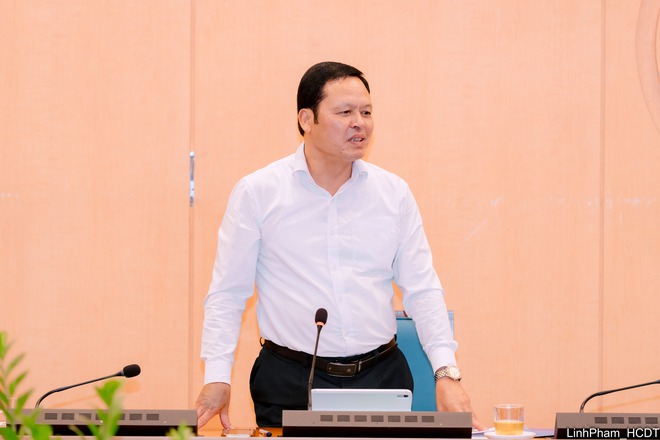

Leaders of the Departments of Agriculture and Environment, Science and Technology, and Education and Training report at the meeting.
At the meeting, leaders of the Departments of Agriculture and Environment, Industry and Trade, Education and Training, Culture and Sports, and Science and Technology provided updates on the rollout of centralized slaughterhouse zones, food-safe wholesale markets, food-safe traditional markets, collective kitchen models, ready-to-eat meal models meeting food safety standards, as well as the operation of the city's food safety website and its food safety management and traceability system.
Overall, the pilot models now being introduced have helped improve control over high-risk areas such as slaughtering, markets, and street food. They have also gradually restored order in small-scale food trading, increased transparency, helped residents identify and choose safer food, and laid the groundwork for shifting management from a reactive approach to a more proactive, preventive one.
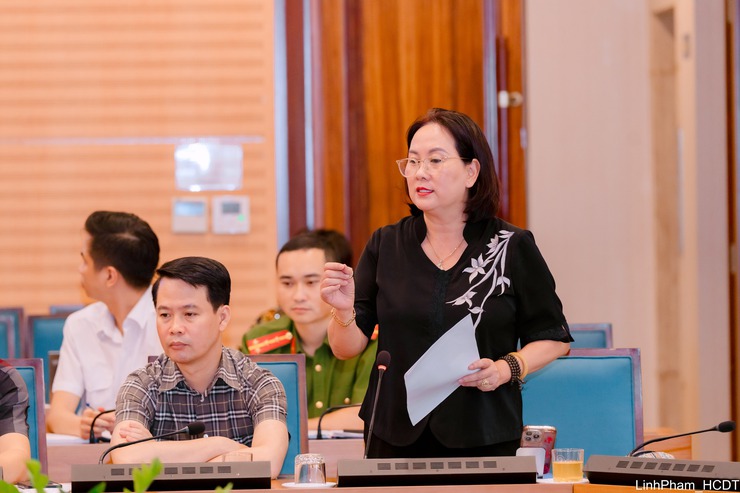
Nguyen Thi Mai Huong, Deputy Director of the Hanoi Department of Culture and Sports, reports at the meeting.
Transparency and full digitalization to tighten food safety control
To address these bottlenecks at the root, many participants proposed using technology to modernize food safety management. Hanoi plans to pilot 100 AI-powered cameras at hotspots such as centralized slaughterhouses, wholesale markets, and major street food areas. These systems will not only monitor activity around the clock but also automatically detect violations, helping authorities respond more accurately and quickly.
At the same time, the city will expand the use of static QR codes at stalls in traditional markets and operate extension No. 8 on the 1022 hotline to receive residents' feedback.
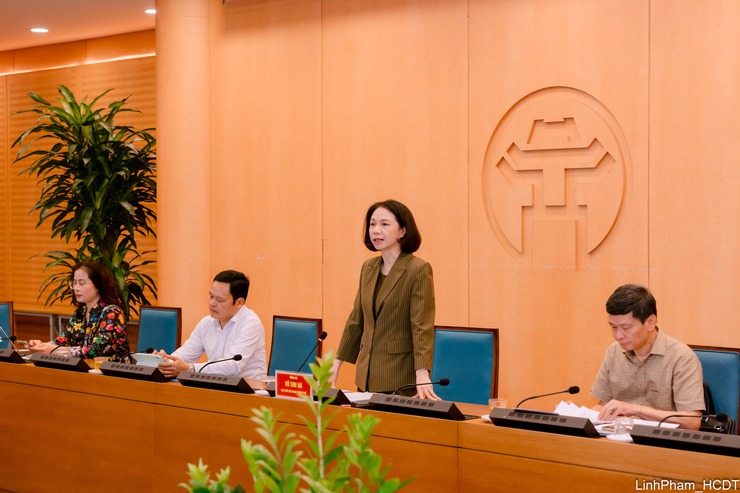
Vice Chairwoman of the Hanoi People's Committee Vu Thu Ha delivers concluding remarks at the meeting.
In her concluding remarks, Vice Chairwoman of the Hanoi People's Committee Vu Thu Ha stressed that food safety work must be carried out regularly and continuously, with synchronized tasks and solutions, tighter control across the city, strong use of information technology, practical model-building, and changes in consumer awareness.
She said the entire implementation process must be public and transparent. Departments, agencies, and local authorities must conduct a full review of procedures, contents, results, participating forces, and documentation, ensuring that every stage is backed by data, evidence, and records that can be checked and supervised at any time. In particular, residents, especially parents, must be able to access information easily. Menus and meal portions must be clearly disclosed and cross-checked.
Food production and business establishments must proactively install camera systems and connect them to monitoring networks, while remaining ready to provide complete records whenever inspected. Transparency, from the assigned personnel to the inspection results, must be clearly reflected in both documentation and digital data.
"Each unit must protect itself through transparency and be ready to explain its responsibilities whenever required," Ha said.
On implementation, she called for stronger use of information technology to ensure fairness and objectivity. All directives, inspection results, and violations must be made public, while cases that have corrected shortcomings and met requirements should also be recognized. The city will promptly commend, evaluate, and promote units that perform well, while strictly criticizing localities where serious violations occur.
Emphasizing the need for a new approach, Ha said food safety work should be carried out in a way that is friendly and close to residents, avoiding an overly administrative style and helping build consumer confidence.
During the Action Month for Food Safety, which runs from April 15 to May 15, the city will roll out models in all 126 communes and wards. Ha assigned departments and agencies to immediately issue detailed written guidance for each model, clearly defining the content, schedule, and responsibilities for implementation.
Each commune and ward must select at least one food safety model for pilot deployment and fully update and enter data for evaluation purposes. Schools, in particular, are required to carry out the assigned steps strictly and in full accordance with guidance.
The city will conduct a comprehensive review and evaluation after one month of action. Based on the results, it will study and propose policy adjustments, while scaling up effective models to support long-term food safety control across Hanoi.