At the fourth plenary session of the Hanoi Party Committee’s Executive Board on the morning of January 14, Standing Member of the Hanoi Party Committee and Permanent Vice Chairman of the Hanoi People’s Committee Duong Duc Tuan said that, to meet the capital’s development needs, the Hanoi Party Committee has proposed orientations for drafting a new resolution to replace Resolution No. 15-NQ/TW, in line with Hanoi’s development requirements in the new period.
Tuan noted that immediately after the Politburo issued Resolution No. 15-NQ/TW, the Hanoi Party Committee promptly issued an implementation plan and an action program translating the resolution into concrete targets and tasks with clear assignment of responsibilities at each level and in each sector.
The Hanoi People's Committee issued its own implementation plan with 20 indicators and 96 tasks and tracked 74 proposed tasks for central ministries and agencies, ensuring coordinated and unified implementation.
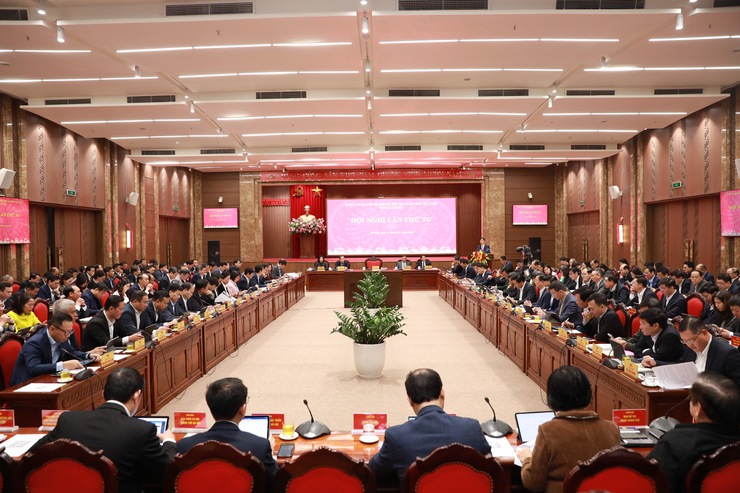
Overview of the meeting.
The communication and dissemination of the resolution were conducted in a structured and innovative manner, creating broad impact among cadres, Party members and the public. Implementation has delivered important results.
The capital's economy maintained solid growth while the economic structure shifted in a positive direction, increasing the share of services and reducing the share of agriculture.
Gross regional domestic product in 2025 was estimated at more than VND1.56 quadrillion (US$63.7 billion), while GRDP per capita exceeded VND176 million (US$7,180). Several indicators met or exceeded targets, particularly in social security, health insurance coverage, workforce training, urban wastewater treatment and housing development.
The cultural and social sectors continued to receive strong attention and investment, with many major programs and projects to build an elegant and civilized Hanoian identity implemented effectively.
The capital's education and training sector maintained its leading position nationwide in quality. The share of trained workers increased, while science and technology and digital transformation achieved notable results, with Hanoi ranking first nationwide on the provincial digital transformation index.
Planning, construction and urban development recorded positive progress with the approval of the Capital Planning for the 2021–2030 period with a vision to 2050 and the adjustment of the Capital Master Plan to 2045 with a vision to 2065. Transport and urban infrastructure continued to receive investment, with many key projects completed and put into operation, contributing to a more modern and civilized urban landscape.
National defense and security were maintained, social order and safety were ensured and external relations and international integration continued to expand, enhancing the capital's position and prestige on the international stage. Party building and political system development were strengthened, meeting the requirements for building a clean and strong Hanoi Party organization.
Based on a comprehensive review of the implementation of Resolution No. 15-NQ/TW, the Hanoi Party Committee emphasized the urgent need to redefine the task system and development orientations for the capital in the new context. This will serve as the foundation for drafting a replacement resolution to support fast and sustainable development of Hanoi through 2030 with a vision to 2045.
According to Tuan, future development orientations must stem from Hanoi's special position and role as the nation's political and administrative center and a major hub for culture, education and training, science and technology, economic activity and international integration.
On that basis, Hanoi is expected not only to advance its own development but also to play a leading role, generating strong spillover effects for regional and national growth.
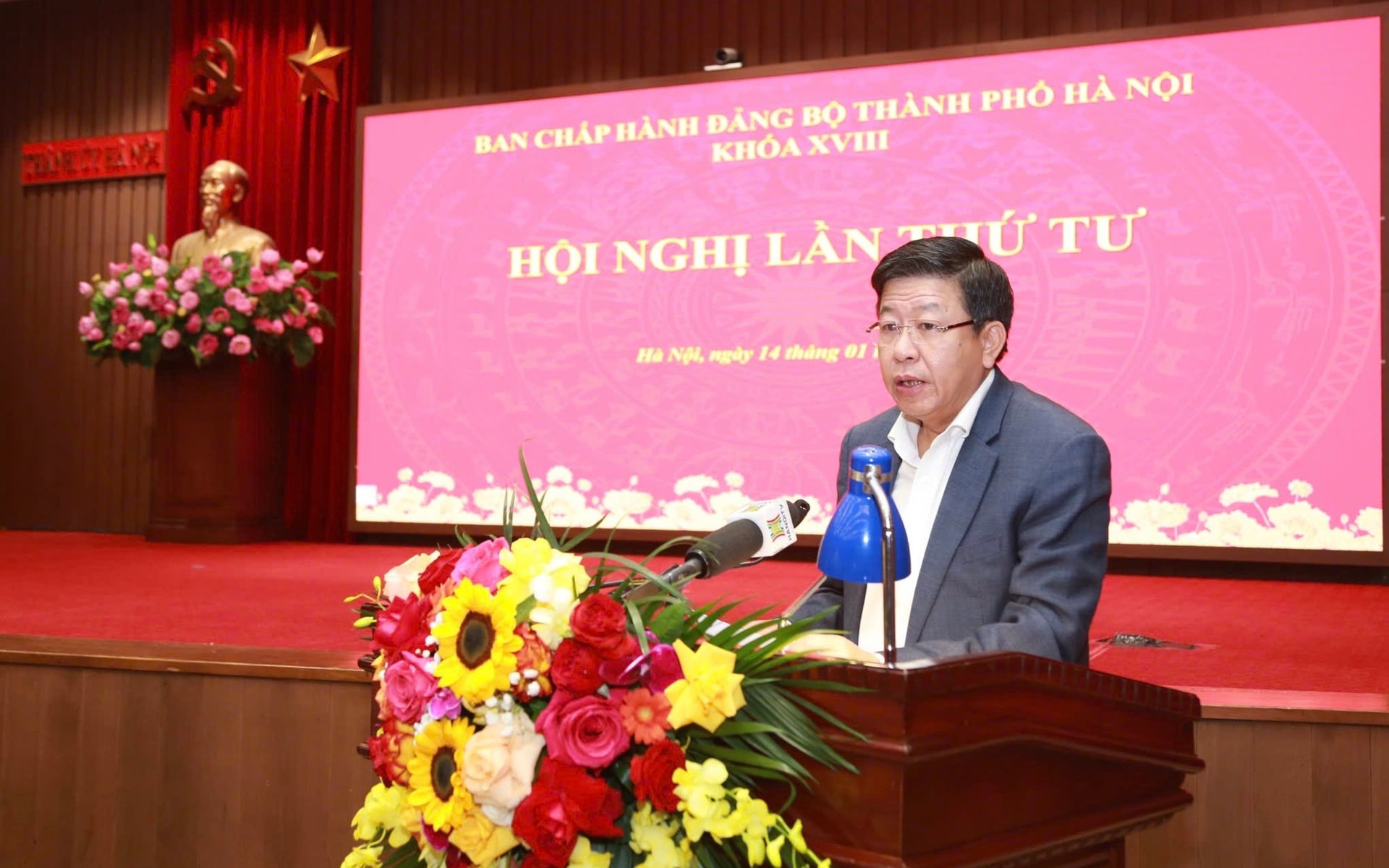
Vice Chairman of the Hanoi People's Committee Duong Duc Tuan at the meeting.
In terms of economic development tasks, Hanoi has identified the priority of continuing economic restructuring linked to renewing the growth model and improving quality, efficiency and competitiveness.
The city will focus on developing high-quality services, digital services, finance, trade and tourism while promoting high-tech industries, information technology industries and creative industries.
At the same time, efforts will be made to address limitations in processing and manufacturing industries and labor productivity. The knowledge economy, digital economy, science and technology and innovation are identified as the main growth drivers in the coming period, with the core centered on Hoa Lac Hi-Tech Park and the innovation ecosystem.
Alongside this, the city will prioritize completing its institutional framework for development as a key and breakthrough task. Practical implementation shows that many special mechanisms and policies under the 2024 Capital Law and related documents have been effective but have also revealed limitations in the face of new development demands.
The orientation is therefore to continue reviewing, amending and supplementing the Capital Law and pilot mechanisms toward stronger and more comprehensive decentralization and delegation of authority, creating broader legal space for Hanoi to proactively decide and implement development tasks.
Regarding urban development, the report clearly identifies the requirement to develop the capital as a smart, green, modern and sustainable city in line with approved plans. The focus is on synchronized investment in infrastructure, especially backbone transport infrastructure, ring roads, bridges across the Red River and the urban railway system.
At the same time, the city will work to resolve long-standing bottlenecks such as traffic congestion, flooding, environmental pollution, renovation and reconstruction of old apartment buildings and redevelopment of substandard residential areas.
In the cultural and social sphere, the report emphasizes continued development of culture as a key resource for the capital's growth, building an elegant and civilized Hanoian identity and developing cultural industries and tourism into spearhead economic sectors.
Education and training and science and technology will continue to be treated as strengths and breakthrough areas, linked to improving human resource quality to meet the requirements of digital transformation, the knowledge economy and international integration. In parallel, the city will ensure social security, enhance welfare and improve quality of life, placing people at the center, as both the goal and the driving force of development.
Notably, the Hanoi Party Committee also stressed that building a comprehensively clean and strong Party organization and political system in the capital is decisive to successfully implementing development orientations.
The focus is on building a contingent of Hanoi officials with strong political resolve, sound ethics, dynamism and creativity, with the courage to think, act and take responsibility. At the same time, the organizational apparatus will continue to be streamlined to operate effectively and efficiently under the two-tier local government model.
Based on these tasks and orientations, the report affirmed that drafting a new resolution to replace Resolution No. 15-NQ/TW is an inevitable requirement. This aims to create a more suitable political and legal framework for the new development context, unlock resources, fully leverage potential and advantages and enable Hanoi to achieve fast and sustainable development.