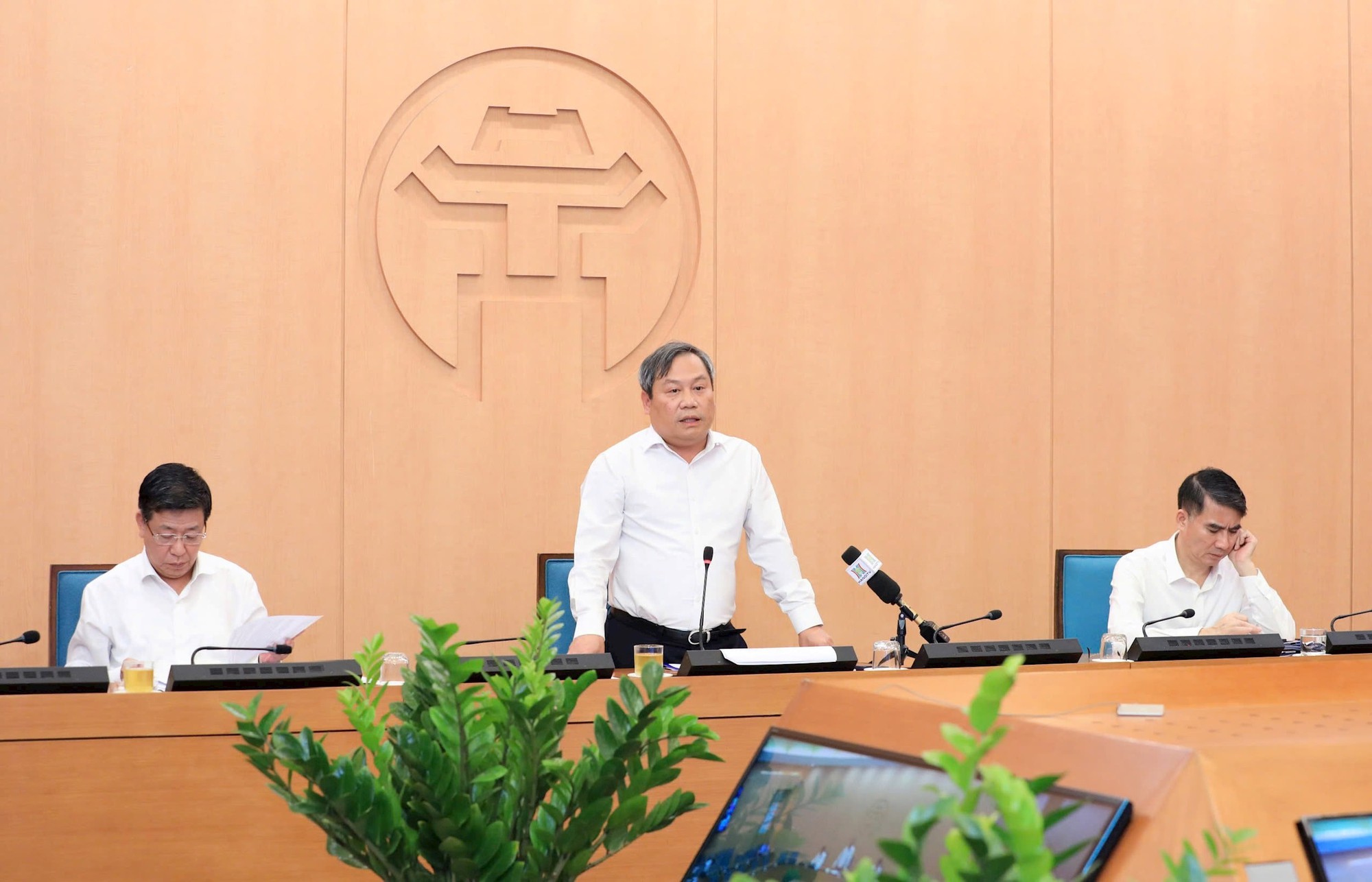
 Chairman of the Hanoi People's Committee Vu Dai Thang chairs the meeting. Photo: Le Hai
Attending the meeting were Duong Duc Tuan, member of the Standing Committee of the Hanoi Party Committee and Standing Vice Chairman of the Hanoi People's Committee; Nguyen Xuan Luu, member of the Standing Committee of the Hanoi Party Committee and Vice Chairman of the Hanoi People's Committee; along with representatives of city departments, agencies, and local authorities. The meeting was held in person at the city People's Committee headquarters and connected online to 17 communes and wards.
Land clearance for Ring Road 4 largely completed
Specifically, Chairman Vu Dai Thang chaired meetings of the steering committees for the Ring Road 4 project in Hanoi; land clearance for the North-South high-speed railway and the Lao Cai–Hanoi–Hai Phong railway; urban railway projects in Hanoi; and key technical infrastructure and transport projects for the 2026–2030 period.
Reporting on the Ring Road 4 project in Hanoi, Ngo Ngoc Van, Director of the city's Transport Construction Investment Project Management Board, said land clearance for the Hanoi section, which stretches 59.2 kilometers across 17 wards and communes, has largely been completed.
The project requires the acquisition of 800.15 hectares of land and the relocation of 9,039 graves. All 13 resettlement areas have been completed, while compensation, support, resettlement, and grave relocation are progressing on schedule. High-voltage power lines from 110kV to 500kV have been relocated, with only a few minor technical infrastructure works remaining in Me Linh, Hoai Duc, Yen Nghia, and Tam Hung.
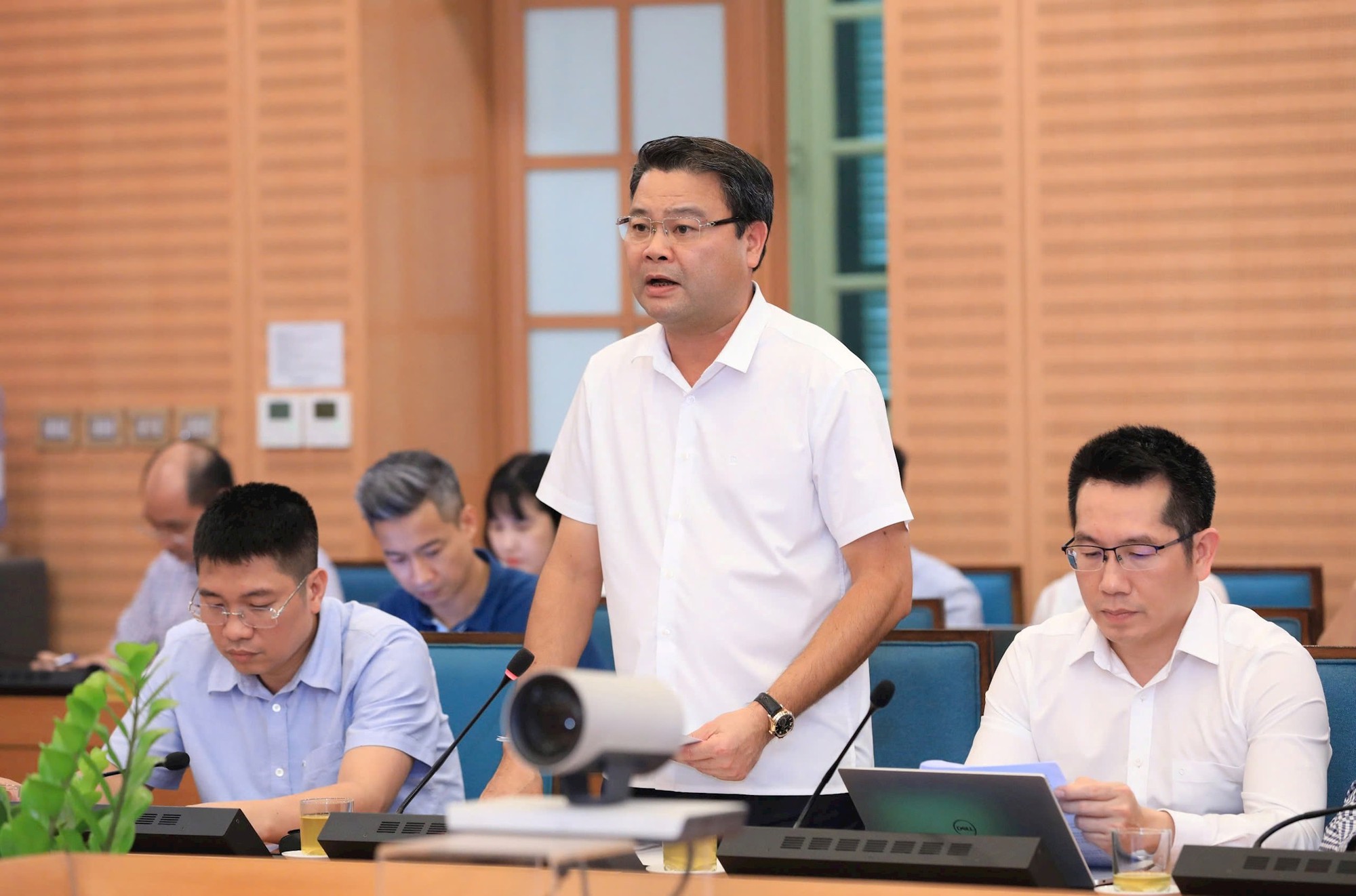
Director of the city's Transport Construction Investment Project Management Board Ngo Ngoc Van reports at the meeting. Photo: Le Hai
In terms of construction, Component Project 2.1, the parallel road, has completed about 35 out of 51.5 kilometers of asphalt concrete paving, with output value reaching around 85%. The city aims to open sections for technical traffic in June 2026. Component Project 3, under the BOT model, broke ground on September 6, 2025, and is being accelerated to serve APEC 2027.
The public investment portion has deployed 43 construction teams across 9 of 12 packages, focusing on major bridges such as Hong Ha, Me So, and Hoai Thuong, with implementation value reaching around 10.6% of contract value.
The investor-funded portion has completed design and appraisal for 57.8 out of 66 kilometers and is expected to start construction in April 2026. A contract addendum has also been signed, and the joint venture has been restructured into three investors as the basis for signing a credit agreement worth about VND25,453 billion (US$1.02 billion) in April 2026.
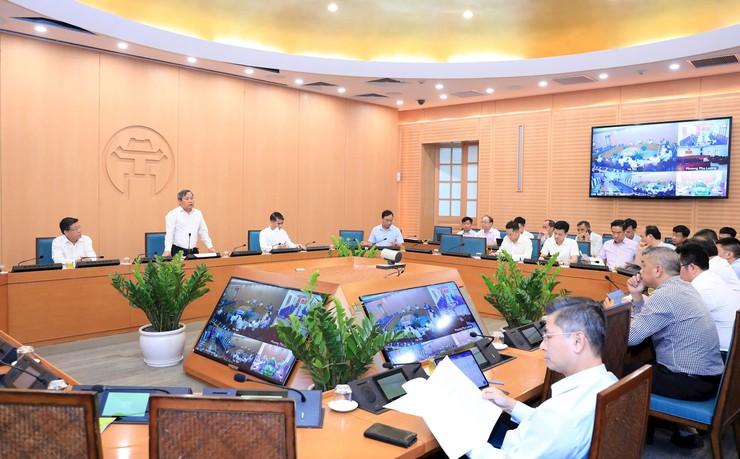
Overview of the April 15 meeting. Photo: Le Hai
Reporting on land clearance for two major railway projects, Bui Duy Cuong, Director of the Hanoi Department of Agriculture and Environment, said the North-South high-speed railway section through Hanoi is about 27.9 kilometers long and is expected to require nearly 126 hectares of land in six communes.
Local authorities have established steering committees, compensation councils, and support teams, and initial reviews of land recovery areas have reached 50–60% of the workload.
Around 5,400 graves are expected to be relocated. The city has proposed 11 resettlement areas covering about 70 hectares and nine grave relocation areas. However, boundary marking has not yet started because no formal request has been made by the investor or local authorities.
For the Lao Cai–Hanoi–Hai Phong railway, the Hanoi section is about 43.5 kilometers long, with around 309.8 hectares of land to be acquired in eight communes and wards. Local authorities have largely completed organizational preparations for land clearance and are currently reviewing land ownership under preliminary files.
More than 900 households are expected to need resettlement, and over 850 graves must be relocated. Local authorities have proposed five resettlement areas covering about 5 hectares, now in the detailed planning stage, and have initially identified two main grave relocation areas.
Reporting on urban railway projects in Hanoi, Do Viet Hai, Deputy Director of the Hanoi Department of Construction, said that under the Capital Master Plan, the urban railway network includes 14 lines with a total length of about 616.9 kilometers.
Under the 100-year vision for the Capital Plan, the network is expected to expand to 18 lines, with a total length of around 996 kilometers, adding inter-regional lines and a "radial-ring" structure to ensure synchronized connections between the urban core and satellite areas.
To date, Hanoi has put about 21.55 kilometers into operation, equivalent to 3.5% of the planned network, while 54.42 kilometers, or 8.8%, are under construction, and about 119 kilometers are under study for investment. The remaining 68.5% has not yet been launched.
A report from the Hanoi Department of Construction on key technical infrastructure and transport projects for 2026–2030 showed that the Capital's core transport system includes five main ring roads, 12 national highways, eight radial corridors, 28 bridges across the Red River, and a 14-line urban railway network, expected to expand to 18 lines under the 100-year vision. Technical infrastructure is divided into three main drainage zones: Ta Day, Huu Day, and North Hanoi, along with 39 wastewater treatment basins and 41 plants.
Transport infrastructure to drive economic growth
At the meeting, leaders of city departments, agencies, and related units discussed implementation on the ground and proposed solutions to speed up progress. Vice Chairman Nguyen Xuan Luu stressed that all units must act proactively and not wait for all new mechanisms to be fully completed before proceeding.
He also urged agencies to update their work in line with the Capital Master Plan's 100-year vision, ensuring consistency from the city level to the grassroots. Departments and agencies must coordinate closely and communicate clearly to communes, wards, and residents to avoid different interpretations that could complicate project implementation.
At the meeting, Standing Vice Chairman Duong Duc Tuan stressed the need to focus on resolving long-standing obstacles, especially those affecting key transport infrastructure projects.
Regarding Ring Road 4, Tuan said progress is basically under control, but issues related to adjustments in investment policy and additional land clearance at some interchanges must be resolved quickly.
As for resources, he said Hanoi needs to diversify investment methods by combining budget funds with private capital, bond issuance, and international cooperation to accelerate projects and create growth momentum for the Capital in the coming period.
In his concluding remarks, Chairman Vu Dai Thang said the purpose of the meeting was to review and assess the progress of key transport and technical infrastructure projects currently underway in Hanoi.
Over the past period, the city has focused on many important tasks, including advising on major mechanisms and policies, developing the Capital Master Plan with a long-term vision, and preparing conditions for the implementation of the amended Capital Law. In all of these strategic documents, infrastructure development, especially transport infrastructure, has been identified as a key driver of growth.
Thang said the city People's Committee has been directly assigned to oversee many important projects, such as ring roads, the urban railway system, and national railway lines crossing Hanoi. These are decisive projects for improving connectivity, supporting socio-economic development, and shaping urban space in the long term.
The Chairman acknowledged and praised the responsibility shown by city departments, agencies, and local authorities in implementing these major projects, especially in land clearance. He cited the Ring Road 4 project as a notable example, with land handed over six months ahead of schedule, helping ensure overall progress and earning recognition from central authorities.
Emphasizing the tasks ahead, he asked all agencies to continue proactively reviewing issues and promptly addressing difficulties, especially those related to land, construction materials, market prices, and construction organization, to keep projects on schedule. Issues beyond their authority must be reported immediately for the city leadership to direct solutions.
For national railway and international rail connection projects, the city sees land clearance as the core task. Therefore, close coordination with ministries and central agencies is needed to quickly determine routes and boundaries, creating the basis for synchronized implementation while ensuring close alignment with the Capital Master Plan's 100-year vision.
Regarding the urban railway system, Thang said this will be a pillar of development in the coming period. The city, therefore, needs to quickly complete planning and technical standards, clearly define the roadmap, and set investment priorities. In the short term, Hanoi will focus on key lines such as Line 1 and Line 6 while ensuring synchronized connections with the national railway network.
For the road system, he said the city will continue prioritizing the completion and closure of ring roads, especially Ring Roads 3 and 3.5, and will study investment in Ring Road 5 in a way that matches actual conditions and promotes regional connectivity.
On that basis, Thang called on all steering committees, departments, agencies, and local authorities to raise their sense of responsibility, coordinate closely, and ensure effective implementation of these key projects, creating momentum for the socio-economic development of the Capital.