The session also examined preparation for the election of deputies to the 16th National Assembly and People's Councils at all levels for the 2026–2031 term, along with preparations before, during, and after the Lunar New Year, and the collective year-end review of the Party Committees of the three wards.
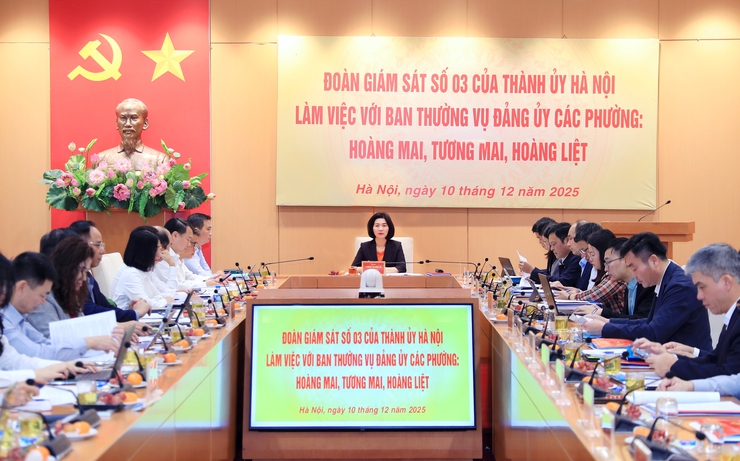
Overview of the meeting.
The working group noted that in recent months, the three wards have focused on implementing eight priority themes. Each ward has gradually strengthened its digital-transformation work to raise the rate of online public-service applications and build familiarity among residents in using digital tools.
At the same time, the wards have worked on accelerating public-investment disbursement, speeding up site clearance, introducing measures to reduce flooding, and addressing sidewalk encroachment, informal markets, and temporary stalls.
However, the working group emphasized that several shortcomings still need attention. Digital skills among some cadres, civil servants, non-specialized staff, and neighborhood leaders remain limited. Use of shared databases and specialized software is not yet deep. The share of fully online public-service applications remains low compared with potential, and many residents still prefer submitting paperwork in person.
In public-investment disbursement, some major projects in Hoang Mai Ward remain slow, with disbursement below 50 percent.
A typical example is the Minh Khai – Vinh Tuy – Yen Duyen road, which links Ring Road 2.5 with Ring Road 3. In Hoang Liet Ward, several large projects have low or average disbursement, including the road along the North–South railway and the Linh Dam Lake section connecting Nguyen Huu Tho Street and Hoang Liet Street, as well as the renovation of parks and flower gardens in land plot F5/CXKVI. In Tuong Mai Ward, disbursement for its preschool construction project also remains slow.
In site clearance, Hoang Mai Ward still faces difficulties with parcels of interspersed land, land that has changed ownership many times, encroached land, or plots allocated beyond legal authority, which complicates verification and deduction of financial obligations. Long-running projects, such as Tam Trinh Street with nearly ten years of delays, have faced inconsistent policies over time.
The working group also noted that despite efforts, difficulties remain in removing obstacles for delayed projects and in resolving pressing public-concern issues. Sidewalk encroachment, informal markets, temporary stalls, and illegal parking continue to reappear after enforcement campaigns, especially in complex areas. Many unlicensed parking lots and storage yards still occupy public land and violate land-use and construction regulations.
Several localized flooding points have not been fully resolved due to overloaded drainage infrastructure, aging systems, low ground elevations compared with surrounding wards, and limited investment funding.
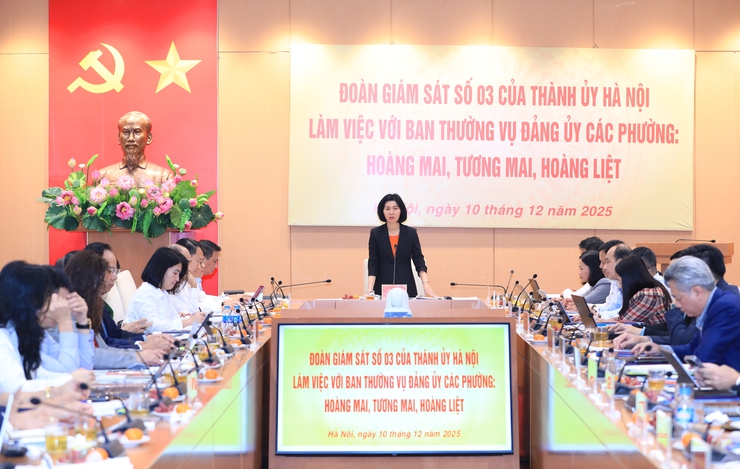
Overview of the meeting.
Traffic congestion during peak hours frequently occurs at intersections such as Truong Dinh, Giai Phong, and Do Muoi. Waste sorting at source has not become routine, and public participation remains low. Illegal dumping of construction waste and household items at collection points continues.
Concluding the working session, Deputy Secretary of the municipal Party Committee and Chairwoman of the Hanoi People's Council Phung Thi Hong Ha acknowledged the progress of the three wards in adapting to new requirements and implementing assigned tasks.
On specific matters, she requested that when implementing decentralization and delegated authority linked to administrative procedures and digital transformation, the wards must evaluate actual effectiveness and maintain a sustainable level of resident participation in online public services.
She stressed that site clearance and public-investment disbursement must be prioritized without delay, describing these as critical responsibilities of the city. She urged the wards to be more proactive in working with municipal departments and agencies to seek guidance and resolve bottlenecks.
Regarding delayed projects and construction-order enforcement, she asked the wards to use every available measure to monitor project investors as a basis for reporting to the city and relevant departments for solutions, including recovery of projects when necessary to maintain urban order and public safety. She also asked technical departments, especially the Department of Agriculture and Environment, to take responsibility for the classification of violating investors.
On environmental issues, waste management, congestion, and flooding, she requested the Department of Agriculture and Environment to arrange suitable waste-collection points. For congestion caused by construction sites, stalled works, or slow contractors who keep barriers in place, she directed localities to review and clear obstacles to ensure residents can travel safely.
For preparations related to the election of deputies to the 16th National Assembly and to People's Councils at all levels for 2026–2031, and preparations before, during, and after the Lunar New Year 2026, she asked the wards to comply strictly with regulations and timelines.
After receiving reports and recommendations from the three wards, she instructed them to further clarify and strengthen solutions within their authority and update these into their reports for consolidation by the working group.
She emphasized that the wards must adopt a forward-looking mindset and update their management approaches in line with the city's leadership direction and central-level guidance, especially as the National Assembly is expected to approve a pilot resolution with new mechanisms and policies for major projects in the capital, creating a more enabling legal framework for Hanoi's development.