Attending the meeting were Nguyen Manh Quyen, Member of the Standing Committee of the Hanoi Party Committee and Vice Chairman of the Hanoi People's Committee, along with representatives from city departments and agencies. The meeting was held in person at the headquarters of the Hanoi People's Committee and connected online with commune and ward authorities.
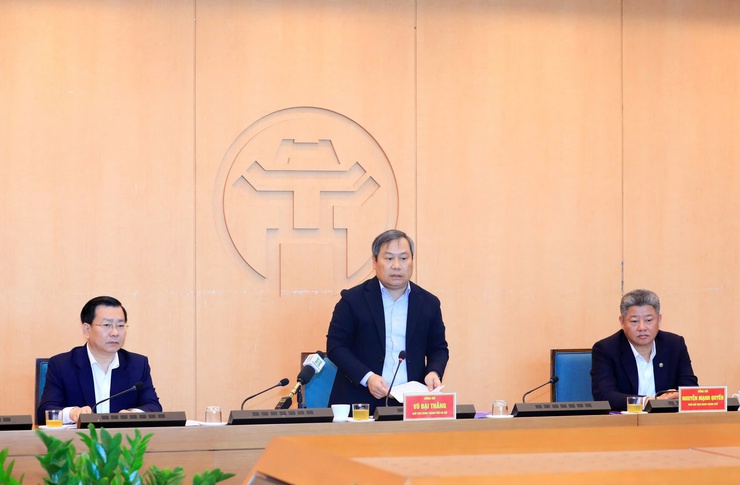 Chairman of the Hanoi People's Committee Vu Dai Thang (center) chairs the meeting on the morning of March 10. Photo: Le Hai
Fuel supply remains stable
Reporting at the meeting, Director of the Hanoi Department of Industry and Trade Vo Nguyen Phong said geopolitical tensions in the Middle East since late February 2026 have triggered strong fluctuations in global energy markets, affecting domestic fuel prices.
In response, city authorities and businesses are implementing multiple measures to ensure supply, stabilize the market, and limit impacts on people's daily life and business operations across the capital.
Phong said Hanoi's average fuel consumption is about 150,000 cubic meters per month, including around 110,000 cubic meters of gasoline and about 40,000 cubic meters of diesel.
The city currently has 453 operating fuel retail stations. Supply mainly comes from major distributors such as Petrolimex Hanoi, Military Petroleum Corporation, PVOIL Hanoi, and other distribution traders.
Hanoi also has three large commercial fuel storage facilities – Duc Giang terminal, Do Xa depot, and Nam Phong depot – with a combined capacity of about 120,000 cubic meters. These facilities play an important role in maintaining reserves and regulating supply for the capital's market.
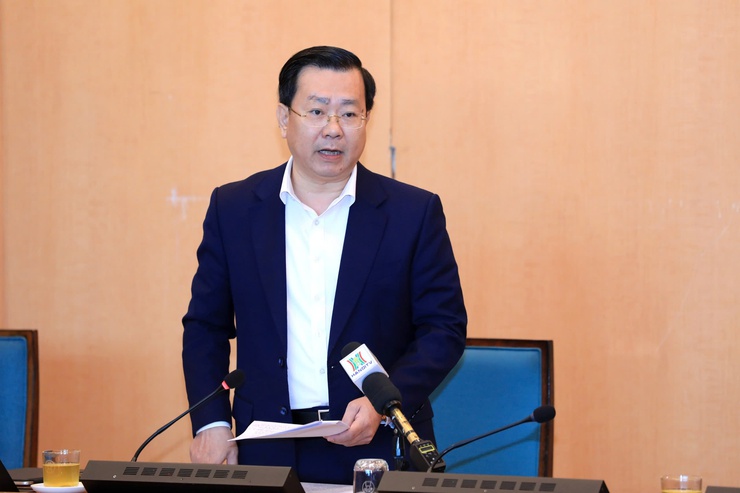 Director of the Hanoi Department of Industry and Trade Vo Nguyen Phong reports at the meeting. Photo: Le Hai
From March 6 to March 8, many fuel stations across Hanoi, especially in inner-city districts, recorded a sharp increase in vehicles coming to refuel. Long lines formed as drivers rushed to buy fuel amid concerns about possible shortages. Some stations temporarily suspended sales because supply had not yet been replenished.
By March 9, however, the situation had largely stabilized. The number of vehicles buying fuel returned to normal levels. Most stations resumed stable operations and complied with regulations on price listing. Several stations that had earlier experienced temporary shortages were restocked and reopened to serve residents.
According to the Department of Industry and Trade, the surge in fuel purchases during early March mainly stemmed from psychological concerns and stockpiling behavior rather than actual consumption demand.
Storing gasoline in cans or containers also poses fire safety risks. Market management forces, therefore, coordinated with local authorities to inspect and handle the sale of gasoline in bottles around fuel stations.
Phong also said that to ensure supply and stabilize the market, the Government, the Ministry of Industry and Trade, and the Hanoi People's Committee have issued timely directives. In Hanoi, the city government has released documents directing measures to secure fuel supply and limit the impact of fuel price fluctuations on growth targets and socio-economic activities.
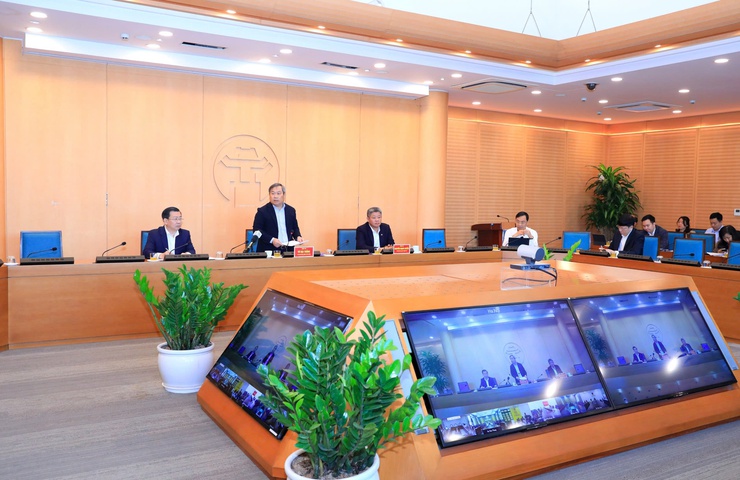 Overview of the meeting. Photo: Le Hai
Under these directives, fuel wholesalers and distribution traders are required to maintain stable operations across the retail network and ensure adequate supply for the market. Market management forces are also strengthening inspections of fuel trading activities to promptly detect and handle violations, especially hoarding, artificial supply shortages, unreasonable discount reductions, or failure to supply retailers.
At the same time, the construction sector has been tasked with studying mechanisms to stabilize construction material prices, update fuel price fluctuations, and promptly issue material price tables while guiding adjustments to construction contracts to ensure the progress of projects, particularly major city works.
To stabilize the market in the coming period, the Department of Industry and Trade proposed that the Ministry of Industry and Trade study flexible tax measures and use the fuel price stabilization fund when necessary to ease domestic price pressures. It also suggested directing major suppliers to distribute fuel more reasonably to ensure the smooth operation of the entire retail network.
According to the department, in emergency situations, Hanoi should be prioritized for essential supplies, especially energy, to maintain production activities, people's livelihoods, and key city functions.
At the city level, the department also recommended strengthening communication so residents understand that supply remains secure, preventing panic and unnecessary stockpiling. Authorities should also encourage energy conservation and greater use of public transport.
The Director of the Hanoi Department of Industry and Trade also called on media organizations to promptly provide accurate and complete information about government and city management efforts in order to stabilize market sentiment and avoid public anxiety.
"Close coordination between regulators, businesses, and residents will be the key factor in keeping Hanoi's fuel market stable and ensuring supply for both production and daily life in the capital," Phong said.
Developing proactive response scenarios
Speaking at the meeting about fuel market conditions in the city, Vice Chairman of the Hanoi People's Committee Nguyen Manh Quyen stressed that departments and agencies must closely monitor market developments and prepare response scenarios to ensure adequate fuel supply for both residents and businesses.
According to Quyen, once fluctuations appeared in global energy markets, city leaders directed the Department of Industry and Trade to closely track developments and propose solutions so the city could proactively manage and stabilize the market. This is an important task to limit negative impacts on socio-economic activities.
Quyen noted that in recent years, Hanoi has faced several challenges related to supply chains. During the Covid-19 pandemic, goods transportation was heavily disrupted and the city had to adopt flexible solutions to maintain circulation. At other times, localized fuel shortages also occurred, forcing regulators to strengthen supervision and management.
The Vice Chairman also asked media organizations to provide objective reporting on fuel market developments, reflecting the real context and avoiding unnecessary public concern. The city is directly directing relevant units to review and ensure supply for essential needs, especially major projects and economic growth targets.
Regarding future tasks, Quyen suggested continuing to recommend solutions to central authorities to ensure fuel supply, diversify import sources, and prioritize supply for large urban areas, such as Hanoi. At the same time, the city should study long-term investments to strengthen energy reserve capacity.
According to Quyen, the city will review the planning of fuel storage facilities, including potential expansion and adjustments of existing depots. The goal is to gradually increase reserve capacity to a level that could meet demand for about six months to one year during extraordinary situations. Hanoi is ready to allocate land for the development of energy storage infrastructure.
At the same time, the city also proposed that central authorities continue investing in expanding domestic refinery capacity to increase supply autonomy.
"If Vietnam continues exporting crude oil while importing refined fuel products, efficiency will remain limited. Strengthening domestic refining capacity will help ensure long-term energy security," Quyen said.
In the short term, the Vice Chairman Nguyen Manh Quyen said the Hanoi People's Committee has issued multiple directives to ensure supply and stabilize the market. Departments, agencies, and local authorities have been instructed to prioritize fuel allocation for essential sectors such as production, public services, key projects, and activities directly linked to economic growth.
At the same time, authorities are required to prepare operational scenarios at various levels in case the market continues to fluctuate or supply difficulties arise. These scenarios must clearly define priority allocations, first for essential public needs, urgent projects, production activities, and sectors that contribute significantly to economic growth.
The Vice Chairman also instructed market management forces to strengthen inspections and supervision of fuel trading activities, promptly detecting and strictly handling hoarding, speculation, or price manipulation.
Special attention must also be given to preventing unsafe fuel storage by residents using cans or containers, which could pose serious fire risks.
Local authorities have been asked to tighten oversight of fuel stations while strengthening public communication to reassure residents about supply conditions and discourage unnecessary stockpiling. Retail stations must also organize sales appropriately to ensure fair distribution so more people can access fuel for transportation and production needs.
"Agencies must work closely together to maintain market stability, ensure public order, and prevent congestion or panic buying at fuel stations. The goal is to keep the economy running normally and safeguard people's livelihoods," Vice Chairman Quyen said.
Residents urged to remain calm and trust government measures
Speaking at the meeting, Chairman of the Hanoi People's Committee Vu Dai Thang said fuel prices both globally and domestically remain volatile due to political and military tensions in the Middle East. Although the Government and ministries have issued multiple measures to stabilize the market and secure supply, prolonged conflicts continue to drive fluctuations.
In Hanoi, where the city is accelerating production and implementing many major investment and construction projects, rising fuel prices have increased production and transport costs and affected project schedules. Many businesses have reported difficulties in accessing fuel for transport, logistics, and construction equipment operations.
The Chairman said the city has directed the Department of Industry and Trade and relevant agencies to coordinate with fuel wholesalers and distributors to maintain supply for residents and businesses. However, as the situation has persisted, temporary supply limitations have appeared in certain areas and at certain times, affecting some projects and business operations.
In response, Thang instructed departments, agencies, and fuel businesses to focus on implementing measures to secure supply, with priority given to essential sectors of the economy.
Fuel must first be allocated to production activities and construction projects, particularly key city developments. Transport vehicles, excavators, loaders, and specialized construction equipment must be guaranteed fuel so projects can maintain progress.
At the same time, the city requires sufficient fuel for public transport systems, including buses, taxis, and passenger transport vehicles, to meet residents' essential travel needs. After that, supply must also ensure daily transportation and household demand, with balanced distribution to prevent localized shortages.
The Chairman stressed that Hanoi is the political, administrative, and economic center of the country, making energy security for the capital a particularly important task. The city will work directly with the Ministry of Industry and Trade and major fuel suppliers to prioritize supply for Hanoi during periods of market volatility.
Meanwhile, market management forces, police, and relevant authorities must strengthen inspections and supervision of fuel trading activities and strictly handle hoarding, speculation, and profiteering that destabilize the market.
Local commune and ward authorities were also asked to intensify public communication, encouraging residents to remain calm and trust the measures implemented by the Government and the city, avoiding unnecessary stockpiling. Localities should coordinate with departments and agencies to develop reasonable fuel allocation plans, prioritizing production, investment, and construction activities.
"This is a difficult period in accessing fuel supply, but the city must ensure that production, business activities, investment, and construction continue operating normally. Once the situation improves, Hanoi must still maintain growth momentum and achieve its development targets," Chairman Vu Dai Thang emphasized.