Reporting at the working session between General Secretary To Lam and the Standing Committee of the Hanoi Party Committee on the morning of January 10, Standing Member of the Hanoi Party Committee and Vice Chairman of the Hanoi People's Committee Nguyen Xuan Luu said the city is clearly shaping a socio-economic development model based on science and technology, innovation, and digital transformation. Hanoi views these as the key drivers for a double-digit growth breakthrough from 2026 and throughout 2026–2030.
Luu said that, in line with General Secretary To Lam's guidance, the Central Government's strategic resolutions, and the application of "superior" institutional frameworks such as the 2024 Capital Law and National Assembly Resolution No. 258/2025/QH15, Hanoi has seen great changes in both awareness and action.
"The city has made a clear shift from an administrative management model to enabling, development-oriented governance," said Luu.
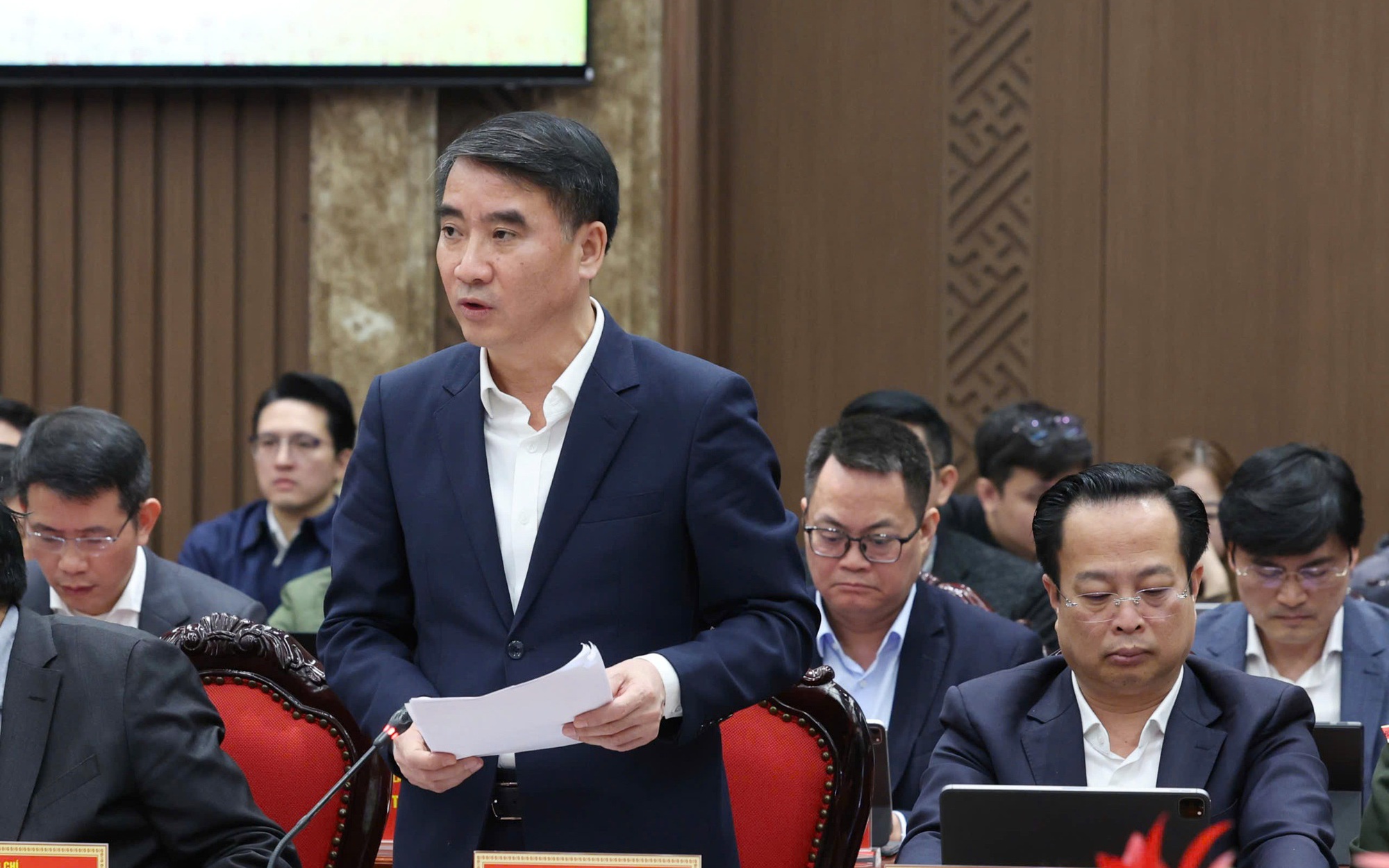
Vice Chairman of the Hanoi People's Committee Nguyen Xuan Luu at the meeting.
He highlighted several positive results recorded in 2025. GRDP growth reached 8.16 percent, exceeding the 8.0 percent target and far above the 6.52 percent posted in 2024. The city's economic scale was estimated at around $63.5 billion and GDP per capita reached $7,200.
Total social investment reached VND595 trillion (US$23.8 billion). FDI attraction reached $4.3 billion, up 169 percent year on year, while disbursed FDI reached $1.44 billion. More than 32,000 new businesses were registered, up 12 percent, with total registered capital of VND420 trillion (US$16.8 billion), up 45 percent.
Trade continued to grow, with total import-export turnover reaching $68.0 billion, up 11.6 percent. Exports reached $20.8 billion, up 8.4 percent, while imports reached $47.3 billion, up 13.0 percent.
State budget revenue stood out, with total collections reaching VND711 trillion (US$28.4 billion). This equaled 138.4 percent of the estimate and rose 38.4 percent, the highest level in many years. Domestic revenue reached VND668.4 trillion (US$26.7 billion), accounting for 94 percent of total revenue.
Local budget spending was ensured in a timely manner for agencies at all levels. Public investment disbursement reached nearly VND90 trillion (US$3.6 billion), equal to 106.8 percent of the plan assigned by the Prime Minister. Total mobilized credit reached nearly VND6.9 quadrillion (US$276.0 billion), up 13 percent compared with 2024.
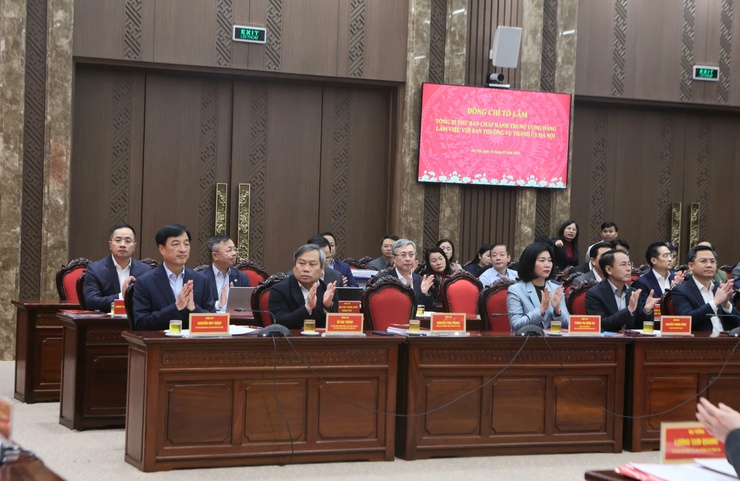
Overview of the meeting.
In 2025, Hanoi also launched construction on a series of strategic infrastructure projects, aimed at creating development breakthroughs and expanding urban connectivity. These included the Red River scenic boulevard corridor, the Olympic Urban Area, seven bridges across the Red River, urban railway lines, and a road link connecting Gia Binh Airport with the capital.
Social welfare remained a priority. In the last four months of 2025 alone, the city waived tuition fees for kindergarten and general-education students, with funding of VND1,243 billion (US$49.7 million). It also supported semi-boarding meals, totaling about VND1,082 billion (US$43.3 million).
He stressed that the 2025 results, especially those delivered in the final three months, reflected strong determination across the entire political system and decisive action by agencies at all levels.
This was most evident in land clearance, implementation of special mechanisms under Resolution 258, building an innovation ecosystem, expanding end-to-end online public services, and pushing decentralization and delegation.
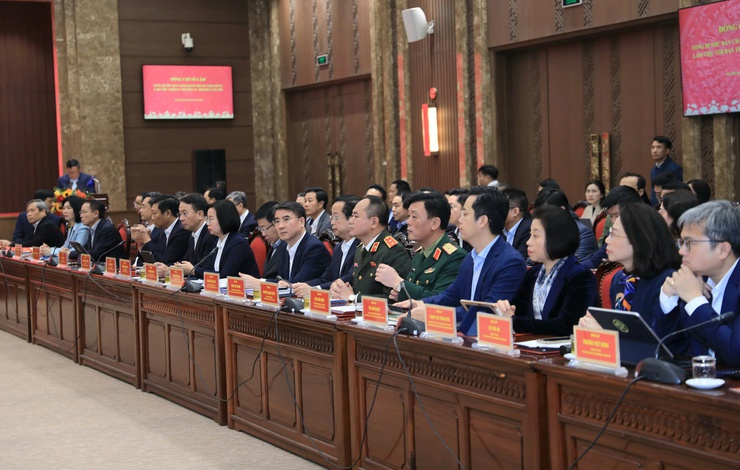
Delegates at the meeting.
From July 1 to December 31, 2025, Hanoi decentralized and delegated 79 state-management tasks from the city level to commune-level authorities, bringing the total number of tasks at the commune level to 841. In 2026, the city expects to further decentralize 97 tasks, raising the total to 938.
Defining a fast but sustainable and well-coordinated growth model
Luu said the 18th Hanoi Party Congress has set key development targets for 2026 and the 2026–2030 period. Hanoi aims for economic growth above 11 percent in 2026 and to sustain that pace throughout 2026–2030. The contribution of total factor productivity to growth in 2026 is targeted at 60 percent.
The share of cultural industries is targeted at 6 percent by 2026 and 8 percent by 2030. The digital economy share is targeted at 35 percent in 2026, rising to 40 percent by 2030. Total social investment in 2026 is projected at VND730 trillion (US$29.2 billion), and about VND5 quadrillion (US$200.0 billion) over 2026–2030.
GRDP size in 2026 is estimated at $70.7 billion and is expected to reach about $113.0 billion by 2030. GRDP per capita is projected at $7,900 in 2026 and $12,000 by 2030.
To deliver these targets, the city assigned, from November 26, 2025, a set of 43 indicators and 92 key tasks and solutions. These were broken down by quarter, sector, and locality to enable close monitoring and oversight.
Luu said that to reach 11 percent growth in 2026, Hanoi will need a total social investment of VND730 trillion (US$29.2 billion). Of this, state-sector investment is VND220 trillion (US$8.8 billion), including public investment of VND126 trillion (US$5.0 billion). Private enterprises and households are expected to contribute VND470 trillion (US$18.8 billion), while foreign investment is expected at VND40 trillion (US$1.6 billion).
The city will roll out key solutions from the start of 2026. This includes implementing the special policies under National Assembly Resolution No. 258/2025/QH15, removing bottlenecks, and accelerating slow-moving land-use projects. If 50 percent of such projects are activated in 2026, they could add about VND100 trillion (US$4.0 billion) to total social investment.
Hanoi will also push progress on major projects such as the Olympic Urban Area, the Red River scenic corridor, Tran Hung Dao Bridge, the road link to Gia Binh Airport, and Ring Road 4. These five projects alone are expected to contribute about VND243 trillion (US$9.7 billion) to growth in 2026.
In parallel, the city will move decisively to resolve obstacles affecting public investment projects. It will apply new land-clearance mechanisms to speed up ring roads and radial corridors, fully implement delegated investment procedures, and develop new financial mechanisms for human resources, innovation, and more flexible capital use.
On the development model, Hanoi is pursuing fast but sustainable growth, balanced across the three pillars of economy, society, and environment. It is advancing a socialist-oriented market economy while ensuring social welfare, protecting the environment, and improving living standards.
The city is also promoting new economic models such as the green economy, digital economy, circular economy, and night-time economy, while continuing to study additional models suited to its development context.
For 2026–2030, Hanoi will treat science and technology, innovation, and the digital economy as the main growth engines.
The city will focus on digital infrastructure, shared data, and AI, while building digital government, a digital economy, and a digital society. It will develop a "Make in Hanoi" innovation ecosystem, aiming to become a startup capital and a hub for R&D, high-tech development, the semiconductor industry, the green economy, and the circular economy. Hanoi has selected 31 key projects and programs for focused direction and implementation.
At the same time, the city will continue removing bottlenecks in mechanisms and policies. It will finalize the capital's comprehensive master plan with a long-term vision, develop cultural industries and tourism into leading sectors, organize urban space under a multi-polar, multi-center cluster model, and improve the investment environment.
Public investment will be used to lead and unlock private investment and FDI, while strengthening the private sector and improving the efficiency of the state sector.
To achieve annual GRDP growth above 11 percent and raise the digital economy share to 40 percent of GRDP by 2030, Hanoi asked the Central Government to continue supporting amendments to the Capital Law in the direction of stronger decentralization, delegation, and authorization.
The city also proposed allowing superior special mechanisms on finance, land, and investment for large-scale projects, including a pilot free trade zone linked to international transport gateways.
Hanoi also proposed establishing a Steering Committee and a Capital Region Development Fund, with contributions from both central and local levels, to implement inter-regional projects, especially in the areas of environment and connectivity infrastructure.