Attending the ceremony were Standing Deputy Secretary of the Hanoi Party Committee Nguyen Van Phong and Deputy Secretary of the Hanoi Party Committee Nguyen Trong Dong.

Overview of the event.
Also present were Standing Committee members of the Hanoi Party Committee including Chairwoman of the Hanoi Vietnam Fatherland Front Committee Bui Huyen Mai, Chairman of the Hanoi Party Committee Inspection Commission Do Anh Tuan, Head of the Hanoi Party Committee Organization Commission Ha Minh Hai, Head of the Hanoi Party Committee Commission for Information and Public Mobilization Nguyen Doan Toan, Head of the Hanoi Party Committee Internal Affairs Commission Tran Dinh Canh, Standing Vice Chairman of the Hanoi People's Council Tran The Cuong, Vice Chairman of the Hanoi People's Committee Nguyen Manh Quyen, Major General Dao Van Nhan, Commander of the Hanoi Capital Command and Secretary of the Hoan Kiem Ward Party Committee and Chairman of the Hoan Kiem Ward People's Council Vu Dang Dinh.
Authorized by the President, Standing Deputy Secretary of the Hanoi Party Committee Nguyen Van Phong presented the Third-Class Labor Order to the Hanoi Party Committee's Internal Affairs Commission.
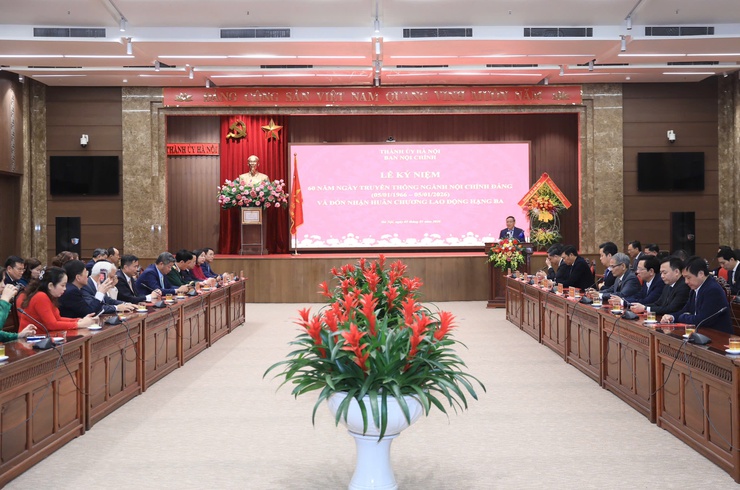
Overview of the event.
Delivering the commemorative address, Deputy Head of the Hanoi Party Committee Internal Affairs Commission Tran Van Kham said that since its establishment in 1966, the Party Internal Affairs sector has undergone multiple adjustments in functions, tasks, organizational models and operating methods across different historical periods.
Throughout this process, advisory bodies to local Party committees on internal affairs have steadily strengthened and developed. From their initial responsibilities in legislative advisory work and legal education, the sector has gradually expanded its scope and capacity.
It now plays an important role in advising on major Party viewpoints and orientations on lawmaking, national security policy, judicial reform, and the fight against corruption, waste, and misconduct, as well as on directions for handling complex cases related to security and social order that attract public attention.
Following Regulation No. 183-QD/TW issued by the Party Central Committee Secretariat on August 7, 2013, the Hanoi Party Committee Internal Affairs Commission was officially re-established and resumed operations. This marked an important milestone that enabled internal affairs work within the Hanoi Party Committee to be carried out in a more systematic, coordinated and effective manner.
After its re-establishment, the commission quickly stabilized its organization, developed working regulations and programs and proactively advised the Standing Committee and Standing Board of the Hanoi Party Committee on internal affairs, anti-corruption efforts and judicial reform.
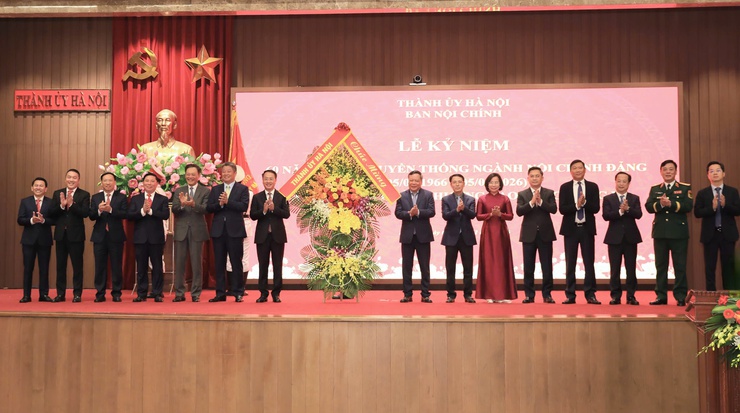
Delegates at the event.
Coordination with agencies in the internal affairs sector became increasingly close and effective. The commission's role as the standing body of steering committees on judicial reform and anti-corruption was clearly strengthened, notably through effective advisory work on three major city-level programs numbered 15, 16 and 17.
It has gradually affirmed its position as the core strategic advisory body of the Hanoi Party Committee in internal affairs, judicial reform and the prevention of corruption, waste and misconduct.
As the standing body of the Hanoi Party Committee's steering committees on anti-corruption and judicial reform, the commission has effectively coordinated, supervised and monitored implementation while strengthening cooperation among internal affairs and judicial agencies and across sectors and levels.
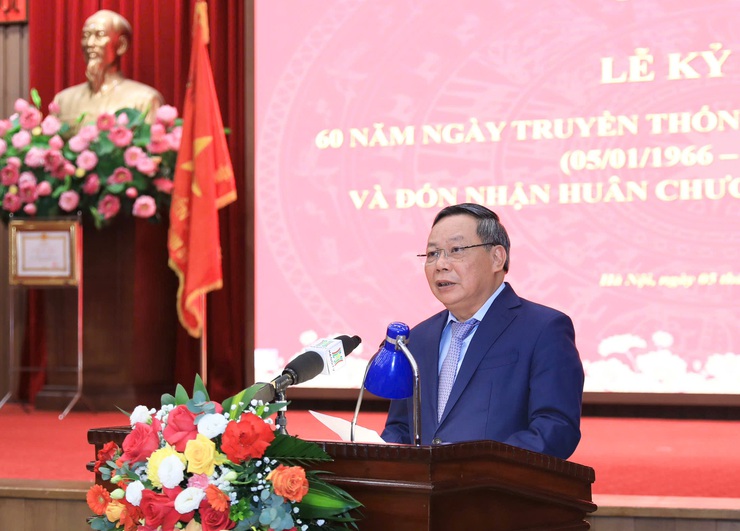
Standing Vice Secretary of the Hanoi Party Committee Nguyen Van Phong.
The monitoring and follow-up of serious and complex cases that draw public attention has been conducted in a decisive and structured manner, improving the effectiveness of corruption detection and handling. Many prolonged and complicated cases have been resolved, helping prevent the emergence of security and order hotspots. These contributions have helped maintain political stability, ensure social order and safety and support the construction and development of Hanoi as a more civilized and modern capital.
Speaking at the ceremony, Standing Deputy Secretary of the Hanoi Party Committee Nguyen Van Phong affirmed that in every stage, the Hanoi Party Committee Internal Affairs Commission has fulfilled its advisory role in leading and directing internal affairs work, anti-corruption, waste prevention and judicial reform.
The commission has helped ensure absolute safety in key areas and during major political, cultural and sporting events and important Party and State activities held in the capital. It has also advised the Hanoi Party Committee to strengthen grassroots engagement, organize citizen reception and dialogue and proactively work with agencies to resolve difficulties and obstacles, thereby creating favorable conditions for socio-economic development.

Delegates at the event.
Emphasizing that 2026 and the remaining years of the current term present major development opportunities, Nguyen Van Phong said Hanoi has begun implementing a series of large and important projects to drive socio-economic growth and reshape the capital's urban landscape. The city aims for growth of over 11% in 2026 and the following years.
He noted that while development opportunities are significant, they come with urgent requirements to renew the Party's leadership methods. This calls for new thinking, stronger awareness and digital capacity, professional working styles, a strong commitment to action, rapid adaptation to global changes and comprehensive application of science, technology and digital transformation to meet growing workloads and high standards for quality and progress. The Party Internal Affairs sector is no exception to these demands and trends.
Phong urged the Hanoi Party Committee Internal Affairs Commission to focus on several key tasks. First, it should build and refine regulations, rules and procedures to enhance effectiveness, coordination and compatibility with science and technology application and digital transformation under the principle of six clear elements and one consistent direction. Close coordination mechanisms with internal affairs and judicial agencies should be strengthened to fulfill assigned tasks.
Second, the commission should intensify training and capacity building for officials to adapt to new working requirements, particularly in applying technology and digital transformation. It should promptly implement software systems for tracking and resolving petitions and complaints and study the development of digital management systems for specialized internal affairs tasks. Working methods and proactive attitudes must be renewed to improve advisory quality and ensure timely, accurate and decisive recommendations.
Third, the commission should focus on reviewing, evaluating and classifying outstanding issues and advising the Standing Committee and Standing Board of the Hanoi Party Committee and the city's steering committee on anti-corruption and waste prevention to resolve persistent shortcomings. This includes addressing delayed tasks in internal affairs, anti-corruption and judicial reform, reviewing and handling public and non-public investment projects facing difficulties or delays and improving the management and effective use of public assets, land and mineral resources to promote development.
Phong said the Resolution of the 18th Hanoi Party Congress emphasizes mobilizing and effectively using all resources for socio-economic development. Achieving double-digit growth requires decisive mobilization of both social and public resources. The city is working to remove obstacles to unlock these resources, in which the Hanoi Party Committee Internal Affairs Commission plays an important role.
He therefore called on the commission to work more actively and effectively with city agencies in proposing amendments and supplements to the Capital Law to establish a strong legal basis and special mechanisms that allow Hanoi to develop faster and more sustainably and make greater contributions to national development.
Facing new challenges and opportunities and building on its 60-year tradition, Phong expressed confidence that the Party Internal Affairs sector of the capital will continue striving to serve as a key advisory body to the Hanoi Party Committee on major internal affairs policies, anti-corruption and waste prevention and judicial reform, thereby helping maintain political stability, social order and safety and creating a favorable environment for the development of a cultured, civilized, modern and happy capital.