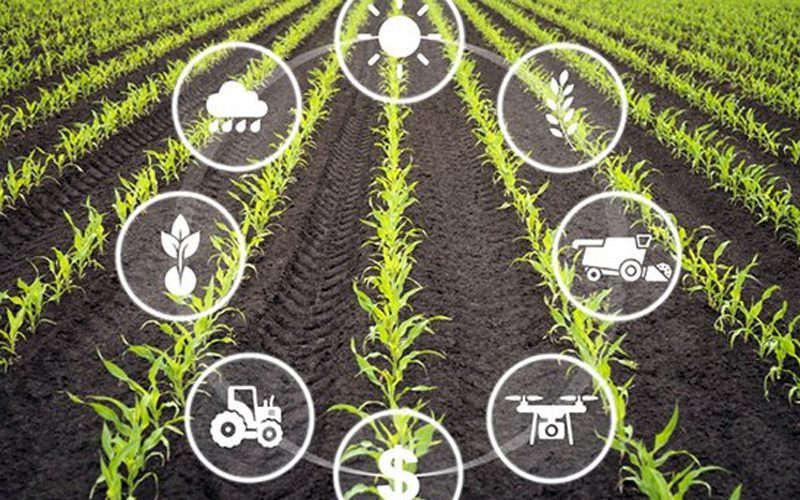
 Illustrative photo
Under the plan, the development and deployment of an Internet of Things (IoT) application ecosystem in smart agriculture is aimed at modernizing agricultural management, production, and monitoring activities; improving the management and operational capacity of state agencies, and raising production efficiency for farmers, cooperatives, and businesses; optimizing the use of land, water, and input materials; increasing the productivity, quality, and added value of agricultural products; ensuring food safety; reducing emissions; adapting to climate change; and contributing to the national digital transformation agenda and sustainable agricultural development in Hanoi.
By 2030, Hanoi aims to build a synchronized policy foundation to create a favorable legal corridor for the deployment, testing, and scaling up of IoT applications in smart agriculture, while also completing mechanisms, standards, technical regulations, and data-sharing and data-exploitation frameworks for the agricultural sector.
The city will gradually invest in and develop IoT infrastructure for agriculture, including sensor systems monitoring soil, water, and air environments; agricultural weather monitoring systems; livestock and aquaculture monitoring devices; telecommunications networks; data centers; and edge computing systems, ensuring openness, interoperability, integration, and information security.
Key IoT applications will be deployed in agricultural production and management, focusing on smart irrigation monitoring and control; soil nutrition and farming environment management; real-time disease management for crops and livestock; digital traceability systems; and smart agricultural supply chain and logistics management.
The city targets 50% of concentrated commodity agricultural production zones applying IoT at a basic level, including environmental monitoring, irrigation, and traceability, while 50% of farmers and cooperatives in specialized farming areas will receive guidance and support to access IoT infrastructure and applications for production management and operations.
For automated monitoring, Hanoi aims for 80% of production, market forecasting, and warning work related to agriculture, forestry, and fisheries to be based on big data analysis and real-time IoT systems. Priority areas include high-yield, high-quality rice cultivation; concentrated rice production; concentrated vegetable production; concentrated fruit cultivation; concentrated medicinal herb production; concentrated flower and ornamental plant production; concentrated aquaculture; and concentrated mixed farming.
By 2035, the city plans to form concentrated commodity agricultural production zones managed and controlled entirely automatically by robots, drones, and smart irrigation systems through IoT and AI platforms. AI will be applied to automate 100% of operational processes in water regulation, forest fire warnings, and environmental pollution control.
In terms of transparent supply chains, IoT data will follow agricultural products from "farm to table," ensuring origin traceability and meeting the strictest domestic and international standards on food safety and emissions reduction.
Therefore, Hanoi will build and develop the city's digital agricultural data platform, integrating data from IoT sensor systems, including soil moisture, nutrients, water environment, and agricultural meteorology; surveillance cameras in production zones; GPS devices used in machinery and production vehicle management; and digital maps of farming areas.
The city will standardize data structures, identification codes for production zones, livestock and aquaculture facilities, and IoT equipment codes.
Open APIs and controlled data-sharing mechanisms will be provided to encourage technology companies, research institutes, and universities to develop value-added services such as pest forecasting, irrigation optimization, productivity analysis, and production environment warnings.
A public-private partnership (PPP) mechanism will be established for investment, operation, and exploitation of agricultural IoT infrastructure and data.
Technologies to be piloted may include automated smart irrigation systems; soil nutrition and farming environment monitoring; livestock health monitoring through sensors; drone applications for monitoring and precision spraying; digital traceability platforms; and smart agricultural supply chain management systems.
Agricultural IoT infrastructure will be developed, including sensors monitoring soil, water, air, weather, farming environments, and crop and livestock health; telecommunications networks; data centers; edge computing systems; data connection, integration, and analysis platforms; along with accompanying cybersecurity mechanisms.
The city will invest in installing sensors and terminal devices to monitor and collect real-time data on agricultural production conditions, providing input data for analytical and operational systems.
4G/5G networks: These will serve real-time data transmission, AI camera imaging, remote control of irrigation systems, farm monitoring, and connection to centralized management platforms.
LPWAN (NB-IoT, LoRaWAN): These are suitable for low-energy applications transmitting small volumes of data over wide areas, such as soil moisture sensors and field environmental monitoring.
Edge computing: This will process data directly at the source, including greenhouses, farms, and aquaculture ponds, reducing latency and supporting instant control of irrigation, ventilation, automated feeding, or environmental threshold warnings.
AI camera applications and image analysis will be used to detect pests and diseases early, assess crop growth, and forecast yields, while automated irrigation systems and smart greenhouse control systems will operate based on real-time data.