According to reports presented at the meeting, in 2025, the Hanoi branch of the Vietnam Bank for Social Policies and the entrusted socio-political organizations closely followed directives and resolutions issued by the Central Government, the Hanoi Party Committee, the Hanoi People's Committee and the Bank's Boards of Directors at all levels.
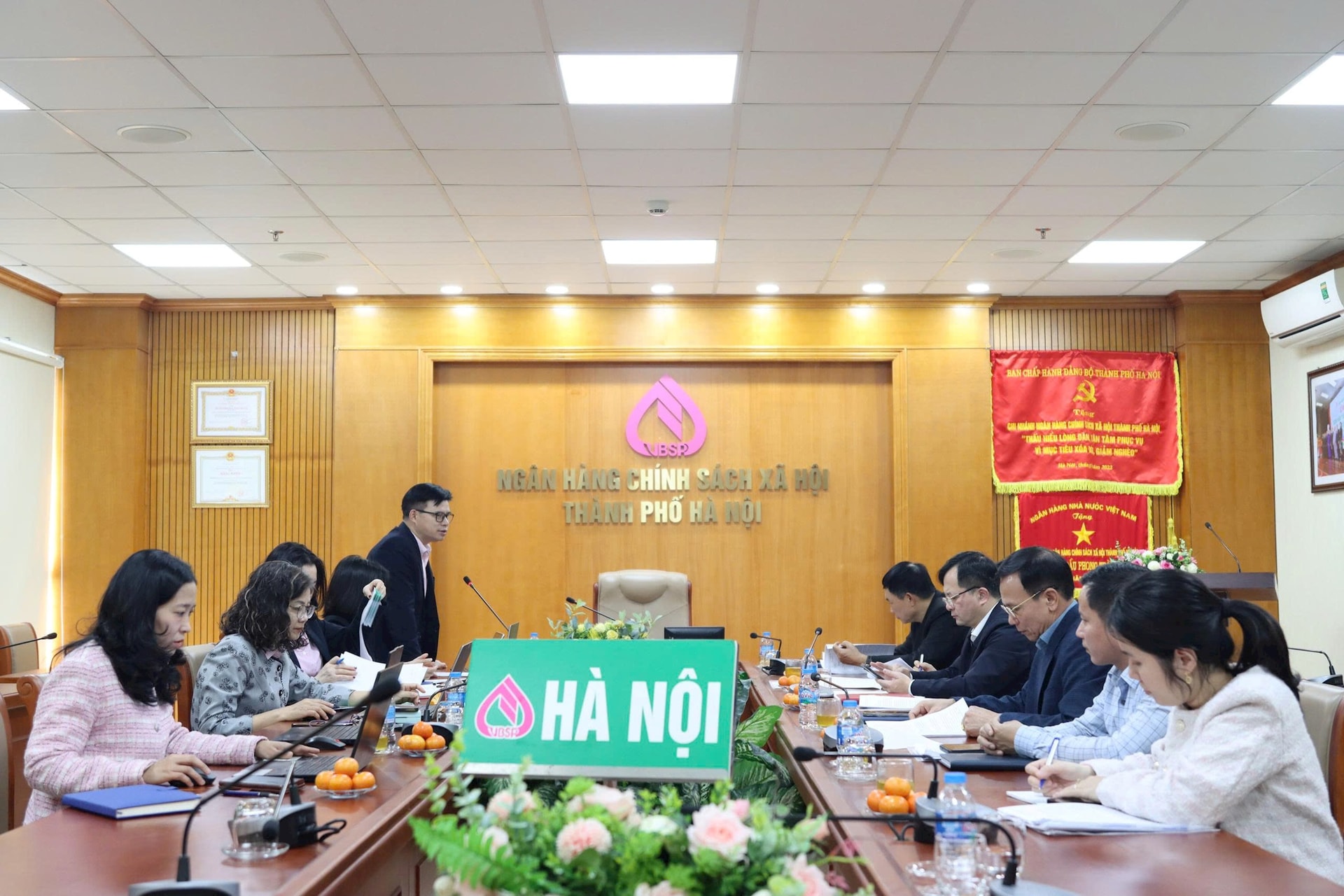
Overview of the meeting.
The parties worked in close coordination to effectively implement social policy credit programs across the city. Advisory work on balancing and allocating capital sources, assigning credit targets, organizing loan assessments, disbursement and debt recovery was carried out in a synchronized and timely manner, ensuring that loans reached the correct beneficiaries.
As of December 31, 2025, total social policy credit capital in Hanoi reached VND18.179 trillion (US$742 million). Outstanding loans entrusted through socio-political organizations amounted to VND18.162 trillion (US$741 million), accounting for 99.9% of total outstanding credit.
Total lending during the year reached nearly VND8 trillion (US$327 million), enabling more than 94,000 poor households, near-poor households and other policy beneficiaries to access preferential loans.
Social policy credit continued to focus on key programs such as job creation, rural clean water and environmental sanitation, social housing, support for students and learners and other priority groups under resolutions of the Hanoi People's Council.
In 2025, social policy credit programs helped create and support employment for more than 71,000 workers. Tens of thousands of households received support to build or upgrade clean water and sanitation facilities, while students from disadvantaged backgrounds and learners in science and technology fields were able to continue their studies. Credit quality was generally well controlled, with the overdue debt ratio for entrusted loans remaining low at 0.022% of total outstanding credit. Across the city, 88 out of 126 wards and communes recorded no overdue debt.

Delegates at the meeting.
Inspection, supervision, professional training and policy communication continued to receive strong attention. During 2025, socio-political organizations coordinated inspections at dozens of grassroots units, savings and credit groups and borrowing households. Numerous training courses were organized for association staff and group management boards, contributing to improved management capacity and more effective use of loan capital. Operations at commune-level transaction points remained stable and responsive to the requirements of implementing the two-tier local government model.
The meeting also frankly pointed out several shortcomings, including overdue debt still concentrated in certain grassroots units, some credit programs showing growth below their potential and actual demand and uneven performance in record keeping and inspection in some localities. Delegates agreed that these issues need to be addressed from the very beginning of 2026.

Delegates at the meeting.
Based on this assessment, the Hanoi branch of the Vietnam Bank for Social Policies and the four socio-political organizations agreed on key orientations and tasks for 2026. Core targets include achieving credit growth of 8–10%, keeping the overdue debt ratio below 0.05%, improving the quality of entrusted lending and the performance of savings and credit groups and accelerating credit programs with relatively low outstanding balances such as student loans and social housing loans.
The parties will also continue to strengthen coordination in inspection, supervision and policy communication to ensure that social policy credit capital delivers tangible results and contributes to social security objectives and the sustainable development of the capital city of Hanoi.