The meeting was joined by members of the supervision team including City Party Committee Member and Chief of Staff of the Hanoi People's Committee Le Thanh Nam who is Deputy Head of the team, Deputy Head of the Hanoi Party Committee's Inspection Commission Do Tam Dieu Quynh, Deputy Director of the Department of Home Affairs Dinh Manh Hung, and Deputy Chief Inspector of Hanoi Nguyen Thuy Hang, along with representatives of relevant departments and agencies under Decision No. 332-QD/TU issued on November 30 2025.
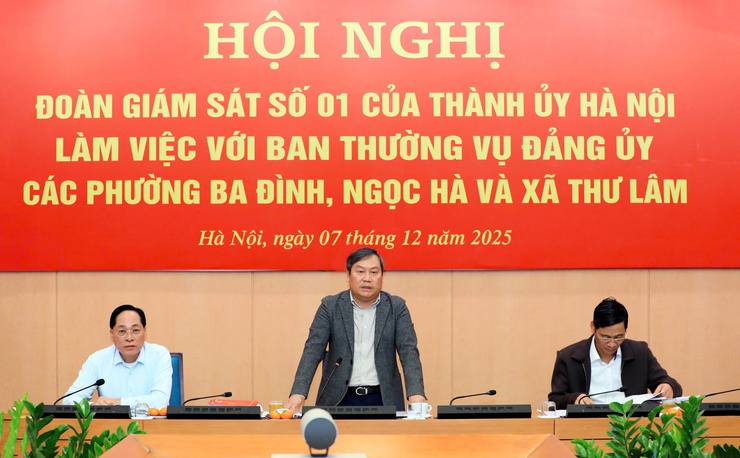
Overview of the meeting.
Removing bottlenecks in land clearance
Reporting to the supervision team, Nguyen Thi Thanh Tam, Secretary of the Commune Party Committee and Chairwoman of the Commune People's Council, said that since its establishment on July 1 2025, the leadership and administration of the Thu Lam Commune Party Committee, People's Council, and People's Committee have been decisive and consistent with clear breakthroughs that demonstrate discipline, effective governance, and administrative innovation at the commune level.
Immediately after its establishment, the Commune Party Committee was consolidated and operated in line with Decision No. 8770-QD/TU of the Hanoi Party Committee, while the organizational apparatus was strengthened to lead and supervise 105 subordinate Party cells with a total of 4,220 Party members.
The results reflect close direction from the Hanoi Party Committee that has been translated through the Standing Board, the Party Committee's commissions, the People's Committee, the People's Council, the Fatherland Front, and local mass organizations, helping improve state management and public-service quality.
Tam noted six major results achieved since establishment. The Party Committee consolidated its apparatus and personnel in line with the two-tier local government model following central and city guidelines, ensuring streamlined and lawful operations. It also issued task assignments, operating regulations, programs, and work plans to maintain smooth public service without disruption and to support residents, businesses, and local organizations.
The commune has completed six out of nine subprojects under the Resolution of the First Congress of the Commune Party Committee, meeting progress and quality requirements and forming a basis for delivering the targets of the term. Socioeconomic conditions and public security have remained stable.
Identifying land clearance as a key bottleneck requiring strong direction, the Party Committee established a Steering Committee for Compensation, Support, and Resettlement chaired by the Party Secretary. It instructed the Commune People's Committee and the entire local political system to engage from the first day of project implementation to speed up public investment and deliver approved plans.
In 2025, the commune has 59 projects under land clearance with a total land recovery area of 311.37 hectares involving 3,750 households and individuals. In the 2026 plan, the commune expects land clearance for 97 projects covering roughly 524.82 hectares with about 4,820 affected households.
Highlighting obstacles encountered since the two-tier local government model took effect, the Commune Party Secretary proposed that the city resolve inconsistencies in compensation, support, and resettlement policies.
She said the city should create a special mechanism to address cases where one project falls under two different compensation policies to ensure uniform implementation. She also requested clear guidance on how to handle illegal structures on public land under commune management to protect residents' lawful rights.
To accelerate land clearance, the commune proposed reducing the public-disclosure period for compensation plans from 30 days to 20 days. It also asked the city to authorize wider use of mandatory inventory measures and compulsory inspections in cases of prolonged non-cooperation that delay project progress.
At the meeting, members of the supervision team requested further clarification on decentralization and delegated authority under the two-tier model, public investment disbursement, land clearance progress including key projects, responsibilities of local authorities in land management, and preparations for the election of National Assembly and People's Council deputies for the 2026 to 2031 term.
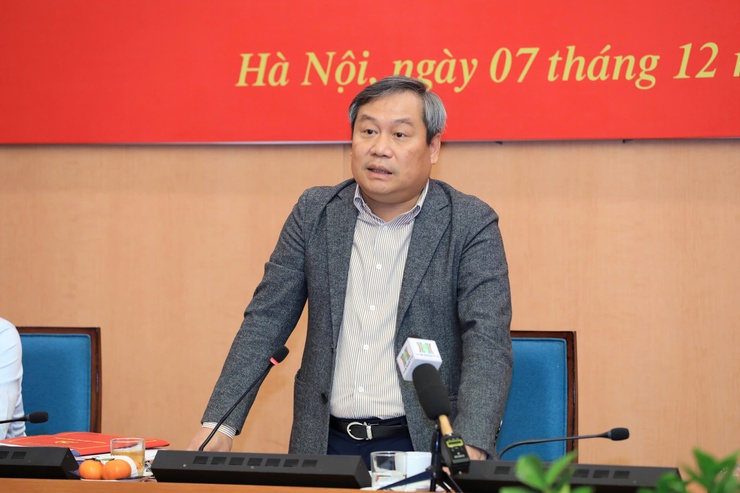
Chairman of the Hanoi People's Committee Vu Dai Thang.
Strengthening the Party Committee's role in assigned tasks
Concluding the meeting, Vu Dai Thang, Deputy Secretary of the Hanoi Party Committee and Chairman of the municipal People's Committee, praised the proactive and serious efforts of the Thu Lam Commune Party Committee and local government in the early stage of implementing the two-tier local government model.
According to the Chairman, Thu Lam is among the communes selected by the municipal Party Committee's Standing Board for supervision. The model's implementation here shows that the commune-level role and functions have been expanded. Despite being the grassroots level, Thu Lam has carried out many tasks previously handled by the city, demonstrating the capacity and effectiveness of local officials.
The Chairman noted that land clearance is the most challenging task, yet thanks to city-level decentralization and delegated authority, the commune has resolved dozens of long-standing cases transferred from district and commune levels. Although the workload remains large, the initial results provide important momentum for local development.
Acknowledging the commune's difficulties under the new model, Thang said the city will continue to expand decentralization and delegation to help the commune deliver its socioeconomic targets and contribute to the city's broader results.
He said that the National Assembly Standing Committee recently reviewed a draft Resolution with special mechanisms and policies for major projects in Hanoi. The draft sets out pilot mechanisms that exceed current legal provisions in several critical areas. As a result, areas with strong development potential in Thu Lam will be prioritized in detailed planning to promote growth.
The Chairman emphasized that tasks in 2026 will be extensive as the municipal Party Committee and the People's Council have approved a growth target of 11 percent, which requires unified effort across the political system. Local government initiative and accountability will be crucial to deliver the city's development goals.
With the progress achieved under the two-tier model, Thang said he believes that the Party Committee, local government, and residents of Thu Lam will complete all assigned tasks.