Attending the ceremony were former Politburo member and former National Assembly Chairwoman Nguyen Thi Kim Ngan; former Politburo member, former Deputy Prime Minister, and former Secretary of the Hanoi Party Committee Hoang Trung Hai; and Party Central Committee member and Government Inspector General Nguyen Quoc Doan.
Also present were current and former leaders of ministries, sectors, and localities, along with representatives of international organizations, associations, investment and financial partners, and a large number of officials and workers involved in the project.
Representing Hanoi was Vice Chairman of the Hanoi People's Committee Truong Viet Dung.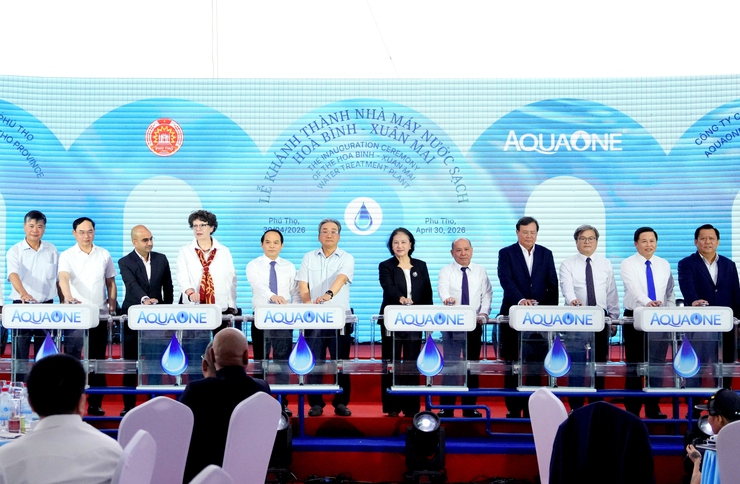 Delegates put the button to inaugurate the Hoa Binh - Xuan Mai Clean Water Plant.
The completion of the Hoa Binh - Xuan Mai Clean Water Plant, with commercial water distribution scheduled to begin in mid-May 2026, marks an important shift from merely supplementing water sources to proactively building a large-scale water supply system capable of meeting current demand and future reserve needs.
The project was developed in line with national water supply planning and the Capital Region master plan, with a clearly defined roadmap for each phase. From the outset, it was designed not only to meet immediate demand but also to serve as a key component in the long-term infrastructure network.
In its first phase, the plant has a capacity of 150,000 cubic meters per day. Capacity is projected to increase to 300,000 cubic meters per day by 2030, 500,000 cubic meters per day by 2040, and up to 900,000 cubic meters per day in the long-run. This investment orientation reflects a vision extending well beyond the normal cycle of a conventional infrastructure project.
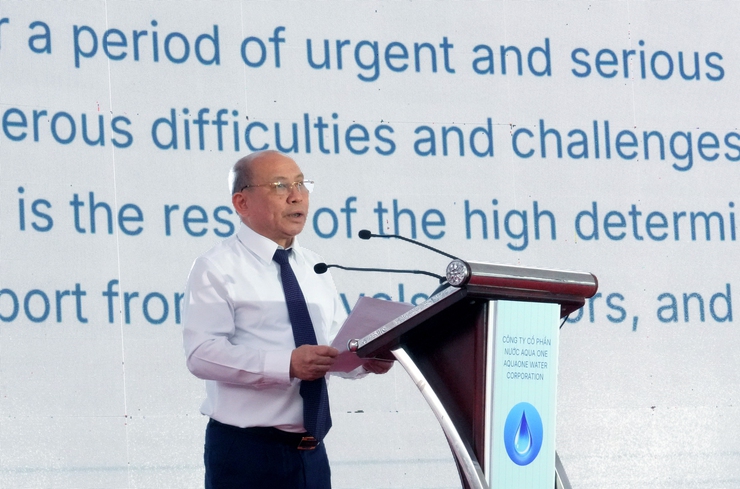 Bui Duc Hinh, Chairman of the Phu Tho People's Council, speaks at the ceremony.
Raw water is sourced from the Da River, known for its stable and high-quality supply. Based on this source, an integrated system of pumping stations, transmission pipelines, and technical facilities has been built, forming a major water supply axis connected to residential and urban areas in Hanoi and neighboring localities.
Once operational, the plant will be able to supply water to approximately 1.3 to 1.5 million residents, helping ease localized water shortages in several areas of Hanoi. The project is also expected to create stable jobs for around 200 workers, most of whom are local residents.
Speaking at the ceremony, Deputy Secretary of the Provincial Party Committee and Chairman of the Phu Tho People's Council Bui Duc Hinh said the project carries major significance in improving people's livelihoods and promoting socio-economic development in both the locality and the wider region. He said the project's completion reflects the investor's determination, the close coordination of related agencies, the support of local authorities, and the consensus of residents.
Phu Tho's leadership called on the investor to continue operating the plant safely and efficiently while ensuring the highest water quality standards. Relevant agencies and local authorities were also urged to continue supporting the project to maximize its effectiveness.
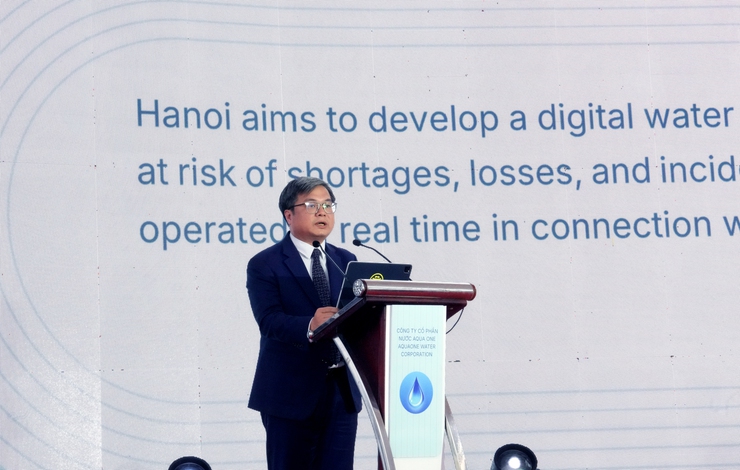 Hanoi Vice Chairman Truong Viet Dung speaks at the ceremony.
Speaking at the event, Hanoi Vice Chairman Truong Viet Dung said the world is entering a new stage of development in which physical infrastructure and digital infrastructure are no longer separate but are merging into one unified system.
In that structure, electricity is no longer simply energy, but intelligent energy. Transportation is no longer merely infrastructure, but a real-time operating system. Clean water is no longer just a resource, but the lifeblood of the city, one that must be managed through data, technology, and modern operational capacity.
A modern water supply system, he said, must be able to understand its own operating condition, forecast urban demand, and proactively regulate supply to ensure optimization in all situations.
From that perspective, Hanoi has clearly defined that water infrastructure development must go hand in hand with digital transformation and smart city building, creating a modern water governance ecosystem based on international standards. The city is shaping three foundational layers of transformation.
First, the city aims to move from a "physical water source" to a "digitized resource infrastructure." The entire water system, from water sources, intake facilities, treatment plants, transmission lines, and distribution networks to end-use points, must gradually be digitized, measured, and managed on a unified platform.
Hanoi plans to build a digital map of the water sector integrating data on flow, pressure, water quality, pipeline conditions, areas at risk of water shortages, leakage, and technical incidents. The system will be monitored through data, supported by early-warning technology, operated in real time, and connected to the city's smart urban operations center.
Second, the city aims to move from manual operation to intelligent management based on data and technology. A synchronized smart monitoring system must be deployed across the entire water supply network, using sensors and advanced technology to continuously track operating indicators such as pressure, flow, and water quality in real time.
On that data platform, analytical tools and artificial intelligence will gradually be applied to forecast demand by area and time period, detect leaks and incidents early, and optimize the operation of the entire system from production and transmission to final distribution. The water supply system must advance from simple monitoring and response to predictive capability, early warning, and real-time operational decision support.
Third, the city aims to move from isolated infrastructure works to an integrated smart urban ecosystem. The water supply system must be tightly connected with urban planning, transportation, industrial zones, high-tech parks, and new urban areas.
All water infrastructure must be linked to the city's broader urban data systems, gradually forming an integrated platform in which water supply information becomes part of the city's overall operational ecosystem. On that basis, Hanoi aims to build operational simulation models and gradually develop digital twins for key areas so that every investment decision, operational plan, and incident response scenario can be analyzed and tested in a digital space in advance.
Within that framework, the Hoa Binh - Xuan Mai project adds a new water source for the western and southern parts of Hanoi, contributing to the restructuring of the capital's water supply system toward diversification, interconnection, and backup capacity. At the same time, it serves as an important platform for the city to deploy modern water governance based on data and move toward a "smart water - smart city" model.
Once in operation, the plant will be capable of supplying water to about 1.3 to 1.5 million residents, helping address localized water shortages in several parts of Hanoi.
According to Vice Chairman Truong Viet Dung, Hanoi has set out four clear principles of action:
First, a safe, continuous, and uninterrupted water supply is a mandatory standard for a modern city.
Second, every water infrastructure project must integrate technology and data from the outset so that infrastructure development always goes hand in hand with stronger governance capacity.
Third, the entire system must be connected to one unified operational platform to improve regulation, emergency response, and optimization.
Fourth, residents and businesses must remain at the center of service, with water quality, supply stability, and customer experience continuously improved.
Hanoi highly acknowledges and appreciates Aqua One Water Joint Stock Company and related units for their efforts in implementing the project on schedule and with quality assurance. On that foundation, the city expects that in the coming period the enterprise will continue upgrading its investment to a more modern level, gradually shifting toward intelligent operation, strengthening the application of technology in governance, and proactively participating in the city's urban data ecosystem.
At the same time, investment and production activities must be closely tied to social responsibility, including protecting water sources and the environment, sharing with the community, and accompanying the sustainable development of the capital.
Investing in water infrastructure today means investing in production, health, quality of life, and the city's future development. Hanoi is committed to continuing to accompany investors, proactively removing obstacles, improving a transparent and stable investment environment, and enhancing management and operations based on data and practical results," Truong Viet Dung emphasized.
Construction began in April 2024 and was completed in April 2026. The Hoa Binh - Xuan Mai Clean Water Plant is expected to become not only a key infrastructure project but also an important foundation for improving residents' quality of life and promoting socio-economic development in the region in the years ahead.