The meeting was attended by leaders from the city's departments and agencies. It was held in person at the headquarters of the Hanoi People's Committee and connected online to local authorities in wards and communes affected by the projects.
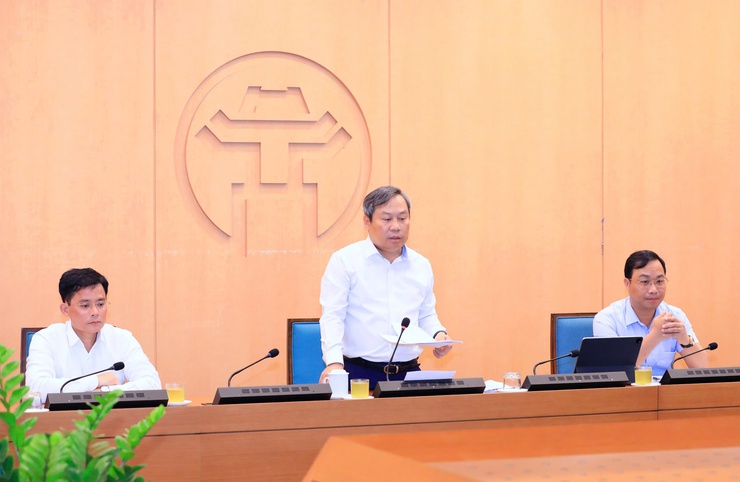 Chairman of the Hanoi People's Committee Vu Dai Thang chairs the meeting
Many localities aim to complete site clearance before May 15
A report by Vu Xuan Tung, Deputy Director of the Hanoi Department of Agriculture and Environment, showed that site clearance for the Ring Road 2.5 and Ring Road 3.5 projects is being conducted intensively by local authorities. Most policy and regulatory obstacles have been addressed, helping accelerate progress on several key sections.
According to the report, Ring Road 2.5 includes 13 sections, of which six have completed site clearance, while the remaining seven are underway. On March 19, the Department of Agriculture and Environment issued Decision No. 651/QD-SNNMT to establish a task force to support site clearance for the remaining sections across seven wards.
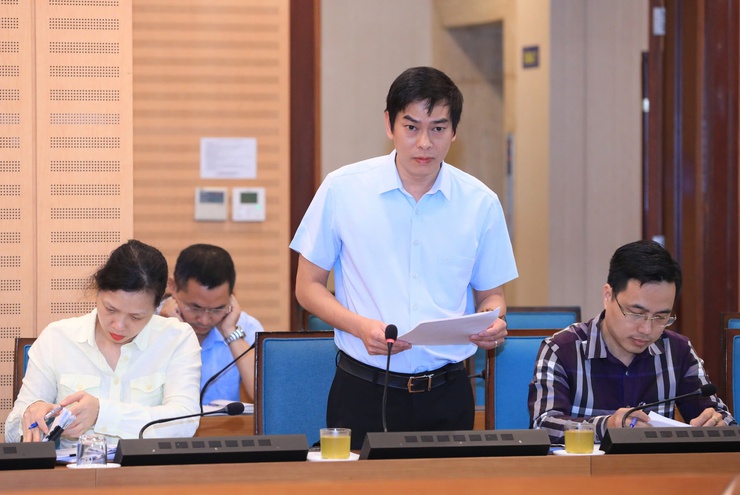 Deputy Director of the Hanoi Department of Agriculture and Environment Vu Xuan Tung reports at the meeting
Since March 20, the task force has worked directly with local authorities to assign responsibilities and resolve obstacles. Surveys and inspections have been completed, and several localities have largely completed compensation, support, and resettlement plans. Among the seven areas affected by Ring Road 2.5, Yen Hoa ward still has the largest workload.
Key sections, such as Linh Nam – Vinh Hoang, Dam Hong – Nguyen Trai, Cau Giay – Dich Vong, and Xuan Tao – Nam Thang Long, have largely completed compensation and resettlement arrangements.
Specifically, the Linh Nam – Vinh Hoang section has completed clearance in Vinh Hung ward, while payments are ongoing for 91 households in Hoang Mai ward, with completion expected before May 30, 2026. The Dam Hong – Nguyen Trai section has secured sufficient housing and land for resettlement, though some issues remain related to pricing approval and payment mechanisms.
Sections including Cau Giay – Dich Vong, Dich Vong – Duong Dinh Nghe, Vu Pham Ham – Tran Duy Hung, and Nguy Nhu Kon Tum – Nguyen Trai have built clearance plans with no remaining policy obstacles. Many localities have committed to completing work between May 15 and May 30, 2026.
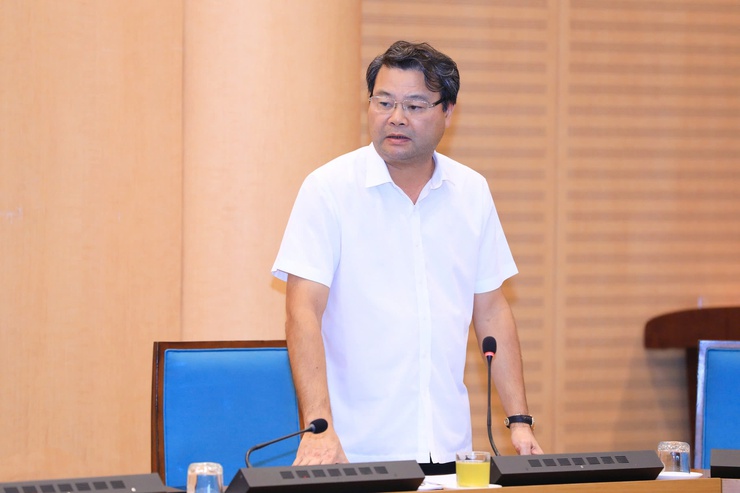 Ngo Ngoc Van, Director of the Hanoi Traffic Construction Investment Project Management Board, reports at the meeting
For Ring Road 3.5, the route runs from Quang Minh – Thien Loc – Thuong Cat Bridge – National Highway 32 – Thang Long Boulevard – National Highway 6 – National Highway 1A – Ngoc Hoi Bridge – Hung Yen. Two sections have been completed and put into operation, two are under preparation, while several bridges, interchanges, and other sections are currently undergoing site clearance.
The completed sections include the stretch from Thang Long Boulevard to Phuc La – Van Phu and from National Highway 32 to Thang Long Boulevard. Son Dong commune reported completing clearance for two industrial clusters, Doan Ket and Thanh Dung packaging, on April 24, 2026.
At Thuong Cat Bridge, clearance in Thien Loc commune is nearly complete, while the remaining work in Thuong Cat ward is expected to finish before May 15, 2026. Ngoc Hoi Bridge has completed 100% of site clearance on the Hanoi side, while work continues in Hung Yen.
Sections from Thuong Cat Bridge to National Highway 32 and from Phuc La – Van Phu to the Phap Van – Cau Gie Expressway are being built. The section passing through former Ha Dong has been approved but lacks funding, while the Thanh Tri section is completing investment procedures and environmental impact assessments. The interchange with Thang Long Boulevard has reached 99.8% completion and is expected to be operational before May 15, 2026.
According to the Department of Agriculture and Environment, most issues related to compensation, support, and resettlement for Ring Road 3.5 have been resolved. The city is also considering assigning a capable investor to implement the entire route in a coordinated manner, ensuring progress and connectivity.
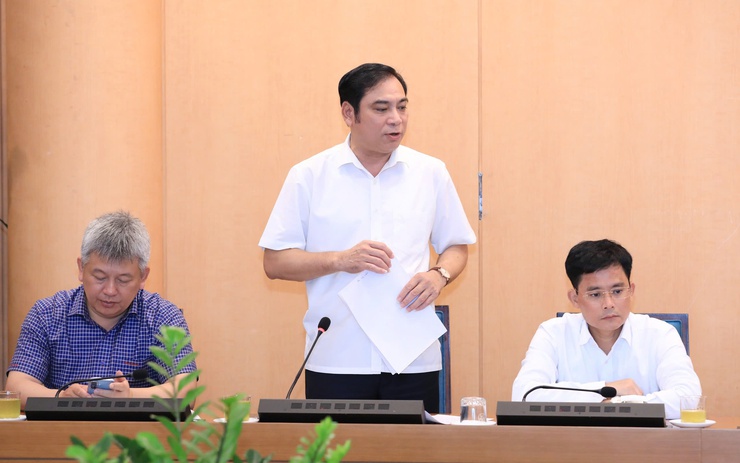 Dao Duy Phong, Deputy Director of the Hanoi Department of Construction, reports at the meeting
At the meeting, representatives from wards and communes, including Xuan Dinh, Kien Hung, Tay Tuu, Khuong Dinh, and Thien Loc, raised specific difficulties and proposed solutions related to site clearance and resettlement plans. Leaders from the Departments of Finance, Construction, and Agriculture and Environment directly addressed these concerns.
Accelerating progress to meet committed deadlines
In his concluding remarks, Chairman Vu Dai Thang acknowledged the strong consensus among local authorities, stressing the need for maximum effort during the final phase to ensure deadlines are met.
He noted that since the 18th Hanoi Party Congress, site clearance has received strong and consistent direction across the political system. Localities have mobilized resources and actively engaged residents to build consensus and hand over land for key projects.
 Chairman of the Hanoi People's Committee Vu Dai Thang delivers concluding remarks
Ring Road 2.5 and Ring Road 3.5 are critical transport corridors that must be completed soon to enhance regional connectivity and ease traffic congestion. The city praised the progress achieved so far, noting that most outstanding issues have been resolved or addressed with clear solutions.
In the coming period, Thang instructed local authorities to deploy resources and accelerate site clearance in line with committed timelines, aiming to complete many sections before May 15 and May 30, 2026. Priority will be given to public engagement and persuasion, ensuring social consensus.
Regarding policies and mechanisms, he directed departments to urgently resolve pending issues, particularly the approval of resettlement housing prices and the allocation of housing and land. "Progress must be accelerated so residents can quickly choose and settle into new homes," he stressed.
He also called for the planning and construction of resettlement areas to follow a modern approach, ensuring the living conditions are equal to or better than previous residences and avoiding infrastructure gaps between new urban areas and resettlement zones.
Project investors and management boards were instructed to begin construction immediately in areas where site clearance has been completed, preventing delays that could undermine public confidence.
For cases involving the relocation of businesses, factories, and industrial clusters, the city will study and issue appropriate support mechanisms to maintain production, employment, and livelihoods.
For large-scale developments such as the Olympic Sports Urban Area, the Chairman requested the development of specific policies for housing, resettlement, and social housing, ensuring systematic infrastructure and urban landscape.
In terms of implementation, the city will review and select capable investors while delegating authority to localities, with clear accountability attached. Independent site clearance projects are encouraged to create clean land for early construction.
As for social welfare, Thang instructed local authorities to pay special attention to vulnerable groups and disadvantaged households, ensuring timely support and preventing complex disputes during land recovery.
He praised the responsibility shown by local authorities and called for continued efforts to complete site clearance, contributing to infrastructure development and the socio-economic growth of the capital.