Vice Chairwoman of the Hanoi People's Committee Vu Thu Ha on the morning of October 29 worked with the Hanoi High-Tech College on its development plan to become a high-quality vocational institution and a national center for advanced training and practice.
Reporting to the Vice Chairwoman, Meritorious Teacher and Doctor Pham Xuan Khanh, Rector of the College, said the school was formed by merging the Hanoi College of Environmental Technology into the Hanoi High-Tech Vocational College and renamed the Hanoi High-Tech College in 2022.
The school operates as a self-financed public institution and currently has three campuses located in Xuan Phuong Ward, Thanh Xuan Ward and Tu Liem Ward.
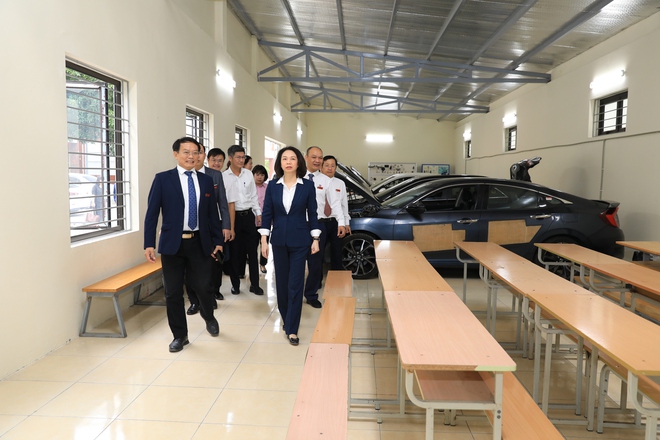
Overview of the visit.
The teaching staff consists of 220 lecturers and officers, including seven PhDs, five PhD candidates and 107 holders of master's degrees.
The College is offering training in 46 occupations. In the 2025–2026 academic year, enrollment includes 7,350 long-term students, in addition to around 1,000–1,500 short-term learners each year. More than 98 percent of students find employment within six months of graduation.
According to Doctor Pham Xuan Khanh, based on development orientations of the central government and Hà Nội, the College aims to become a high-quality institution by 2026 and a national center for advanced vocational training and practice by 2028.
The school is implementing full financial autonomy and will actively apply public–private partnership mechanisms to mobilize resources for facilities, equipment and training programs.
In terms of scale, the College plans to increase enrollment to 16,000–17,000 students and expand domestic and international recruitment. Ninety percent of training programs will be updated according to national qualification standards. The College will compile three to five new curricula in high-tech fields that integrate digital skills and green skills. At least 15 key occupations will be developed, including three to five with strong competitiveness in the region.
The College also plans to open new strategic training majors aligned with technological trends such as artificial intelligence, aviation engineering, semiconductor chip design and high-speed railway engineering.

Overview of the meeting.
To achieve these goals, the College requested additional investment from the City and Ministry of Education and Training for laboratories, practice equipment, a student dormitory, and public and transport facilities. It also proposed support for training and professional development of lecturers.
At the working session, representatives of departments and agencies exchanged opinions and contributed to completing the College's development plan.
Vice Chairwoman Vu Thu Ha emphasized the shared responsibility of departments, districts and related units in developing the Hanoi High-Tech College, which plays an important role in training high-quality vocational human resources for the capital. She requested strong coordination and decisive implementation of assigned tasks.
She stated that the College must meet all criteria of a high-quality institution while building a clear roadmap toward recognition as a national key vocational school. To do so, obstacles related to planning, facilities, and lecturer quality must be addressed.
Vice Chairwoman Vu Thu Ha requested the College to incorporate proposals from departments and add content related to innovation and scientific–technological development. The College must finalize its development plan in November this year.