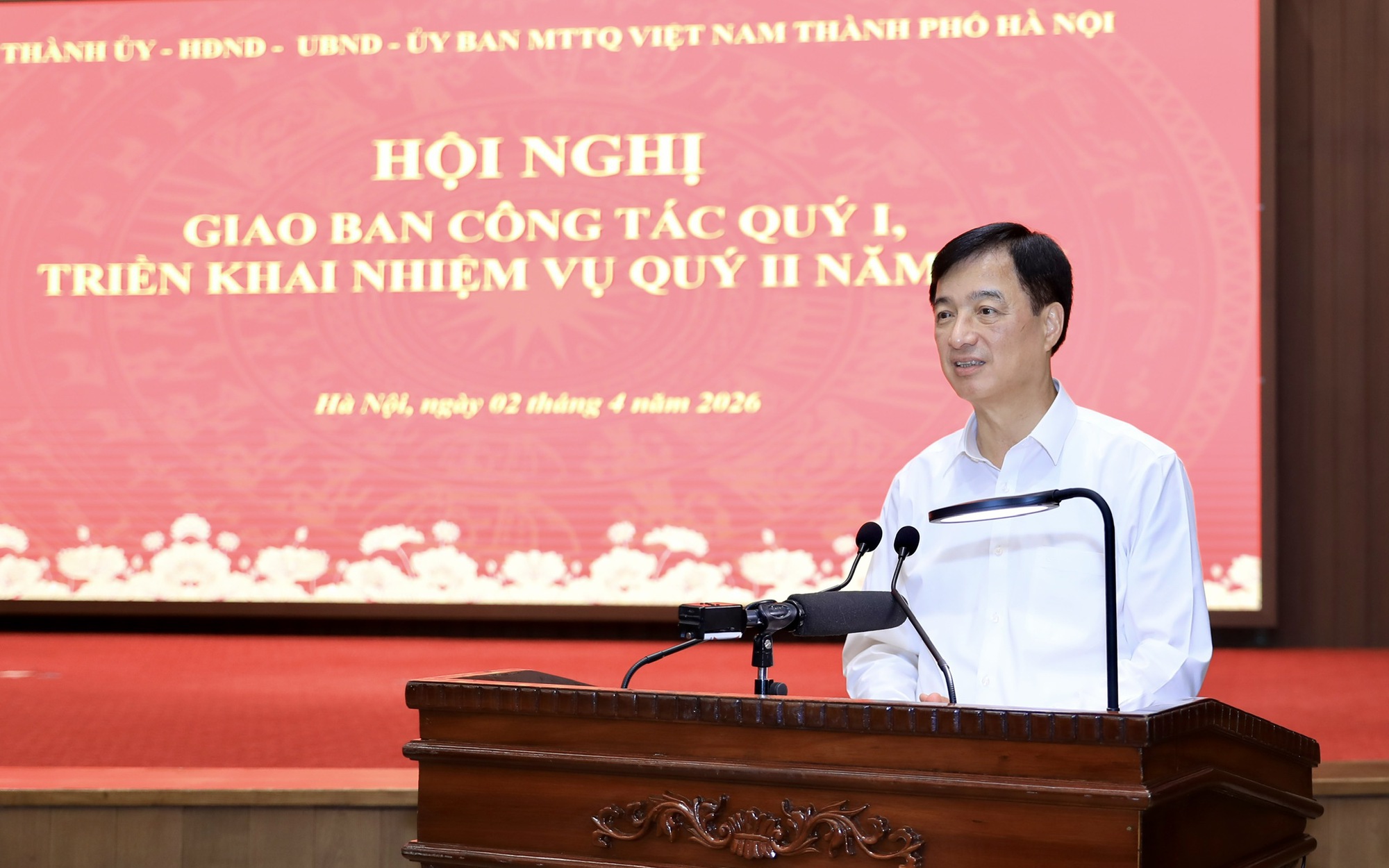
 Hanoi Party Secretary Nguyen Duy Ngoc delivers concluding remarks at the conference.
Speaking in his concluding remarks on the afternoon of April 2 at the first-quarter review conference and the deployment of second-quarter tasks for 2026, Politburo member and Secretary of the Hanoi Party Committee Nguyen Duy Ngoc stressed that the first quarter of 2026 marked historic and deeply proud milestones for the capital and the country.
For Hanoi in particular, he said, the city has now fully brought together the three strategic pillars of "Institutions - Planning - New Development Model" for the capital with a 100-year vision, clearly reflecting Hanoi's spirit of daring to think, daring to act, and daring to make breakthroughs, while building public trust, consensus, and participation.
Praising the efforts, determination, solidarity, and shared commitment of the entire Party organization, government, and people of the capital, Ngoc affirmed that everyone has the right to feel proud to have taken part in and seen their own role and contribution in the city's transformation.
He said this has added confidence and momentum for the city to keep moving forward, and that Hanoi must continue maintaining a high work pace and organize implementation faster, more decisively, and more effectively.
According to Ngoc, in the first quarter of 2026, the city achieved comprehensive and outstanding results in institutional and planning improvements, economic, cultural, and social development, defense and security, social order and safety, social welfare, Lunar New Year care, and improving residents' quality of life.
He said this is convincing evidence of the correctness of the city's chosen policies, direction, and methods of implementation.
Pointing to several shortcomings caused by subjective factors, such as limited leadership accountability, weak coordination among the "four pillars," and digital transformation that has not yet become substantive, Ngoc said the city has identified a clear principle: not blaming objective conditions, not avoiding responsibility, and looking directly at the truth in order to address problems effectively.
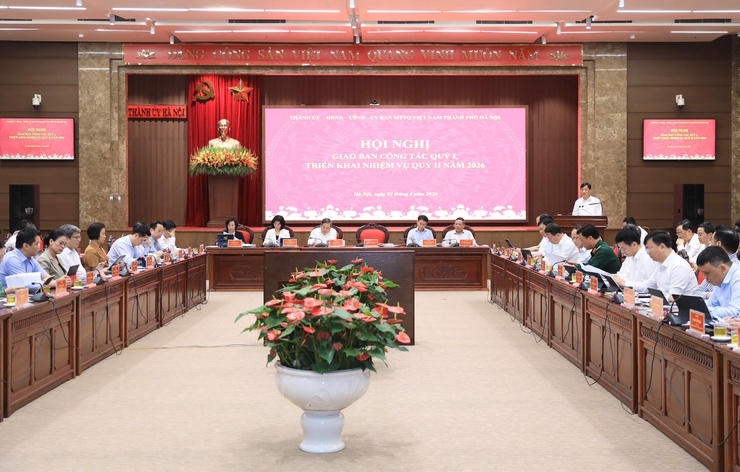 Conference overview.
Ngoc highlighted several lessons drawn from the final months of 2025 that should be carried forward into the second quarter, the whole of 2026, and the entire term.
First, he called for continued innovation in Party leadership methods, stronger accountability of leaders, and improved working styles under the spirit that "Hanoi says it and does it, does it quickly, does it correctly, does it effectively, and sees it through," as well as "understand deeply, act correctly, and follow through to the end."
He stressed the need to promote the role of Party secretaries as true "conductors" in leadership and administration, willing to take responsibility and stand at the forefront in driving the resolution of urgent, important, new, difficult, and unprecedented tasks.
Second, he called for improving leadership capacity and renewing implementation under the four-pillar model of the Party, the People's Council, the People's Committee, and the Fatherland Front from the city level to the grassroots level, following the principle of "six clear points and one unified line."
He also called for stronger decentralization and delegation of authority, faster disbursement of public investment, mobilization of all social resources, breakthroughs in strategic infrastructure, and acceleration of the capital's major strategic projects and those of the wider capital region.
These include the Red River Landscape Axis, the Olympic Sports Urban Area, seven Red River bridges, belt roads and radial roads, a high-quality medical complex, a mixed digital technology industrial park, and the development of multi-purpose urban areas and craft villages.
Third, he said the city must choose the right breakthrough point and act decisively while mobilizing the strength of the entire political system. The Hanoi Party Committee and the full four-pillar system have chosen site clearance as the proactive breakthrough point to unlock what he called "the bottleneck of all bottlenecks" in the development of the capital's infrastructure system.
Fourth, he called for renewing the mindset, methods, and organization of inspection and supervision, shifting from a "passive" approach to a "proactive" one, strengthening early warnings and prevention from the outset and from afar, under the principle that inspection and supervision should serve development.
He called for regular supervision from the stage when policies and decisions are first formed, weekly and monthly tracking of assigned tasks, timely removal of difficulties and obstacles for localities, and a move toward data-based supervision and real-time inspection.
Fifth, he said the lives and happiness of residents must always be placed at the center of every policy and every action. He stressed the importance of cultural and social development and ensuring social welfare and benefits.
The city, he said, must implement strategic and thematic resolutions of the central government in education, health care, culture, and social welfare in a synchronized manner with ambitious targets, ensuring that all residents of the capital benefit from development gains. He also called for organizing Lunar New Year activities with a new spirit and stronger momentum while enhancing the "Tet Hanoi" brand experience.
Sixth, he stressed the need to firmly and persistently maintain defense and security and social order and safety in connection with building a strong people-centered defense posture, and to ensure the city is never caught off guard in any situation.
He also called for building the capital's armed forces into a revolutionary, disciplined, elite, and modern force, protecting key targets, major projects, and important political events in the city.
He said foreign affairs and international integration should be further strengthened as increasingly important and regular work, carried out proactively and substantively to bring new resources and a stronger position to the capital.
"The city is moving in the right direction. A new working style and method across the four pillars has begun to take shape. As General Secretary To Lam assessed, Hanoi has clearly formed a new momentum, a new work pace, and a new sense of responsibility throughout the capital's political system. Public trust and expectations for the city's future development have risen, creating a strong ripple effect across the country," Ngoc said.
On that basis, in the very first days of the second quarter, in order to create a turning point for faster breakthroughs in the effective operation of the two-tier local government model, achieve double-digit growth, create substantive breakthroughs in science and technology, innovation, and digital transformation, and prepare well for the second phase of Inspection and Supervision Delegation No. 10 of the Politburo and the Secretariat, Ngoc called on the city's entire political system across the four pillars to focus on several key tasks.
First, he called for continuing strong innovation in leadership methods, tightening discipline and order, and strengthening the role of leaders across all four pillars of the city's political system. He said the city must follow the spirit of the General Secretary's directive on March 30, 2026: continue to promote a strong spirit of decisive work, maintain a high work pace, tighten discipline and order even further, and ensure that every policy and decision is implemented as quickly, decisively, and effectively as possible.
He also stressed the need to continue strengthening the role of leaders of Party committees, agencies, and units as true locomotives and centers of unity, willing to take responsibility and act for the common good. Each cadre and Party member, he said, must raise their own standards, create pressure on themselves to perform, take real-world results as the measure, and use public satisfaction as the evaluation criterion.
Party committees at all levels, he said, must truly serve as leadership cores and take the lead in shifting decisively from "administrative management" to "development creation and service." They must complete the working regulations of the new government apparatus before April 30, 2026, linked with the one-year review of the two-tier local government model, and effectively implement the project on "Improving the leadership capacity and fighting strength of Party committees at all levels and promoting the pioneering, exemplary, and responsible role of cadres and Party members, especially leaders, in the new era."
He also called for immediate and synchronized implementation throughout the political system of an OKR/KPI governance model on the HanoiWork digital workspace from April 2026, reduction of paperwork, conferences, and meetings, and a complete end to the practice of requiring both paper and electronic reports. Monthly evaluation of officials using modern OKR and KPI tools must be implemented in a substantive way, with strict handling of irresponsible officials.
Second, he called for decisive implementation of the action program for Resolution No. 02-NQ/TW of the Politburo and for the revised Capital Law to be detailed in practice immediately after promulgation, along with phased implementation of the capital's master plan with a 100-year vision. Standards, norms, pricing frameworks, and technical regulations serving the implementation of the revised Capital Law and the 100-year plan should be issued in the second quarter of 2026. A dedicated task force should also be established while mobilizing public and social participation in supervision.
Third, he said the city must remain persistent and resolute in not retreating from the target of GRDP growth of 11 percent or more in the second quarter and for the full year, in line with "four principles," and must focus on the following knots and bottlenecks: boosting public investment disbursement at the commune and ward levels, accelerating strategic infrastructure projects, urgent projects, and multi-purpose urban areas, striving to complete budget revenue and public investment disbursement plans within the first nine months of 2026, and immediately building and implementing measures to stimulate growth, investment, and consumption.
He also called for using the new institutional and planning framework to create momentum for high-quality growth and major restructuring of the economy, and for accelerating the implementation of Resolution 57-NQ/TW with a focus on strategic industries, core technologies, high technology, and sectors with high added value and export value, with Hoa Lac High-Tech Park as the center.
Fourth, he called for stronger and more substantive decentralization and delegation of authority linked with administrative reform and comprehensive digital transformation. The Immediate implementation of decentralization and delegation across the political system must be completed before April 30, 2026.
He also called for removing administrative bottlenecks, especially in land matters, including transferring functions from land registration offices to the commune level, restructuring land-related administrative procedures, and implementing the "Land-Use Right Certificate Handed Directly to Residents" project, with 100 percent of applications completed fully online before April 30, 2026.
Fifth, he called for concentrating resources to accelerate strategic and key projects, especially the Red River Landscape Axis, the Olympic Sports Urban Area, seven Red River bridges, urban railway projects, belt roads 1, 2.5, 3, 3.5, and 4, radial roads, and multi-purpose urban areas. The city must also complete investment procedures and begin construction on projects implemented under Resolution No. 258/2025/QH15.
It must completely address 342 delayed budget-funded projects and 420 delayed non-budget projects during the second quarter of 2026. He also called for coordination with the Ministry of Construction to promote the policy of leading investment in Belt Road 5 and the route connecting the Vietnam National Village for Ethnic Culture and Tourism to Ba Vi National Park within 2026.
Sixth, he called for a real breakthrough in solving five major bottlenecks. Emergency flood prevention projects must be completed on schedule. AI cameras should be expanded, and monitoring camera centers should be established in 100 percent of communes and wards.
The city must also speed up the handling of 418 redundant office facilities and public assets left after administrative restructuring, under the firm principle that once there is a plan, there must be a deadline for completion, and once a receiving agency has been designated, the assets must be handed over and put into use immediately.
"The tasks and responsibilities now facing the city Party organization and the full four-pillar system are enormous. This requires Party leaders to truly immerse themselves in new, major, and difficult work in order to find a path, open the way, create development, and better serve residents and businesses," Ngoc said.
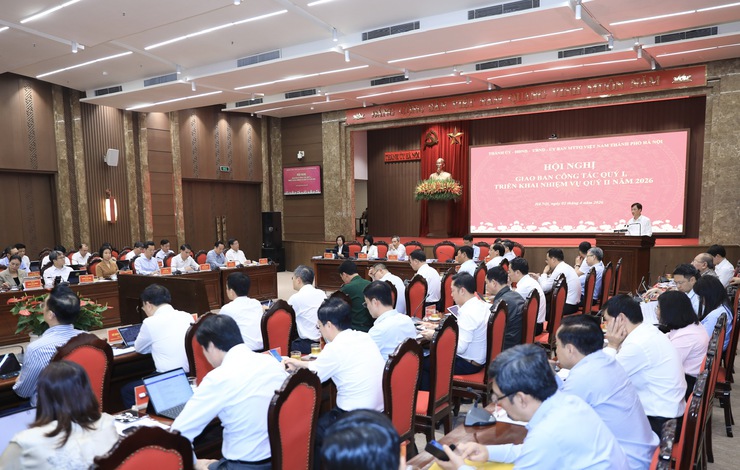 Delegates attend the conference at the Hanoi Party Committee headquarters.
Immediately after the conference, Nguyen Duy Ngoc requested that Party committees, Party organizations, the political system of Hanoi, agencies, units, and every level and sector deeply internalize and effectively implement the "three strategic pillars," promote double-digit growth under the spirit of "understand correctly, act immediately, and follow through to the end," and urgently develop implementation plans with clear roadmaps, specific task assignments, and accountability attached to each individual.
He also called for clearly assigning responsibility to the head of each pillar, each Party committee, each department and agency, and each commune and ward for each specific task, while strengthening inspection, supervision, urging, and progress tracking across the four pillars and combining them with surprise inspections to assess implementation in a substantive way.
"2026 and the entire 2026-2030 term are of decisive importance in turning the 100-year vision into reality so that Hanoi can develop to its full stature and meet the trust and responsibilities entrusted by the central government, the trust and expectations of the people of the capital, and of compatriots across the country. I firmly believe that by drawing on its glorious tradition, its pioneering spirit, its exemplary role, and its example for the whole country, the Party organization, government, and people of the capital will fully live up to the spirit: Hanoi says it and does it, does it correctly, does it quickly, and sees it through to the end. We will be worthy of being the cultured and heroic capital of the country," Ngoc emphasized.