Standing Member of the Hanoi Party Committee and Permanent Vice Chairman of the Hanoi People's Committee Duong Duc Tuan on the morning of January 14 presented a report proposing amendments to the Capital Law No. 39/2024/QH15 at the Fourth Conference of the Executive Committee of the Hanoi Party Committee.
The proposal aims to complete a distinctive legal framework, strengthen decentralization and delegation of authority and create breakthrough momentum for the capital's rapid and sustainable development.
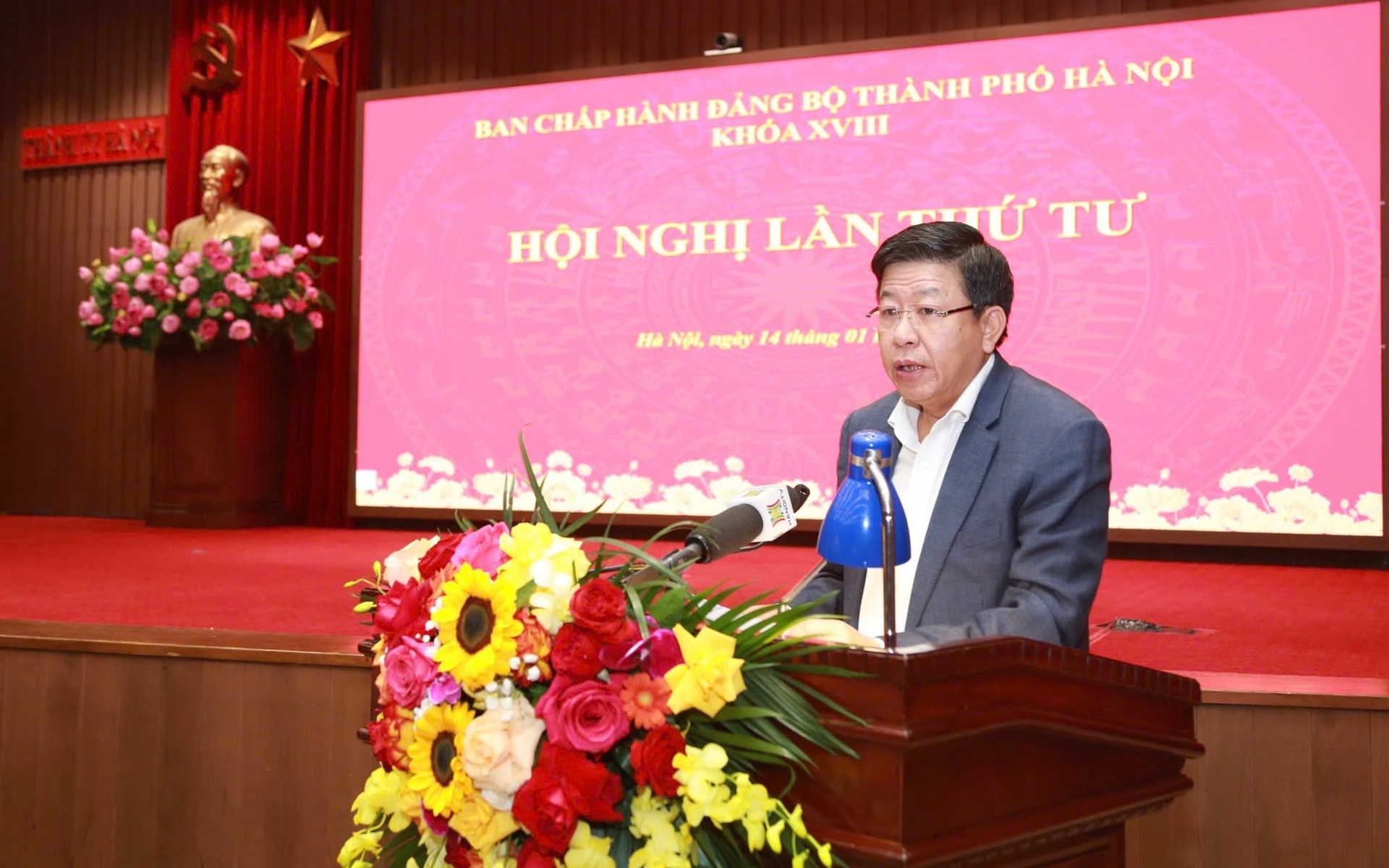
Permanent Vice Chairman of the Hanoi People's Committee Duong Duc Tuan at the meeting.
At the meeting, Tuan said that in practical terms, the recent reorganization of city agencies and units, together with the implementation of the two-tier local government model, has had a significant impact, fundamentally changing organizational structures and the mechanisms for decentralization and delegation among levels of government.
The 2024 Capital Law included many distinctive mechanisms and policies at the time of its promulgation. However, since then, numerous laws and National Assembly resolutions have been issued with new legislative perspectives and approaches. Many of these introduce more open and enabling mechanisms and contain provisions that affect or amend the Capital Law.
In addition, several National Assembly resolutions piloting special mechanisms and policies for localities and specific projects have been revised and supplemented with highly favorable and innovative provisions. These introduce new issues that require study and selective adoption to align with the capital's development trajectory in the new period.
The 2024 Capital Law was not designed as a long-term, stable "framework law" capable of anchoring the capital's superior mechanisms against changes in general legislation. As a result, many provisions that were once distinctive have quickly become generalized, blurring the boundary between mechanisms specific to the capital and those applied nationwide.
This has a complicated legal application and directly affected the drafting of implementing documents for the Capital Law by the city.
Provisions of the Capital Law remain constrained by a uniform management mindset under general legislation and do not yet allow the capital to proactively pilot and test new models, mechanisms and policies, particularly in urban governance, innovation and digital transformation. The lack of controlled pilot mechanisms has reduced the capital's ability to respond swiftly to emerging policy challenges.
For these reasons, issuing a revised Capital Law to define distinctive and superior provisions with long-term viability is essential. Such a law would create a favorable and breakthrough institutional framework to guide the construction and development of the capital in line with the capital master plan, with a 100-year vision and a new resolution to replace Resolution No. 15-NQ/TW in the context of new national and capital development requirements.
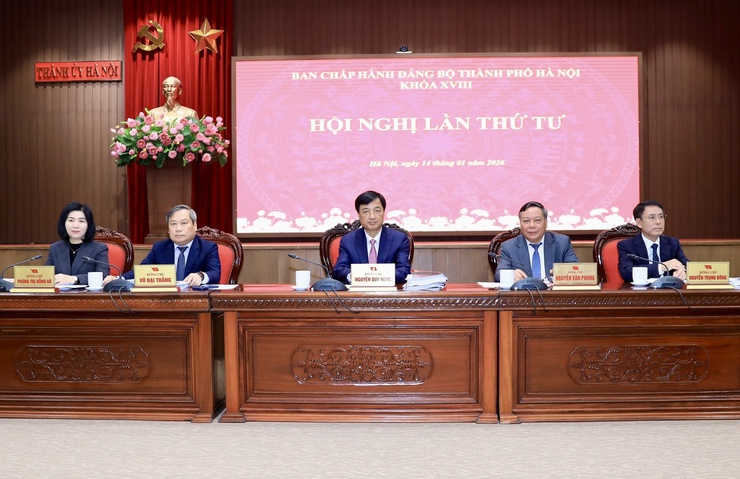
Hanoi leaders during the meeting.
Based on a comprehensive assessment, the Party Committee of the Hanoi People's Committee has identified the objective of amending the Capital Law as completing a special, superior, stable and long-term institutional framework that matches Hanoi's unique position, role and characteristics.
The revised Capital Law aims to establish a legal framework enabling the capital to fully perform its role as the nation's political and administrative center; a major hub for the economy, culture, science and technology and innovation; and a core growth engine for the northern region and the country as a whole.
The guiding principle of the draft law is "greater empowerment, more comprehensive decentralization and delegation and clearer accountability." Amending the Capital Law is not solely Hanoi's responsibility but a shared task of the National Assembly, the Government and central ministries and agencies to remove legal bottlenecks and ensure consistency and coherence across the legal system.
According to Tuan, the proposed revised Capital Law is expected to comprise five chapters and 41 articles, institutionalizing four groups of mechanisms and policies with 31 specific mechanisms.
"The focus is on affirming the capital's distinctive legal status and the priority application value of the Capital Law within the legal system while continuing to strongly decentralize authority to the city government in areas such as organizational structure, staffing, remuneration and policies to attract and utilize high-quality human resources," said Tuan.
Regarding authority, the draft law further delegates broad and comprehensive powers to the capital to proactively decide and take responsibility across multiple fields. These include decisions on organizational structure, staffing, salaries and income and policies for developing, attracting and using high-quality human resources.
At the same time, the city would be empowered to develop and issue institutional frameworks and policies. Hanoi would be allowed to submit draft laws and National Assembly resolutions and to issue detailed regulations for implementing other laws and National Assembly resolutions that differ from Government and central ministry regulations.
The city would also be permitted to pilot mechanisms that differ from existing laws or National Assembly resolutions or that are not yet regulated by law.
The city would gain greater autonomy over budget revenue and expenditure structures, credit decisions and the establishment of financial funds to serve development investment. Comprehensive authority would be granted to the city in approving investment projects, selecting investors and contractors and adopting flexible and streamlined investment disbursement mechanisms. The city would also be empowered to decide on forms of socialization, public-private partnerships and new mechanisms for exploiting public assets, works and infrastructure.
In parallel, the city would be authorized to proactively issue mechanisms for managing, using and exploiting forest resources, water resources and other resources and to decide land-use structures, conversion of agricultural and other land, land readjustment measures, compensation, support and resettlement and land allocation and leasing.
In governance and development, the draft law emphasizes modern capital governance based on digital technology, big data and artificial intelligence, alongside simplified administrative procedures and a strong shift from ex-ante to ex-post controls.
The city would be empowered to proactively issue new development mechanisms, policies and models in science and technology, education and training, healthcare, culture and social welfare and to apply international standards and issue its own standards suited to the capital's development needs.
An important point highlighted in the report is ensuring alignment between the revised Capital Law, the capital master plan with a 100-year vision and a new resolution replacing Resolution No. 15-NQ/TW.
The law's mechanisms and policies are designed to institutionalize major viewpoints, objectives and solutions for developing a green and smart city oriented toward public transport, urban conservation and renewal, transport infrastructure development and the preservation and promotion of the capital's cultural values.
The revised Capital Law also seeks to clearly shape institutions for coordinated development across the Capital Region, the Red River Delta and the Northern Midlands and Mountainous Region, with Hanoi as the core and coordinating center.
Proposals include establishing a Capital Region Development Coordination Committee and a regional development fund to mobilize, allocate and coordinate resources for inter-regional programs and projects and to address cross-regional issues such as infrastructure, the environment and food safety.
Regarding the legislative roadmap, Tuan said the Hanoi People's Committee has worked closely with the Ministry of Justice and relevant agencies to establish a drafting committee and organize numerous meetings, workshops and consultations with Party and State leaders.
Under the plan, the revised Capital Law will be submitted to the National Assembly for consideration and adoption in 2026, with submission for approval expected in April 2026 and subsequent review and finalization of the draft during the session.