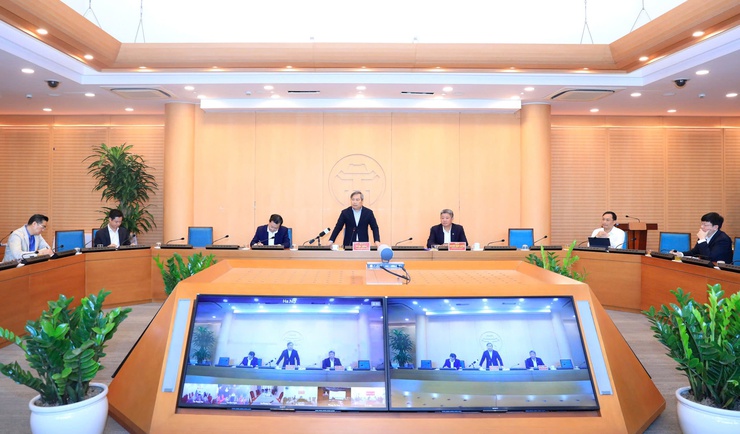
The meeting was held in person and online with communes and wards. Photo: Le Hai
Also attending were Nguyen Manh Quyen, Member of the Standing Committee of the Hanoi Party Committee and Vice Chairman of the Hanoi People's Committee, along with leaders of several city departments, boards and agencies.
Making the most of more than 1,300 traditional craft villages
Reporting on the management and development of craft villages across the city, Director of the Hanoi Department of Industry and Trade Vo Nguyen Phong said Hanoi currently has a large and diverse craft village system that makes an important contribution to the capital's socio-economic development.
The city now has 1,350 villages with crafts and traditional crafts, of which 337 craft villages, traditional craft villages and traditional crafts have been officially recognized by the city, including 269 craft villages, 61 traditional craft villages and 7 traditional crafts.
Hanoi's craft villages operate in six groups of trades, including the processing and preservation of agricultural, forestry and fishery products; handicraft production; the production of wood products, rattan and bamboo goods, ceramics, textiles and garments and small-scale mechanical products; the production and trading of ornamental plants and creatures; the processing of raw materials for rural industries; and services supporting rural production and daily life.
Each craft village has its own identity and produces many unique, sophisticated products rich in traditional cultural value.
Revenue from craft villages across the city is estimated at more than VND25,000 billion (US$980.4 million) a year, creating jobs for around 800,000 workers. Hanoi's handicraft products have been exported to 89 countries and territories, including traditional markets such as the United States, the EU, Japan, Taiwan (China), South Korea, China and Hong Kong (China).
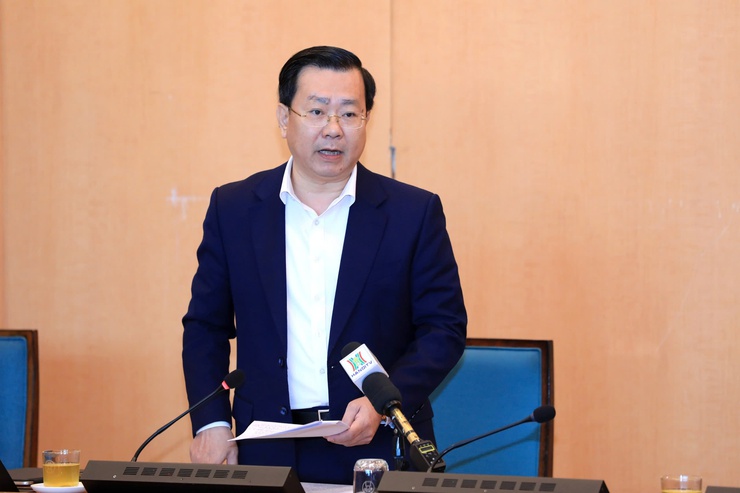 Director of the Hanoi Department of Industry and Trade Vo Nguyen Phong reports at the meeting. Photo: Pham Linh
In addition, 100 craft villages and villages with crafts now have OCOP products. Of the city's total 3,463 OCOP products, 929 are craft village products rated three stars or higher. The city also has 415 artisans, including 19 People's Artisans, 72 Meritorious Artisans and 324 Hanoi Artisans, who play a core role in preserving and developing traditional trades.
According to Phong, in the coming period, the city will continue effectively implementing policies to support rural industries while building a pilot "green craft village" model in 10 villages, tied to digital technology applications, environmental monitoring and the promotion of e-commerce.
At the same time, Hanoi will step up branding and trademark protection for craft villages and introduce product traceability and quality standards linked to environmental protection and circular economy development.
The city is also focusing on developing craft villages in connection with rural tourism and creative, experiential tourism, thereby creating sustainable livelihoods for local residents.
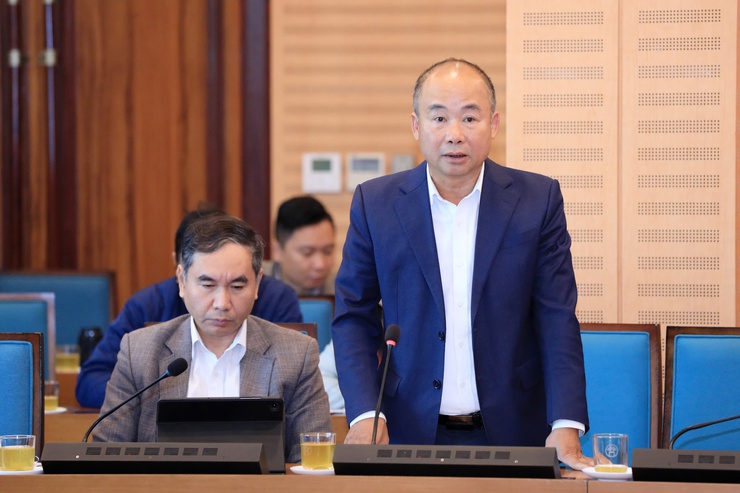 Nguyen Dinh Hoa, Deputy Director of the Hanoi Department of Agriculture and Environment, reports at the meeting. Photo: Le Hai
"Developing Hanoi's craft villages in a sustainable, modern direction while preserving and promoting traditional cultural values is our consistent goal. In the 2025–2030 period, the city aims for craft village production value to grow by about 10% a year on average," Director of the Hanoi Department of Industry and Trade Vo Nguyen Phong said.
Building a synchronized and modern industrial cluster system
Reporting on the management and development of industrial clusters across the city, Phong said Hanoi is stepping up the management and development of industrial clusters to meet socio-economic development needs and create production land for businesses.
Industrial cluster management in the city follows a clearly defined decentralization framework. The Hanoi People's Committee decides on the establishment, expansion, or adjustment of industrial clusters, while the Department of Industry and Trade leads appraisal and advisory work. Meanwhile, commune and ward authorities propose the establishment and expansion of clusters and oversee their operations at the local level.
Hanoi currently has 75 operating industrial clusters covering 1,469 hectares, including 70 clusters established before 2018 with a total area of 1,427 hectares and 5 clusters established during 2018–2020 with a combined area of 42 hectares.
In addition, 80 industrial clusters are under implementation, covering a total of 2,755 hectares, including 1 cluster established before 2018, 26 established during 2018–2020 and 53 launched since 2020. The city is also studying plans for 43 more industrial clusters with a total area of 3,072 hectares.
According to Phong, in the past, industrial cluster development mainly stemmed from local demand. Many clusters were small in scale, had incomplete infrastructure and were located within residential areas, creating management difficulties, especially in environmental treatment, fire prevention and firefighting and construction order management.
Since the Government issued new regulations on the management and development of industrial clusters, the city has improved its management mechanisms, issued specific regulations, and strengthened planning reviews to ensure that industrial clusters develop with synchronized technical infrastructure, sufficient land area, and proper production conditions.
New industrial clusters are required to complete infrastructure systems, including internal roads, water supply and drainage, wastewater treatment, solid waste treatment, electricity supply, telecommunications, and full compliance with fire safety and environmental protection requirements.
The city has also advised on the planning of 198 industrial clusters, with a total area of 7,296 hectares to create land reserves for industrial and handicraft production in line with the capital's development orientation.
In the coming period, the Department of Industry and Trade will continue reviewing planning, reclaiming land from delayed or inefficient projects to reallocate it to capable investors and accelerating the establishment and infrastructure construction of industrial clusters.
The city is orienting cluster development toward a green, modern, sustainable, ecological and smart model linked to attracting high-tech, green-tech and low-carbon-emission industries.
"The development of industrial clusters will help create production infrastructure space, attract investment, promote economic restructuring toward a higher share of industry and services and contribute to the city's target of GRDP growth of over 11% in 2026 and the following years," Phong said.
Reorganizing craft village production and promoting industrial clusters
After hearing comments from departments, agencies and commune and ward authorities, Vice Chairman of the Hanoi People's Committee Nguyen Manh Quyen said at the meeting that, following instructions from city leaders, the Department of Industry and Trade had been assigned to take the lead and work with the Department of Agriculture and Environment and related units to prepare a report on the development of craft villages and industrial clusters. After the meeting, the agencies will continue refining the report, especially the parts related to planning, production organization and labor use in craft villages.
According to Quyen, Hanoi has a unique craft village system that has been highly regarded by international organizations. Since the Covid-19 pandemic, especially from late 2022 onward, the city has focused on promoting craft village development toward the regional and global market.
Hanoi has invited the World Crafts Council to work with the city and has also cooperated with international universities to support product design and expand consumer markets.
Over the past two years, more Hanoi craft villages have been recognized as members of the World Crafts Council. In 2024, Bat Trang and Van Phuc were recognized. In 2025, Chuyen My and Son Dong followed. "This is the right direction and it should continue to be promoted," Quyen stressed.
Alongside these achievements, Quyen said many craft villages in the past developed spontaneously, were interwoven with residential areas and carried environmental pollution risks. The city is gradually reorganizing production, as seen in Quang Phu Cau incense village, which, after restructuring, has become an attractive tourism destination.
Regarding industrial cluster development, the city is oriented toward relocating production facilities out of residential areas. Under regulations, craft village industrial clusters must reserve at least 60% of their land area for traditional trades, while the remaining 40% may attract other businesses. The capital's industrial clusters are being developed under the direction of being "bright, green, clean, beautiful and fragrant."
The city is also promoting craft village tourism with design and creative centers in each locality. For example, Trach Xa ao dai tailoring village is developing a design room model using 4D technology.
"In the coming period, the city requires departments and agencies to urgently complete the relevant legal documents while proactively guiding businesses in implementing industrial cluster projects and reviewing planning to create livelihoods for residents during the urbanization process," Quyen said.
Developing craft villages and industrial clusters in line with the capital's planning
Giving directions at the meeting, Chairman of the Hanoi People's Committee Vu Dai Thang stressed that this is an important issue, directly tied to people's livelihoods and the development of rural and not-yet-urbanized areas of the capital in the coming period.
In drafting the capital's master plan with a 100-year vision, the city has focused heavily on urbanization, the development of growth poles and development corridors and the use of industry, science and technology and digital transformation as growth drivers. However, these orientations are mainly concentrated in urban and central areas.
Meanwhile, with an area of about 3,300 square kilometers and only nine growth poles, Hanoi still has many areas designated as reserve zones, green zones or areas intended to preserve traditional cultural space. For that reason, the city needs to continue developing models suited to rural characteristics, including craft villages and industrial clusters.
Thang said Hanoi has a very rich craft village system, especially in the former Ha Tay area, home to many craft villages well known both nationally and internationally. These craft villages carry not only economic value but also strong cultural and traditional significance and a high degree of community-based production. Therefore, preserving and developing craft villages remains a long-standing policy of the city.
However, craft village production also has limitations, including small scale, low production capacity, high skill requirements and difficulty ensuring the same level of uniformity as industrial production. Environmental issues in many craft villages also require tighter management.
From that reality, the city has adopted a policy of relocating craft village production into handicraft industrial clusters, separating production areas from residential areas to form concentrated production zones with synchronized infrastructure and wastewater and solid waste treatment systems. Several localities have already implemented this model with initially positive results.
Regarding industrial clusters, Thang said they are smaller in scale than industrial parks and focus on attracting small and medium-sized enterprises, local businesses and especially production facilities developed from traditional trades. However, compared with the capital's potential, the industrial cluster system remains rather modest.
The city currently has 75 operating industrial clusters covering nearly 1,500 hectares, including 70 established before 2018. In addition, around 80 others are in the process of investment preparation or site clearance, including 46 undergoing appraisal procedures and investor selection.
The Chairman asked departments and agencies to clearly assess the operating efficiency of the 75 existing industrial clusters, especially the number of businesses, production value, number of workers and workers' income, in order to clarify this model's contribution to local economic development and job creation.
According to Thang, in the context of implementing the capital's long-term master plan, it is necessary to continue affirming the role of industrial clusters as important production spaces for small and medium-sized enterprises, supporting industries and local production facilities. These are also places where household-based production in villages can be shifted into concentrated production zones, helping address environmental issues.
Thang also asked local authorities, especially commune-level governments, to pay attention to reviewing demand for craft village and industrial cluster development and to ensure these contents are integrated into the capital's overall planning.
At the same time, once industrial cluster projects have been approved, he said authorities must focus on site clearance, infrastructure completion and environmental treatment so the projects can quickly go into operation and create conditions for businesses to start production.
"Developing craft villages and industrial clusters not only creates production space but also helps generate jobs, raise incomes and enable rural workers to grow the economy right in their own localities," the Chairman stressed.