At the meeting, the Party Secretaries of Phuc Tho, Hat Mon and Phuc Loc communes reported on their local performance.
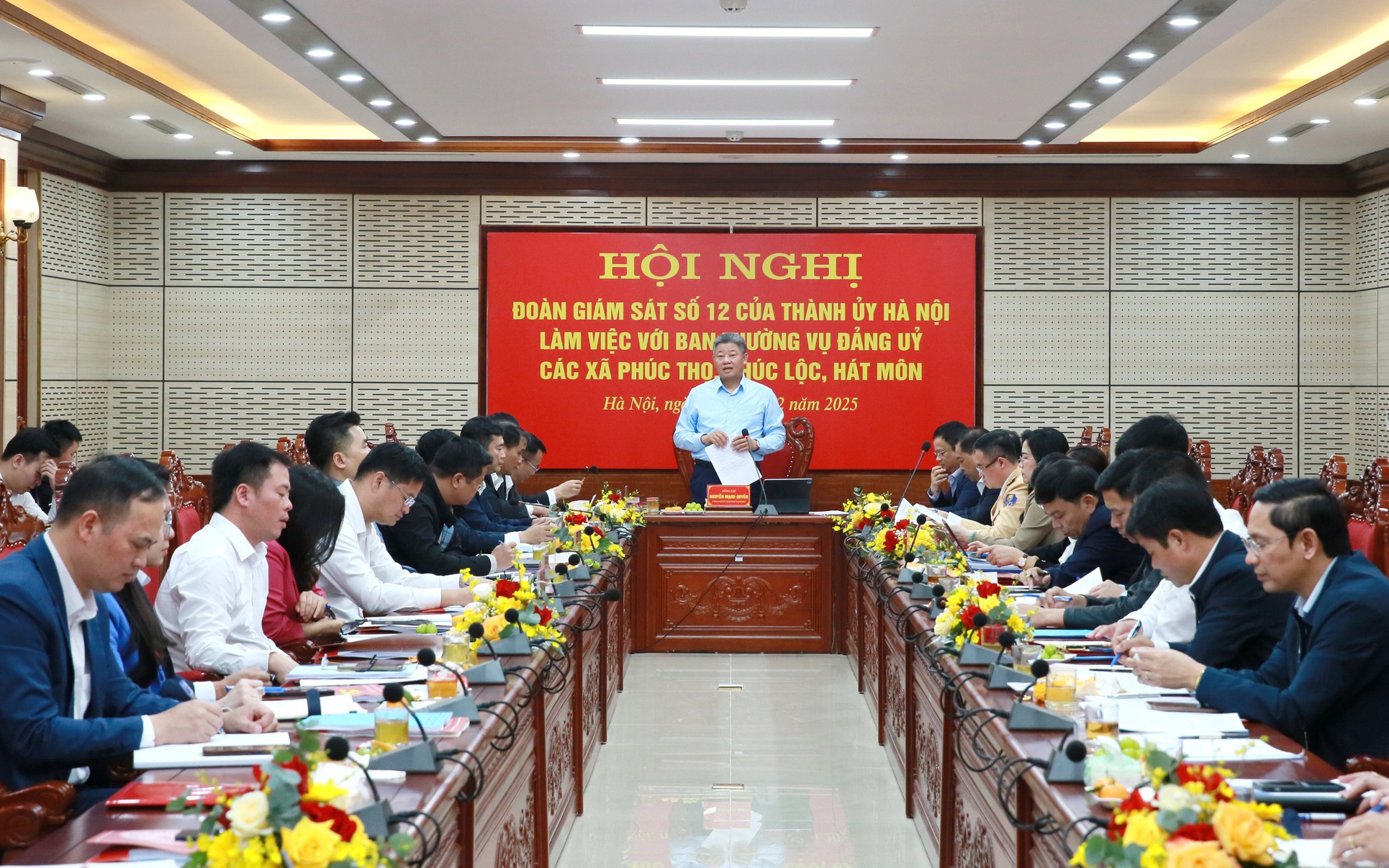
Overview of the meeting.
After shifting to the two-tier local government model, Phuc Tho, Phuc Loc and Hat Mon Party Committees focused on reorganizing their administrative structures and assigning civil servants according to the delegated functions and duties.
Key directives, resolutions and work programs were fully disseminated and plans for each sector were issued on time, which helped the political system operate in a coordinated and effective manner.
Political security and social order have been maintained, and socio-economic conditions continued to improve. Several major targets for 2025 have been met or exceeded. Hat Mon Commune surpassed four of its eleven targets, including total state budget revenue, the reduction of underweight children under five years old, the share of households recognized as cultured families and the number of villages maintaining the cultured village title.
Alongside these results, localities also highlighted existing challenges. Phuc Tho Commune faces a shortage of civil servants, especially in highly specialized fields such as information technology, healthcare and education.
Some staff transferred from the commune level to new roles still lack capacity, while workloads have increased because many duties were previously handled at the district level. Most medical staff hold intermediate qualifications and the shortage of doctors affects primary healthcare quality.
The commune asked the city to assign experienced officials to support digital transformation and strengthen the health station and to consider defining unified qualification requirements for party cell secretaries and village heads, while adding personnel for the communal military command.
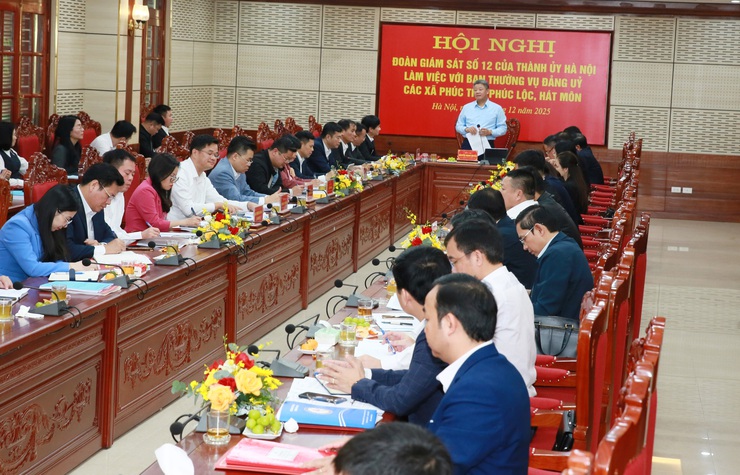
Delegates at the meeting.
Hat Mon Commune's biggest challenge relates to site clearance. The commune asked the city to issue simplified procedures for small projects under commune authority and shorten the posting period for compensation maps and plans.
Due to large infrastructure needs and limited local resources, Hat Mon also requested flexible funding support for site clearance. The commune proposed being authorized to prepare a concept proposal for the Cam Dinh – Hiep Thuan canal embankment road, which would connect to the Hat Mon Temple national relic and asked for a drainage and wastewater project in the 2026–2030 period.
Phuc Loc Commune asked the city to continue granting full authority to the communal People's Committee to approve investment proposals and public investment projects and to adjust public investment plans to improve flexibility in capital use.
The commune also requested swift approval of the Red River flood control plan to create a legal basis for eco-tourism investments along the river and asked for permission to auction small land lots, with the commune allowed to retain all proceeds to provide counterpart funding for infrastructure projects.
According to Phuc Loc Party Secretary To Van Sang, the commune has more than 10 kilometers of Red River frontage with rich agricultural and alluvial advantages that require an appropriate mechanism for effective development.
During the discussion, members of Supervisory Delegation No. 12 commended the quality of the communes' reports. They analyzed each thematic area in detail, identifying achievements and remaining gaps. The delegation requested the communes to supplement information so the final summary report for the City Party Committee can be completed.
In his concluding remarks, Vice Chairman Nguyen Manh Quyen acknowledged the proactive and committed approach of the three communes during the implementation of the two-tier local government model. He said this is an important stage to test the model in practice and draw lessons for more effective implementation.
He emphasized that the two-tier model is the right direction and has proven effective in reducing administrative layers and increasing local autonomy. He said staff must adopt new thinking and creative methods to achieve the best results.
Vice Chairman Nguyen Manh Quyen noted that central and city authorities are continuing to assess and study options to choose the strongest and most suitable model for local governance.
He asked the communes to continue performing the tasks under the eight supervisory themes and to persist in implementing planning, especially in agriculture where Hanoi aims to build a high-quality, multi-purpose production model linked to experiential tourism.
He also asked the three communes to maintain environmental sanitation, avoid interruptions in waste collection and strive for public investment disbursement of at least 95 percent by year-end. The communes should proactively review and list projects requiring site clearance and track progress closely while addressing pressing community issues such as construction order, traffic congestion and flooding.
Vice Chairman Quyen stressed that unity and consistency within the grassroots political system will determine the effectiveness of the new model. He said the communes must remain proactive, flexible and ready to propose solutions that meet the demands of this new stage.