The event holds special significance for the Party organization, authorities and people of O Dien Commune and the former Tong Goi area, marking the community's persistent efforts to preserve, transmit and promote traditional cultural heritage values.
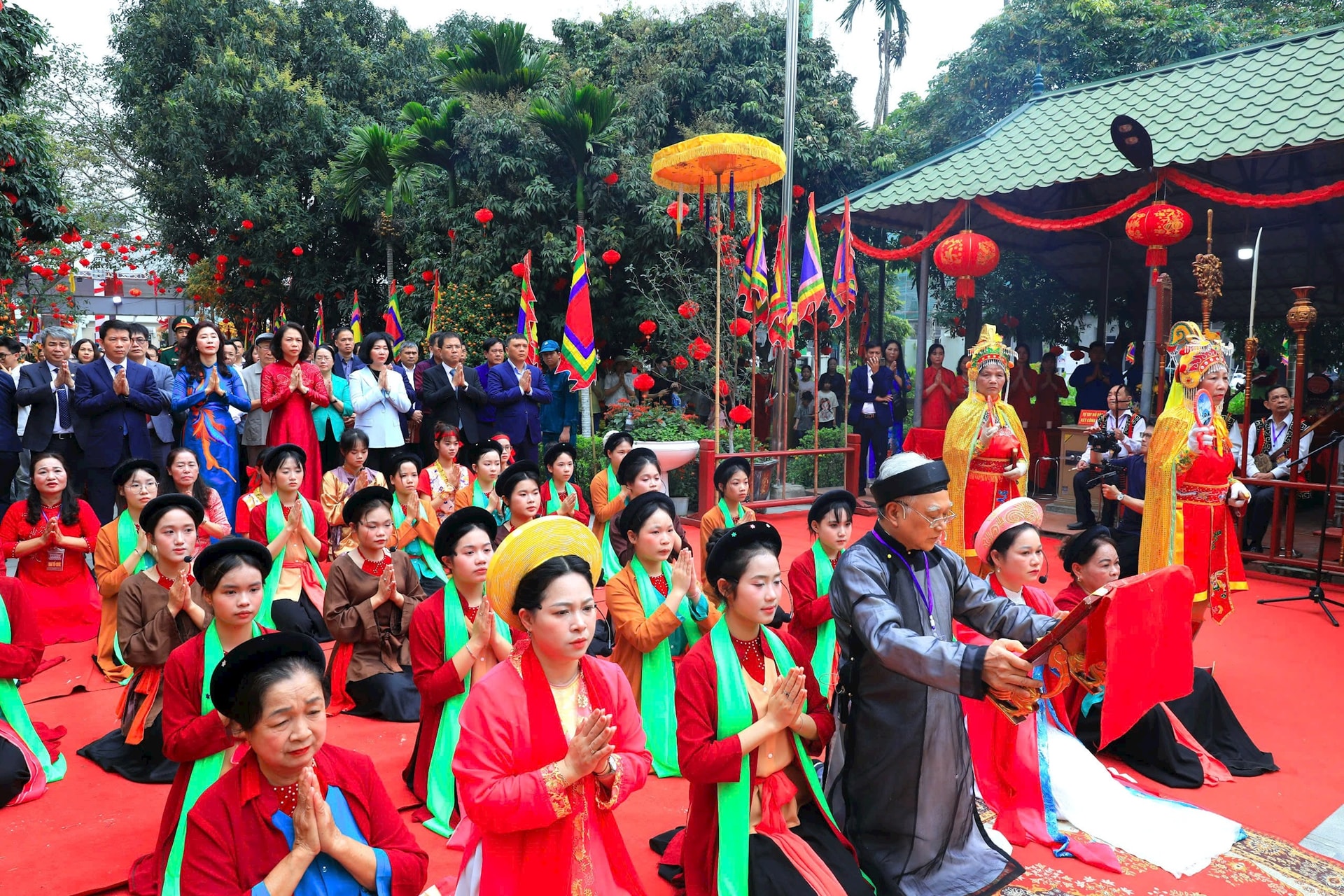 City leaders and residents of O Dien Commune offer incense at Van Son Mausoleum.
Attending the ceremony were Phung Thi Hong Ha, Deputy Secretary of the Hanoi Party Committee and Chairwoman of the Hanoi People's Council, and Vu Thu Ha, Vice Chairwoman of the Hanoi People's Committee.
Tong Goi, also known as Coi Son, is an ancient land dating back to the early Common Era, once part of Chu Dien Commune. After many administrative changes, it is now O Dien Commune. Enriched by the alluvium of the Red River and Nhue River, the area formed an early and prosperous community engaged in wet rice cultivation, weaving, blacksmithing and river trade.
According to Bui Thi Thu Hang, Vice Chairwoman of the O Dien Commune People's Committee, Tong Goi is not only rich in production traditions but also known for its academic heritage. Four scholars from the area earned doctoral degrees in the 15th and 16th centuries and are recorded at the Temple of Literature. The land also has a strong revolutionary tradition and once served as a stop for the Capital Regiment after 60 days and nights of fighting to defend Hanoi in the early days of the national resistance war.
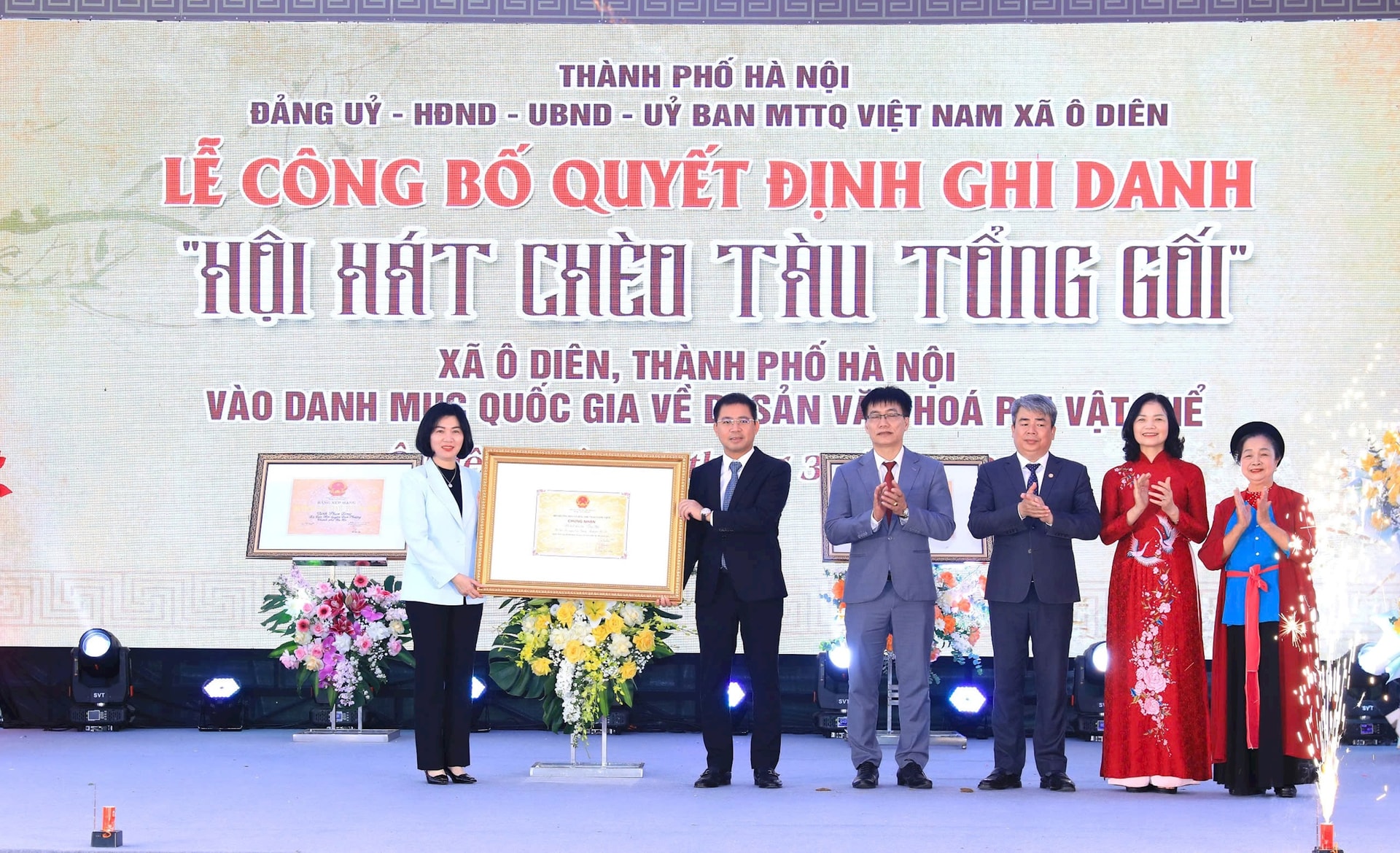 Deputy Secretary of the Hanoi Party Committee and Chairwoman of the Hanoi People's Council Phung Thi Hong Ha presents the inscription decision to representatives of O Dien Commune.
Throughout its long history, General Van Di Thanh, the tutelary deity worshiped locally, holds a special place. According to legend, he was born in 1380 and died in 1416 during the resistance against the Ming army under the reign of Tran Trung Quang. Villages including Thuong Hoi, Thuy Hoi, Phan Long and Vinh Ky built mausoleums and communal houses in his honor. Feudal dynasties conferred upon him the title of Superior Deity with many noble designations.
From the worship of the tutelary deity and folk singing traditions, the people of Tong Goi created Cheo Tau singing, also known as Tau Tuong singing, a folk performance art distinctive to the northern delta.
The Cheo Tau festival was first held in 1683 from the 15th to the 21st day of the first lunar month. According to custom, a grand festival was organized every 20 to 25 years in years of abundant harvest. The last festival under the feudal period took place in 1922.
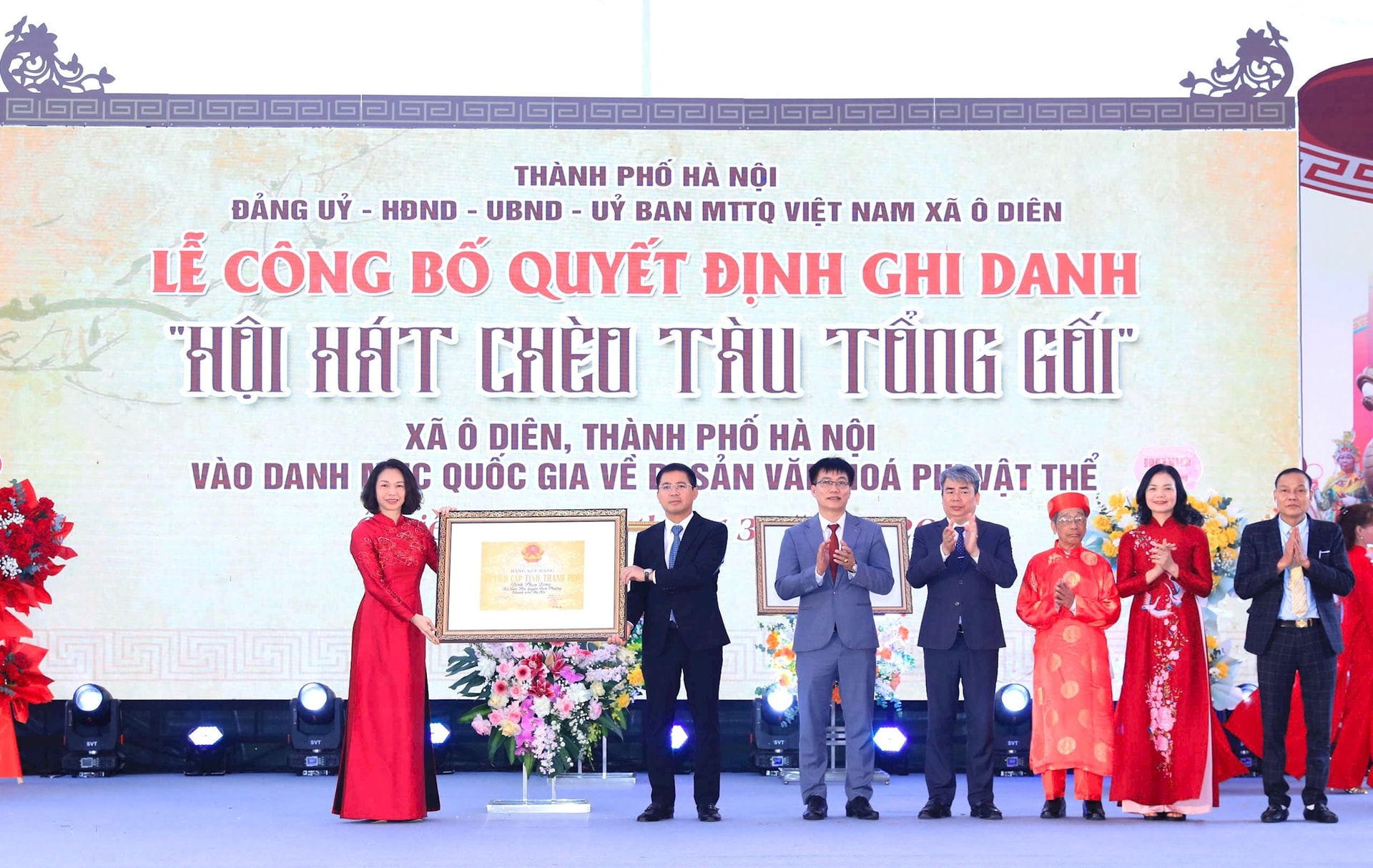 Vice Chairwoman of the Hanoi People's Committee Vu Thu Ha presents heritage ranking certificates for Phan Long and Thuy Hoi communal houses to O Dien Commune.
Cheo Tau singing harmoniously combines spiritual rituals and artistic performance, expressing gratitude to Van Di Thanh while reflecting the community's material and spiritual life and aspirations for prosperity and happiness. Its melodies, narratives and ritual rules have been preserved across generations, becoming a treasured spiritual asset of local residents.
After 1954, due to historical circumstances, the festival was not held for a long period. In 1998, after a 76-year absence, it was revived. Artisans worked with cultural agencies to collect materials, record performances and pass them on to younger generations. Dozens of training classes were organized, attracting more than 1,000 children.
To date, five artisans have been awarded the title of Meritorious Artisan by the President. Based on surveys and scientific documentation by the Hanoi Department of Culture and Sports, in 2025 the Ministry of Culture, Sports and Tourism issued Decision No. 1351/QD-BVHTTDL inscribing the Tong Goi Cheo Tau Singing Festival of O Dien Commune on the National List of Intangible Cultural Heritage. The same year, the Hanoi People's Committee ranked Phan Long and Thuy Hoi communal houses as city-level historical relics.
At the ceremony, after a representative of the Ministry of Culture, Sports and Tourism announced the inscription decision, Chairwoman of the Hanoi People's Council Hong Ha presented the official certificate to representatives of O Dien Commune. Meanwhile, Vice Chairwoman of the Hanoi People's Committee Thu Ha presented heritage ranking certificates for Phan Long and Thuy Hoi communal houses in a solemn and celebratory atmosphere.
Do Chi Hung, Deputy Secretary of the O Dien Party Committee and Chairman of the O Dien People's Committee, stated that the inscription and heritage ranking are both an honor and a major responsibility for the locality in preserving its heritage. In the coming period, the commune will continue coordinating with professional agencies to organize training, restore festival spaces and preserve the architecture of communal houses and mausoleums, creating favorable conditions for sustainable heritage practice.
The inscription of the Tong Goi Cheo Tau Singing Festival on the National List and the heritage ranking of the communal houses affirm the unique cultural value of this ancient land along the Red River and further enrich the cultural identity of the thousand-year-old capital.