The delegation also held meetings with major partners, including Sumitomo Corporation, Japan's Ministry of Land, Infrastructure, Transport and Tourism, Japan International Cooperation Agency, and Tokyo Metro to expand cooperation in climate adaptation, smart city development, and urban railway infrastructure.
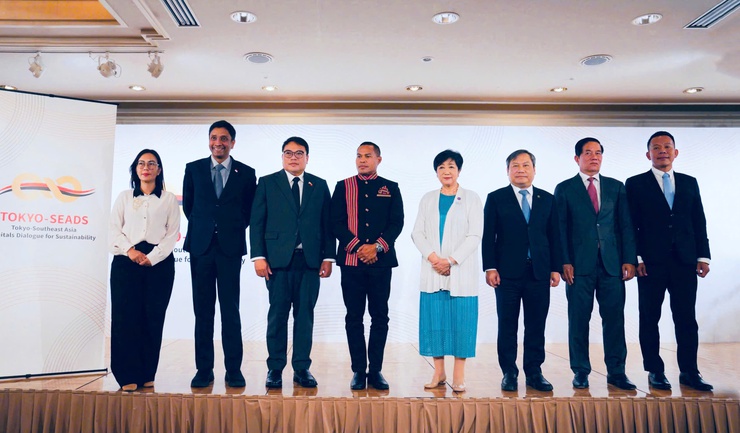 Hanoi People's Committee Chairman Vu Dai Thang and delegates attend the first Tokyo and Southeast Asian Capitals Dialogue on Sustainable Development.
Establishing a New Cooperation Framework for Disaster-Resilient Cities
At the first Tokyo and Southeast Asian Capitals Dialogue on Sustainable Development, urban leaders focused discussions on increasingly severe natural disasters and shared common challenges, including storms, flooding, and urban subsidence, all of which pose direct threats to lives and property across the region.
The joint TOKYO SEADS declaration set out a concrete action roadmap centered on strengthening multilateral cooperation to build sustainable adaptive infrastructure systems. The document affirmed that participating cities will concentrate resources on constructing and maintaining key works such as river dikes, sea dikes, retention lakes, and smart drainage networks while accelerating the application of digital technology in risk governance.
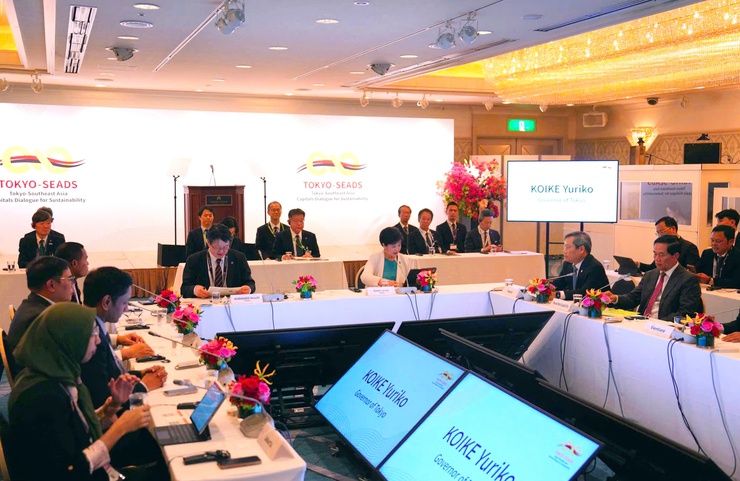 Overview of the first Tokyo and Southeast Asian Capitals Dialogue on Sustainable Development chaired by Tokyo Governor Koike Yuriko.
Contributing to the region's shared efforts, Chairman Vu Dai Thang delivered a keynote speech highlighting Vietnam's practical experience under the "four on-site" disaster response principle. He said Hanoi is making a strategic shift from reactive response to proactive adaptation by integrating climate change scenarios into long-term planning and prioritizing the use of artificial intelligence in disaster forecasting and early warning.
Thang stressed that Hanoi is not merely a recipient of international experience but also a responsible partner ready to join joint projects on workforce training and infrastructure technology transfer.
A key highlight of the dialogue was the commitment to implementing practical projects rather than stopping at information sharing. Participating capitals will periodically review progress on infrastructure works and dispatch experts for on-site assessments to identify optimal solutions to urban flooding challenges.
The strong consensus reached at the first TOKYO SEADS sent a clear message of solidarity among Asian cities, with a shared goal that no city should face the destructive force of natural disasters alone.
Accelerating Smart City Projects and Strategic Investment Cooperation
On the same day, Thang and the Hanoi delegation held an important working session with leaders of Sumitomo Corporation to discuss progress on the North Hanoi Smart City project.
At the meeting, Yukihito Honda, Executive General Manager of Sumitomo's Diverse Urban Development Division, expressed his pleasure at welcoming the delegation and shared the corporation's orientation for implementing new cooperation projects in Vietnam and Hanoi.
With a strong commitment to moving the North Hanoi Smart City project forward, the investor asked Hanoi to continue directing relevant agencies to closely coordinate and accelerate land handover in key areas so that technical infrastructure components can be launched in sync.
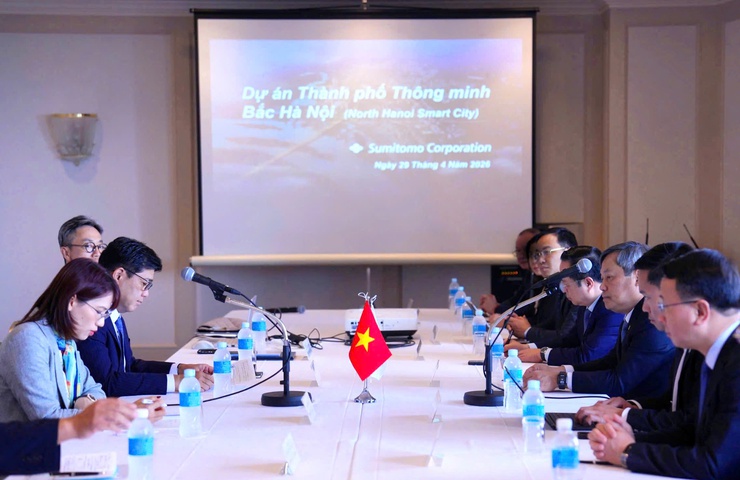 Chairman Vu Dai Thang and the Hanoi high-level delegation work with Sumitomo Corporation leaders on April 29.
After hearing proposals from the Japanese side, Thang acknowledged the investor consortium's persistent efforts in pursuing the project. He emphasized that Hanoi always creates the most favorable conditions for large-scale projects that symbolize the friendly cooperative relationship between Vietnam and Japan.
Regarding Sumitomo's recommendations, Hanoi's position is to work alongside the investor to remove obstacles while ensuring a balance between corporate interests and the capital city's sustainable development planning.
Speeding Up Urban Railway Development
Also on April 29, within the framework of the trip, the Hanoi delegation held meetings with Japan's Ministry of Foreign Affairs, the Ministry of Land, Infrastructure, Transport and Tourism, and Japan International Cooperation Agency. The focus was on accelerating urban railway projects, seen as a critical growth engine for Hanoi's next development phase.
At the meeting, Thang said that amid rapid urbanization, Hanoi aims to develop 100 kilometers of urban railway by 2030 and eventually expand the network to 400 kilometers under the new Central Government resolution. In particular, Metro Line No. 2, the Nam Thang Long - Tran Hung Dao section, along with the extensions connecting to Noi Bai International Airport, carries special strategic importance.
Thang said Hanoi has now been granted its highest level of autonomy in investment decisions, borrowing limits, and implementation scheduling under new legal regulations. The city is committed to ensuring the progress of land clearance, historically the biggest bottleneck in previous ODA-funded projects, to create the best conditions for project implementation.
On the Japanese side, agency representatives praised Hanoi's proactive approach and expressed hope that both sides will soon unify technical standards and cost norms to support the development of a synchronized railway industry.
Japan also affirmed its readiness to support Hanoi not only through yen-denominated loans but also in workforce training, operations and maintenance technology transfer, and management experience drawn from successful models such as Tokyo Metro.
Earlier, on April 28, the Hanoi delegation held a working session with Tokyo Metro to study Tokyo's transit-oriented development model. The delegation surveyed the operator's integrated training center, transfer stations, and commercial development systems linked to rail stations.
The Hanoi high-level delegation's working visit to Japan from April 26 to April 30 achieved its planned objectives, reaffirming Hanoi's commitment to accompanying Japanese strategic investors and helping deepen the Comprehensive Strategic Partnership between the two countries in a more substantive and practical direction.