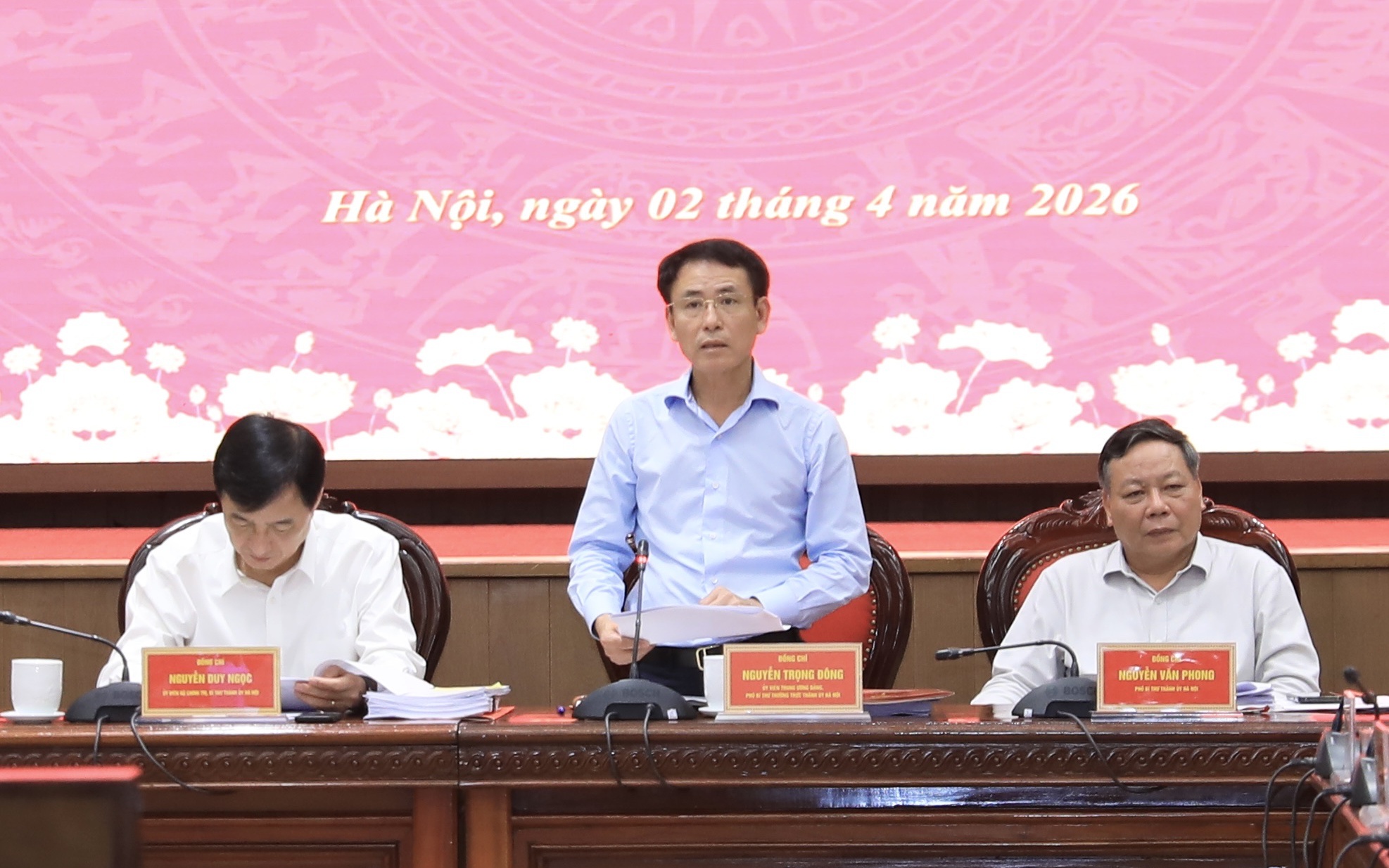
 Permanent Deputy Party Secretary Nguyen Trong Dong moderates the discussion.
Director of the Department of Agriculture and Environment Bui Duy Cuong reported that Hanoi is currently implementing site clearance for 1,428 projects spanning a total of 20,586 hectares. Notably, 27 of these are key municipal projects covering 10,700 hectares. Thanks to the drastic direction from city leaders and the proactive involvement of local authorities, site clearance has seen significant improvement through innovative and renewed working methods.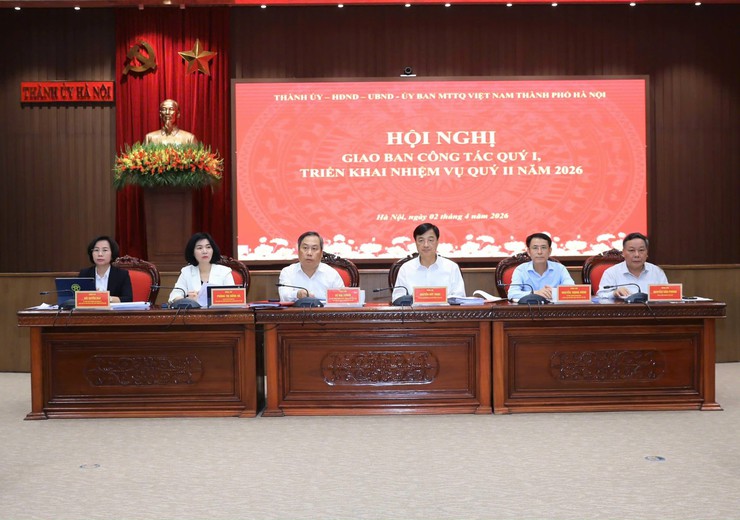 Party Secretary Nguyen Duy Ngoc and other city leaders chair the conference.
To unlock land resources, Cuong called on departments and agencies to speed up procedures related to investment, planning, construction, and land. He said current policies are now more open, planning is clearer, and financial obligations have also been reduced significantly. He therefore urged localities to develop implementation plans, push ahead with determination in 2026, and aim to complete all land-use right certificates by 2028 to improve management efficiency and create a more sustainable source of revenue.
Cuong, head of the city's tax authority, said that under the program "A Month Accompanying Business Households: Understanding Tax Policy Correctly and Doing Business with Confidence," the Hanoi Tax Department organized a full month of outreach and set up 320 mobile support points. As a result, it directly assisted 55,000 business households. In addition, 179,000 business households shifted to basic accounting books, and 164,000 registered electronic bank accounts.
The Hanoi tax authority has also stepped up information technology adoption with four breakthrough products in professional operations and has successfully piloted them at more than 1,000 businesses. At the same time, it is changing its management mindset, moving away from the model in which taxpayers "self-declare, self-pay, and take responsibility," toward a people-centered service approach that uses data systems to guide taxpayers in compliance.
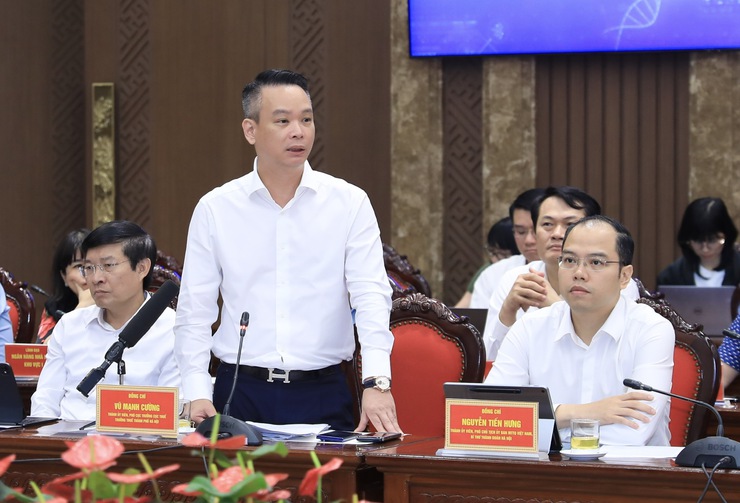 Vu Manh Cuong, head of the city's tax authority, speaks at the conference.
Director of the Department of Industry and Trade Vo Nguyen Phong said Hanoi's market remained basically stable in the first quarter, with goods supply meeting consumer demand, especially during the Lunar New Year holiday. Total retail sales of goods and consumer services revenue continued to post solid growth, reaching VND253 trillion (US$9.61 billion).
To help stabilize market prices, Phong said the department would step up oversight of the city's market management force and tighten inspections of gasoline stations to ensure adequate supply for production, business activities, and household demand.
At the same time, the department will continue implementing programs effectively, especially price stabilization programs, promotional campaigns, and trade links between Hanoi and other provinces and cities, in order to support higher retail sales and consumer services across the city.
It will also strengthen trade promotion activities and bring Hanoi products onto e-commerce platforms. A "Hanoi Store" is expected to launch on Shopee in April.
The department is also coordinating with the Department of Finance to review and propose support measures for enterprises providing public utility services, including environmental sanitation, urban greenery, lighting, and other essential services, which have been directly affected by fluctuations in fuel prices.
Director of the Department of Finance Nguyen Ngoc Tu said public investment was a standout area in the first quarter. Although the results did not fully meet the original plan, the city disbursed VND24 trillion out of VND32 trillion. He described this as an impressive increase, up 300 percent from the first quarter of 2025.
However, most of the disbursement was concentrated in city-level projects. He therefore called for continued efforts to accelerate site clearance. He also said that for problems at the commune and ward levels, there needs to be coordination with the Department of Construction and the Department of Finance to review and adjust implementation so that project progress can move faster.
The department will also advise the city People's Committee on adjusting the 2026 capital plan, focusing on projects with strong capital absorption capacity in order to ensure the disbursement rate.
Nguyen Huu Tuyen, Party Secretary and Chairman of the Tay Tuu Ward People's Council, shared experience from piloting the "3-5-7 People's Council model" in a more substantive way with clear outputs.
The model is built around three groups of content. The "3" refers to three groups of issues that People's Council deputies must closely follow: land, construction, and urban order; social welfare, daily life, and voter petitions; and projects being implemented in the area, especially matters related to site clearance.
Reported information must be specific in terms of location, content, and severity, and must be verifiable, in order to avoid vague or overly subjective reporting.
The "5" refers to the principle of giving a short report in five minutes, focused on five main points: the most notable developments, the most pressing issue, what has been handled, what remains unresolved, and recommendations to the People's Committee. Each report covers no more than five issues, helping control the quality of incoming information and avoid spreading attention too thin.
The "7" refers to a closed handling process completed within seven days: receiving information, classifying it, assigning it for handling, giving an initial response, checking implementation, finalizing results, and reporting back to voters. This allows residents' recommendations to be tracked through to the end, with clear progress and accountability.
In day-to-day operation, the ward uses a Zalo group to receive, compile, and monitor issues without creating additional procedures. After two months, 8 out of 10 recommendations had been handled through the process. The model is still being refined for more systematic and effective implementation.
Nguyen Minh Hong, Party Secretary and Chairman of the Tay Phuong Commune People's Council, spoke about applying science and technology and digital transformation in the operation of the political system and local socio-economic life.
In line with the direction of the city Party Committee and Steering Committee 57, the commune views digital transformation as an inevitable trend and an important driver for moving from an administrative management mindset to development governance, with residents at the center of service delivery. With a population of 112,000, the commune considers this a shared task of the entire political system, from the Party Committee, government, Fatherland Front, and mass organizations to each Party cell, residential group, official, and Party member.
The commune has organized meetings and resolution study sessions on Microsoft Teams, connecting 38 sites and helping more than 2,700 Party members participate quickly and effectively. The "paperless meeting" model, the use of AI at work, and the "electronic Party member handbook" have begun to change management methods and save time and costs.
In the recent election, the commune built a real-time digital dashboard to track voter turnout, helping leaders monitor the situation and issue timely instructions. Voter turnout reached 99.83 percent.
In the coming period, the commune will continue maintaining the effectiveness of its modern one-stop administrative unit, accelerate digital transformation across all four pillars, improve management and administration quality, and provide better service to residents. Tay Phuong Commune has committed to continuing this push, improving governance capacity, serving residents more effectively, and contributing to the locality's sustainable development.