The events also marked the official establishment of Party organizations and Vietnam Fatherland Front committees at the provincial, city, commune, ward, and special zone levels, following the nationwide administrative restructuring
General Secretary To Lam attended the ceremony in Ho Chi Minh City, underscoring the significance of the nationwide administrative restructuring process.
Politburo member and State President Luong Cuong was present in Hanoi, while Prime Minister Pham Minh Chinh attended the event in Hai Phong. National Assembly Chairman Tran Thanh Man took part in the ceremony in Can Tho, and Permanent Member of the Party Secretariat Tran Cam Tu participated in the event in Da Nang.
Other Politburo members, Central Party Secretaries, and members of the Party Central Committee were also present at ceremonies held across provinces and cities throughout the country.
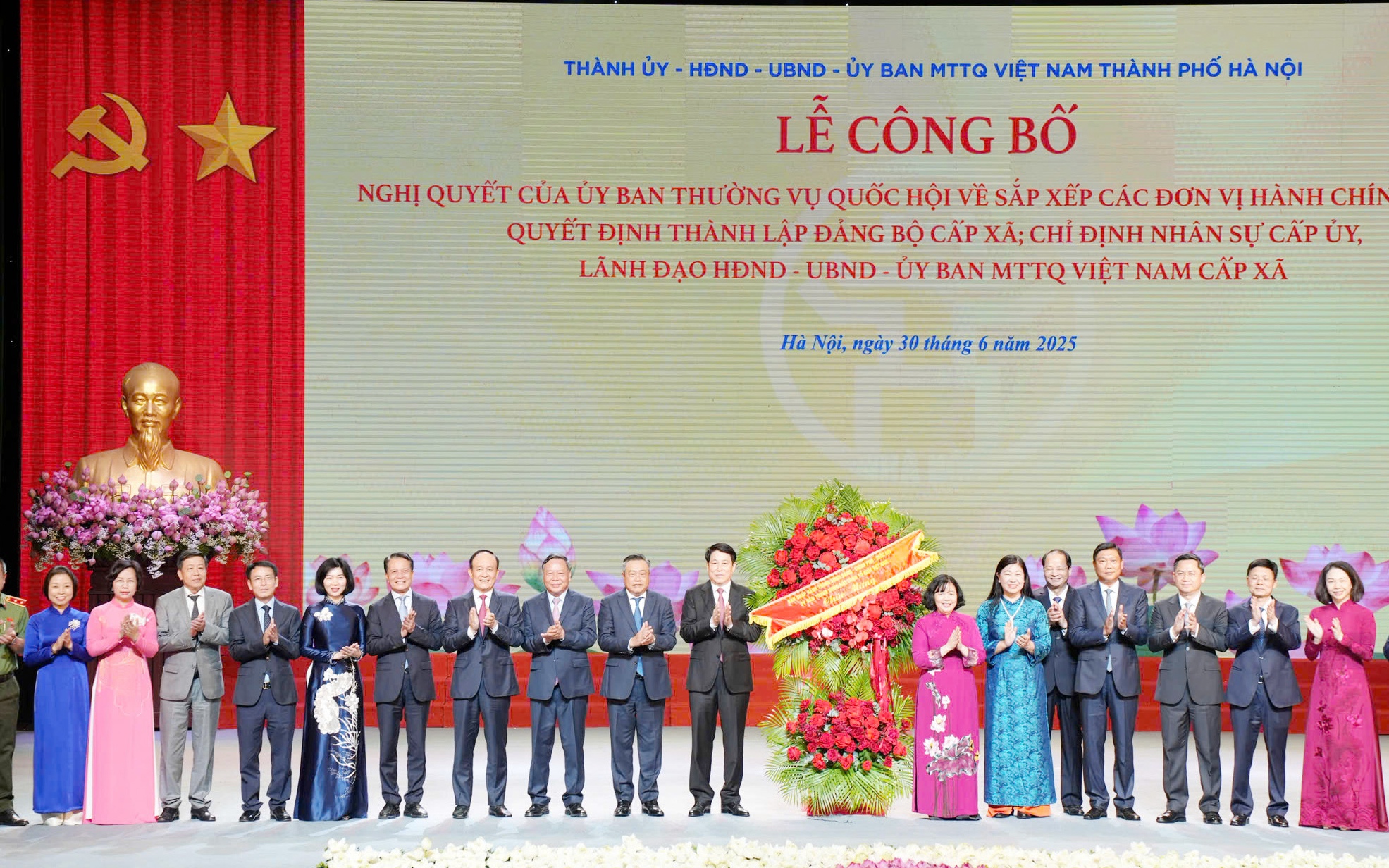
Delegates at the event.
In Hanoi, the ceremony was held both in person and virtually. The central location was the Vietnam–Soviet Friendship Cultural Palace, which was connected to 126 newly formed communes and wards throughout the city.
Alongside President Luong Cuong at the main venue were Central Committee members, including Chief of the Presidential Office Le Khanh Hai, Permanent Deputy Head of the Central Organization Commission Hoang Dang Quang, and Deputy Chairman of the Central Committee of the Vietnam Fatherland Front Hoang Cong Thuy.
Hanoi's delegation included Politburo member and City Party Secretary Bui Thi Minh Hoai; former Politburo members and previous Hanoi Party Secretaries Pham The Duyet and Pham Quang Nghi; Central Committee member, Deputy Secretary of the City Party Committee, and Chairman of the Hanoi People's Committee Tran Sy Thanh; Permanent Deputy Secretary of the City Party Committee Nguyen Van Phong; and Deputy Secretary of the City Party Committee, Chairman of the City People's Council, and Deputy Head of the City's National Assembly delegation Nguyen Ngoc Tuan.
Also in attendance were former Central Committee members and former city leaders from different periods, members of the Hanoi Party Standing Committee, Party Committee members, and Party Secretaries, Chairpersons of the People's Committees, and Chairpersons of the Vietnam Fatherland Front Committees of the 126 newly established communes and wards.
Each of the 126 new commune and ward locations was chaired by their respective Permanent Deputy Party Secretaries. Participants also included former district, town, and city leaders, members of the district-level Party Committees, members of the Party Committees of the new communes and wards, leaders of Party-affiliated agencies, and representatives of residential communities and religious groups in the area.
At the ceremony, Nguyen Van Phong, Permanent Deputy Secretary of the Hanoi Party Committee, announced several resolutions and decisions by competent authorities on the restructuring and establishment of commune-level administrative units in Hanoi for the year 2025.
Phong stated that the National Assembly Standing Committee, the Vietnam Fatherland Front Central Committee, and the Hanoi municipal government had issued resolutions and decisions in line with the Party and State's policy to streamline and enhance the effectiveness of administrative structures and improve state governance.
Specifically, there are seven key documents and document groups:
- A resolution from the National Assembly Standing Committee regarding the reorganization of commune-level administrative units in Hanoi for 2025.
- A decision by the Vietnam Fatherland Front Committee recognizing the titles of the Standing Committee of the Hanoi Fatherland Front.
- A resolution by the Hanoi Party Executive Committee to dissolve 30 district-level Party Committees under the Hanoi Party Committee.
- Decisions by the Hanoi Party Executive Committee to establish 126 Party Committees at the commune and ward level.
- Decisions by the Hanoi Party Standing Committee to establish the Hanoi Fatherland Front Committee and appoint the Executive Committee, Standing Committee, Party Secretaries, Deputy Secretaries, and Inspectors of the newly created commune-level Party Committees.
- Resolutions by the Standing Committee of the Hanoi People's Council appointing the Chairpersons, Vice Chairpersons, and heads of commune-level People's Councils and People's Committees.
- A decision by the Hanoi Fatherland Front to establish commune-level Fatherland Front Committees.
For provinces and cities that underwent administrative mergers, the ceremony consisted of two parts. The first part announced resolutions from the National Assembly and its Standing Committee, decisions by the Government and Vietnam Fatherland Front regarding the reorganization of provincial administrative units and provincial-level political and administrative structures.
The ceremony's second part included announcements of resolutions by the National Assembly Standing Committee and decisions from provincial-level Party Committees, People's Councils, and Fatherland Front Committees concerning the restructuring of commune-level administrative units, political systems, and appointments of key personnel.
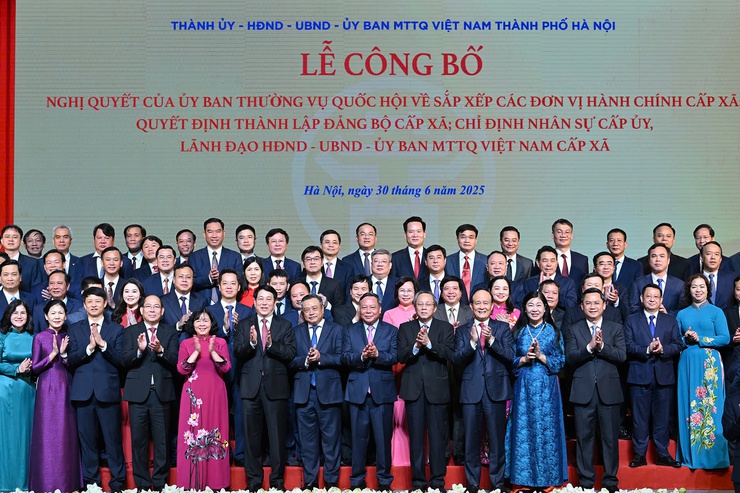
Delegates at the event.
According to Resolution No. 1656/NQ-UBTVQH15, passed by the National Assembly Standing Committee on June 16, 2025, the reorganization of commune-level administrative units in Hanoi has been officially approved.
The decision, based on Government Proposal No. 369/DA-CP dated May 9, 2025, provides for the establishment of 126 commune- and ward-level administrative units, as detailed in the resolution’s appendix. The resolution takes immediate effect, with relevant authorities required to complete all preparatory work to ensure the new administrative units become fully operational by July 1, 2025.
Decision No. 559/QD-MTTW-BTT issued on June 27, 2025, by the Standing Committee of the Central Fatherland Front recognized the titles of seven members of the Standing Committee of the Hanoi Fatherland Front for the 2024–2029 term (list attached).
Deputy Secretary Nguyen Van Phong also announced Decision No. 8657-QD/TU dated June 18, 2025, by the Hanoi Party Executive Committee, which ends the operations of 30 district-level Party Committees under the Hanoi Party Committee. This includes 12 urban districts, one town, and 17 rural districts. These committees will cease operations as of July 1, 2025.
Phong also outlined the contents of 126 decisions to establish Party Committees for the newly formed communes and wards.
These decisions were made in accordance with the Party Charter and its implementation guidelines, resolutions of the Central Executive Committee, and conclusions of the Politburo and the Secretariat on organizational and administrative restructuring. They also reflect amendments to the 2013 Constitution and recent resolutions of the National Assembly on the reorganization of commune-level administrative units in Hanoi.
The Hanoi Party Executive Committee has officially decided to establish 126 commune- and ward-level Party Committees, which will serve as the immediate governing bodies for local Party organizations under the Hanoi Party Committee.
Each newly formed committee will comprise affiliated Party organizations and members, with detailed lists specifying their structure and membership. The functions, responsibilities, and organizational framework of these committees will be regulated by the Party Secretariat. The decision takes effect on July 1, 2025.
Phong stated that for personnel decisions related to local Party leadership, People's Councils, People's Committees, and Fatherland Front Committees at the commune level, the Party Committee Standing Committee has assigned members of the City Party Standing Committee and city leaders to attend the decision-handover ceremonies at all 126 new communes and wards on June 30, 2025.
The next part of the ceremony involved presenting appointment decisions to collectives and individuals.
At the beginning of this part, Hanoi Party Secretary Bui Thi Minh Hoai and Deputy Chairman of the Central Vietnam Fatherland Front Hoang Cong Thuy presented decisions recognizing official titles and extended congratulations to the Standing Committee of the Hanoi Fatherland Front for the 2024–2029 term.
The session was chaired by Ha Minh Hai, a member of the Hanoi Party Standing Committee and Head of the Party Organization Commission. He noted that on June 26, 2025, in line with central directives, the Hanoi Party Standing Committee, People’s Council, and Fatherland Front issued decisions establishing Party Committees and appointing executive board members, standing committee members, secretaries, deputy secretaries, and leaders of the People’s Councils, People’s Committees, and Fatherland Front Committees for all 126 newly formed communes and wards.
Party Secretary Bui Thi Minh Hoai, Chairman of the Hanoi People's Committee Tran Sy Thanh, Permanent Deputy Secretary Nguyen Van Phong, and Chairman of the City People's Council Nguyen Ngoc Tuan collectively presented decisions to 375 key leaders of the new commune- and ward-level governments, divided into three rounds.
In his address at the ceremony, President Luong Cuong expressed his honor in representing the leadership of the Party and State at this significant event announcing central and municipal decisions on the reorganization of commune-level administrative units in Hanoi.
President Luong Cuong emphasized that the restructuring of administrative units is not merely a technical task but a politically and organizationally significant step that ensures sustainable national development.
The policy to reorganize the administrative apparatus and local units is a major strategic initiative by the Party and the State. It demonstrates strong political determination to build a lean, effective, and people-centered administration that better serves the public.
President Luong Cuong underscored the special importance of this reorganization in Hanoi—a city with a thousand-year history, heroic legacy, and status as the political and administrative center of the nation, a hub of economics, culture, education, science, technology, and international integration.
"This restructuring marks a crucial step to support urban development, enhance cultural and historical values, reform governance, and make better use of Hanoi's space and resources," Cuong said.
The President commended the serious, responsible, and innovative efforts of Hanoi's Party and government in implementing this policy. The city proactively developed a plan to dissolve district-level governments and reduce the number of commune-level units from 526 to 126. Importantly, the restructuring received strong support from more than 97% of officials, Party members, and residents.
President Luong Cuong noted that beginning July 1, 2025, district-level governments will cease operation. The Hanoi municipal government will then directly oversee the 126 commune- and ward-level units.
These new local governments will be larger in scale and must operate with streamlined, capable, and efficient structures that are close to the people and responsive to their needs. To prevent delays or disruptions, especially in services essential to citizens, businesses, and public welfare, the new administrations must ensure smooth and uninterrupted functioning from the outset.
The President called on the Hanoi Party Standing Committee to lead and direct the immediate, synchronized, and efficient operation of the new administrative structure.
He also called on the city to actively implement key directives and resolutions grounded in the Party and State’s policy and legal frameworks.
These include Directive No. 45 on organizing Party congresses at all levels in preparation for the 14th National Party Congress; Resolution No. 57 on breakthroughs in science, technology, innovation, and digital transformation; Resolution No. 66 on legal reform; Resolution No. 68 on private sector development; Resolution No. 59 on international integration; and Resolution No. 15 along with the 2024 Capital Law, which set out Hanoi’s development goals through 2030 with a vision to 2045.
Based on these foundations, Hanoi must develop action programs that are scientific, methodical, focused, and well-planned. These programs should not only fulfill administrative mandates but also demonstrate a renewed spirit in governance and Party resolution implementation.
President Luong Cuong expressed confidence that with its rich heritage, unity, intelligence, and ambition, the Hanoi Party, government, and people will continue to uphold national solidarity, lead innovation in management models, improve local governance, and build a modern, professional administration that serves citizens better and contributes to the nation's progress toward prosperity.
In recognition of Hanoi's achievements in reorganizing commune-level administrative units, President Luong Cuong, on behalf of the Party Central Committee, the National Assembly, the Government, and the Vietnam Fatherland Front Central Committee, presented a congratulatory flower arrangement.
In her response, Party Secretary Bui Thi Minh Hoai stated that the announcement of the National Assembly Standing Committee's resolution and Hanoi's associated decisions and resolutions on organizing commune-level administrative units is a highly significant political event.
"It reflects the strong commitment of the entire political system to realize the Party's major policies by building a lean, effective, and high-performing government capable of meeting the country's development needs in this new era," said Hoai.
She emphasized that as the capital and national political-administrative center, Hanoi recognizes its responsibility to lead and set an example in executing this important mission.
Reorganizing commune-level units is not only a step in institutional reform and administrative streamlining, but also an opportunity for Hanoi to restructure its development space, enhance urban governance, and modernize local government. These efforts aim to serve the public more effectively and support Hanoi's transformation into a smart, livable, and civilized city, maintaining its role as a pioneer in the nation's development.
Party Secretary Bui Thi Minh Hoai acknowledged President Luong Cuong's sincere support and recognition of Hanoi's achievements, calling it a source of motivation for the Party, government, military, and people of the capital to build on these results and strive to achieve the goals set for 2025 and beyond.
On behalf of Hanoi’s Party leadership, People’s Council, People’s Committee, and Fatherland Front, she expressed sincere appreciation for President Luong Cuong’s comprehensive guidance.
She affirmed that the City Party Executive Committee, along with the Party Committees of all 126 communes and wards, will immediately integrate his directives into their work plans and action programs. Starting July 1, 2025, Hanoi’s 126 commune- and ward-level governments will officially begin full-scale operations under the new administrative model with enthusiasm, confidence, and a shared commitment to a brighter future.
On this occasion, Party Secretary Bui Thi Minh Hoai expressed gratitude to the central leadership for their support of Hanoi. She also paid tribute to the contributions of generations of officials, public servants, and workers from the 30 districts, towns, and communes that have completed their historic mission in the capital's development. She wished them good health and encouraged them to continue contributing to Hanoi's future.
She concluded by stressing that in this new era of national progress, for a prosperous, powerful, civilized, and happy country, the Hanoi Party Committee will continue to uphold unity, wisdom, and determination.
It will lead the Party, military, and people of the capital in successfully achieving the objectives set by the 17th Party Congress of Hanoi and in organizing successful congresses at the commune and ward levels, as well as the 18th Hanoi Party Congress, toward the 14th National Party Congress.
The Hanoi Party Committee will also focus on building high-quality leadership teams in the newly established commune- and ward-level Party Committees. These teams will uphold strong ethical standards, enhance professional competence, and harness the potential and strengths of each locality to meet development needs and provide the best possible service to both residents and businesses.