Central government officials attending the meeting included Politburo member and Permanent Deputy Prime Minister Pham Gia Tuc; Party Central Committee member and Deputy Prime Minister Nguyen Van Thang; and representatives of ministries and central agencies.
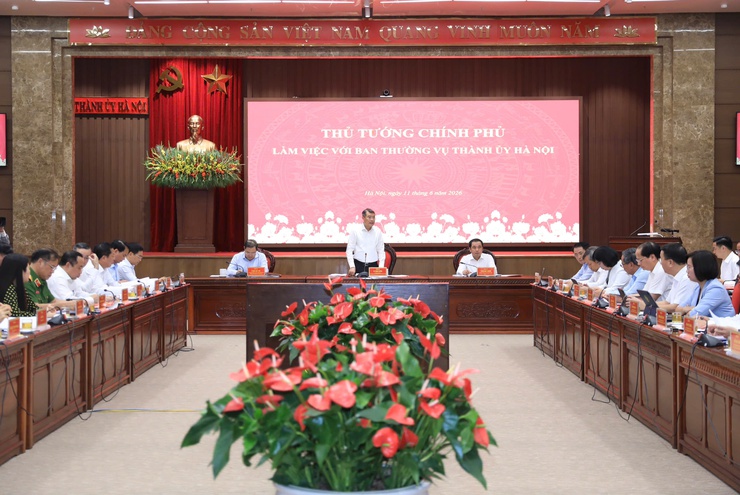 Prime Minister Le Minh Hung delivers remarks and strategic guidance.
Hanoi delegates included Politburo member, Hanoi Party Secretary, and Head of the Hanoi National Assembly Delegation Tran Duc Thang; Party Central Committee member and Permanent Deputy Secretary of the Hanoi Party Committee Nguyen Trong Dong; Party Central Committee member, Deputy Secretary of the Hanoi Party Committee, and Chairman of the Hanoi People's Committee Vu Dai Thang; Deputy Secretary of the Hanoi Party Committee and Chairwoman of the Hanoi People's Council Phung Thi Hong Ha; and Deputy Secretary of the Hanoi Party Committee Nguyen Van Phong. Also attending were members of the Hanoi Party Committee Standing Board, leaders of the People's Council and People's Committee, and heads of city departments and agencies.
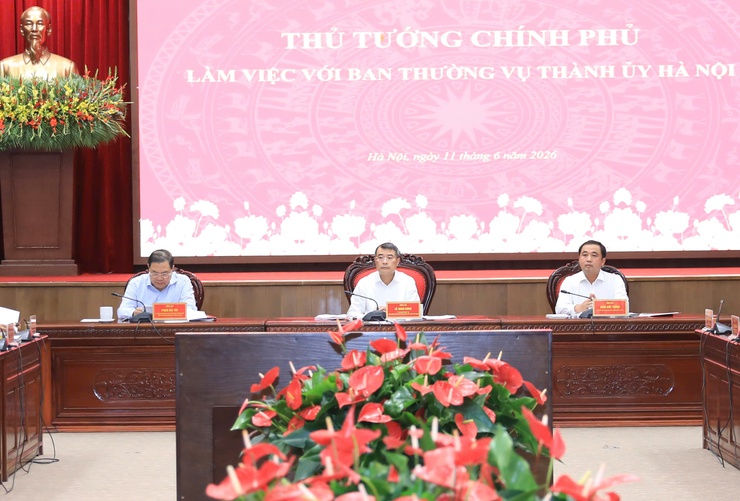 Prime Minister Le Minh Hung, Permanent Deputy Prime Minister Pham Gia Tuc, and Hanoi Party Secretary Tran Duc Thang chair the meeting.
Reporting to the Prime Minister, Chairman of the Hanoi People's Committee Vu Dai Thang said Hanoi's Gross Regional Domestic Product (GRDP) grew 7.87% year-on-year in the first quarter of 2026, slightly higher than the national average of 7.83%, but below the city's target scenario of 10.23%. GRDP growth in the second quarter is projected to exceed 9%.
State budget revenue reached VND369.3 trillion (US$14.2 billion) as of May 31, equivalent to 56.8% of the annual target. Revenue for the first six months of 2026 is estimated at VND404.087 trillion (US$15.5 billion), up 2.9% from the same period last year.
Public investment disbursement is estimated at VND63.942 trillion (US$2.45 billion) in the first six months, an increase of 115.1% year-on-year.
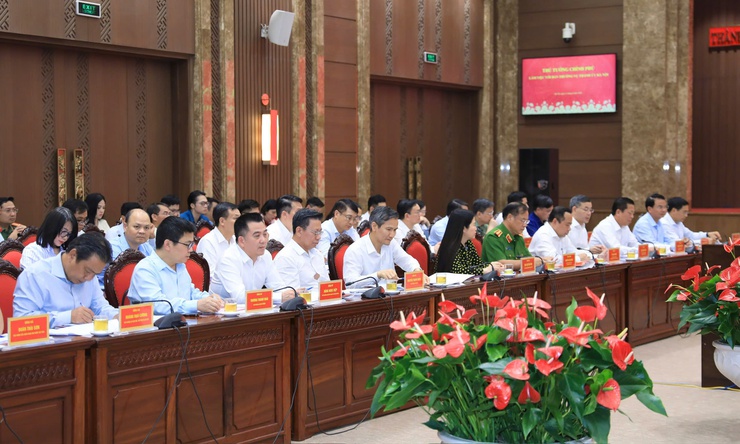 Delegates attend the meeting.
Hanoi has also launched eight major projects and is simultaneously implementing the largest infrastructure program in its history, including ring roads, Red River bridges, urban railway lines, and interregional transport corridors. Land clearance has been completed for six of the seven planned Red River bridges, while efforts continue to resolve remaining obstacles and ensure synchronized implementation.
The city has focused on completing major planning frameworks for urban development and housing, creating a legal basis for mobilizing resources and expanding development space. Key achievements include issuing a plan for renovating and rebuilding aging apartment buildings, approving the Capital Master Plan with a 100-year vision, and launching efforts to publicize, digitize, and visualize planning data to support management and attract investment.
Housing development has accelerated with 93 social housing projects totaling approximately 85,700 apartments. Land has also been allocated for housing for armed forces personnel and resettlement projects linked to major infrastructure developments.
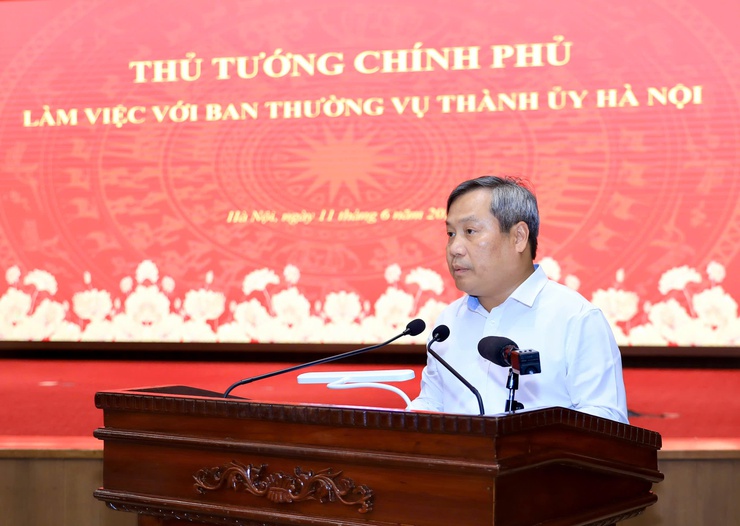 Chairman of the Hanoi People's Committee Vu Dai Thang presents a report.
The city has made progress in addressing major urban management bottlenecks. Five of 16 chronic traffic congestion hotspots have been resolved, while 17 of 35 overloaded traffic locations have been addressed. AI-powered camera systems have been installed at 178 major intersections.
Hanoi has also synchronized the operation of flood-control infrastructure and retention lakes, completed the selection of environmental sanitation contractors in all wards and communes, and strengthened urban order and food safety management. Safe food production zones have been publicly disclosed in 115 of the city's 126 communes and wards.
Regarding the implementation of Resolution No. 57-NQ/TW on breakthroughs in science, technology, innovation, and digital transformation, Hanoi aims for the digital economy to account for 35% of GRDP by 2026 and at least 40% by 2030.
The city has shifted governance toward digital administration through the HanoiWork platform, which currently has 39,300 user accounts, with a 90% activation rate. The platform monitors the progress of 36,350 tasks online.
Of the 292 tasks assigned by central authorities, Hanoi has completed 157, equivalent to 53.77%.
The city has also announced 30 major technology challenges for public-private innovation. Hanoi scored 96.67 points on the national 766 Index for citizen services, ranking fifth among 34 provinces and cities. The rate of electronic results issuance reached 97.79%, while document digitization reached 97.74%.
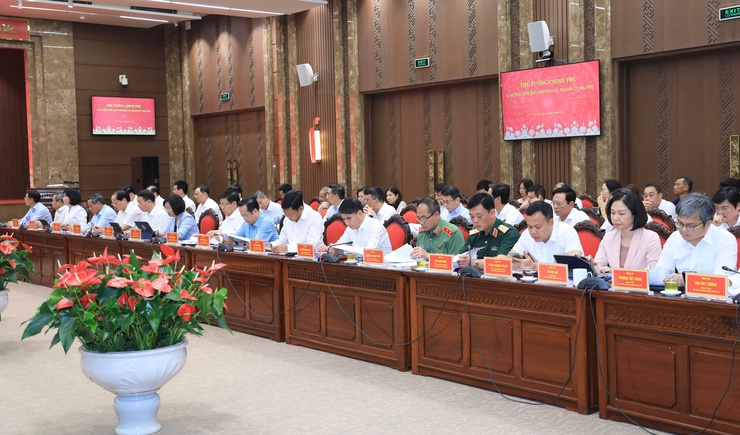 Delegates at the meeting.
As of June 5, 2026, cumulative public investment disbursement reached VND48.926 trillion (US$1.88 billion), equivalent to 40.77% of the plan assigned by the Prime Minister and 31.36% of the city's own plan.
For privately funded projects, Hanoi reviewed 829 projects and removed 488 from the list of delayed cases. Of the remaining 341 projects, covering 8,397 hectares, the city proposed revoking 24 projects, continuing supervision and support for 299 projects, and applying special mechanisms under National Assembly Resolution No. 170/2024/QH15 to 10 projects.
Regarding delayed public investment projects, Hanoi classified 320 projects with a total investment of VND96.953 trillion (US$3.72 billion) into three groups: 54 projects to be terminated, 76 projects with temporary funding suspension, and 190 projects to continue implementation. The city aims to complete the review of terminated projects by June 15, 2026, and suspended projects by June 25, 2026.
On the operation of the two-tier local government model, Hanoi reported that the 126 newly established communes and wards, reorganized from 526 former administrative units, have operated smoothly and effectively since July 1, 2025.
Administrative procedure processing at the grassroots level achieved a record 95.77% on-time or early completion rate, helping Hanoi rank third among 34 provinces and cities on the national 766 Index and maintain the country's leading position in document digitization.
The city has delegated an additional 160 responsibilities to commune-level authorities, bringing the total number of autonomous tasks to 928. This has shortened processing times by three to five working days and eliminated multiple rounds of consultation, generating compliance cost savings of approximately VND9.3 billion (US$357,000) per month.
Following central government guidance on rental housing development, Hanoi has allocated about VND9 trillion (US$345 million) to establish a rental housing fund. Construction is expected to begin between June 15 and June 20, 2026, at two sites in Phap Van-Tu Hiep and Viet Hung.
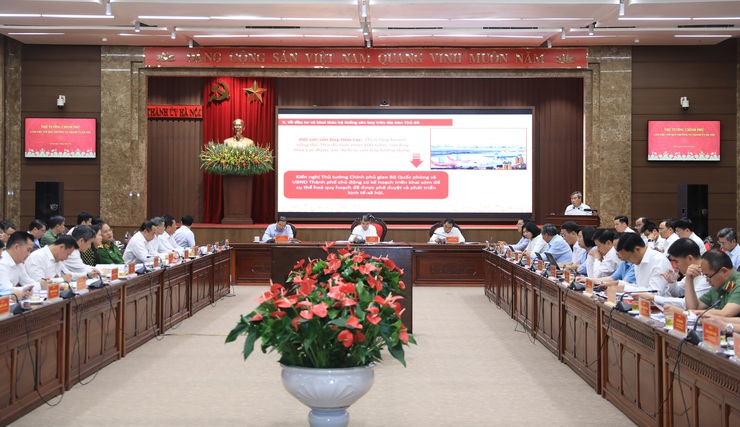 Overview of the meeting.
Key priorities and solutions
Chairman of the Hanoi People's Committee Vu Dai Thang outlined four major priorities for the city.
First, Hanoi will strengthen traditional growth drivers by improving investment efficiency and targeting annual social investment growth of more than 20%, while maintaining public investment as a leading force.
Second, the city will develop new growth drivers and achieve breakthroughs by effectively implementing the Capital Law and special policy mechanisms, accelerating administrative reform and digital transformation, and ensuring that 100% of administrative procedures can be completed entirely online by 2030.
Third, Hanoi will mobilize and use development resources more effectively, with a focus on achieving 100 per cent of the disbursement of public investment. Priority will be given to strategic infrastructure projects, urban railway systems, ring roads, Red River bridges, and digital infrastructure.
The city will also maximize the value of land resources, public assets, and new development areas while promoting transit-oriented development (TOD) models. The goal is to create a sustainable financing mechanism under the principle that "railways finance railways."
Public-private partnerships (PPP) will be expanded, financing channels diversified, and approximately US$25 billion in registered foreign direct investment will be attracted between 2026 and 2030. Hanoi will also accelerate the resolution of delayed projects and unlock resources currently tied up by inefficiencies and bottlenecks.
Fourth, the city will strengthen risk management and ensure sustainable development by expanding digital government, data-driven governance, and smart city management systems. This includes developing a Shared Data Repository, a Big Data Center, and an intelligent operations platform while ensuring cybersecurity and data security.
Recommendations to the Prime Minister
Chairman Vu Dai Thang asked the Prime Minister's support in several areas, including mobilizing financial resources for strategic infrastructure development, particularly urban railways; promoting science and technology development; introducing preferential credit policies for rental housing; accelerating the transfer of management authority over Ba Vi National Park to Hanoi; and expanding development space for Minh Chau island commune.
The city also proposed investment and development of airport infrastructure in the capital region and permission to pilot new economic models similar to those implemented in other countries, while ensuring compatibility with Vietnamese cultural values.
Chairman Thang emphasized that, with proactive leadership, strong determination, decisive action, and responsibility to the Party, the State, and the people, Hanoi remains committed to achieving double-digit economic growth.
He expressed confidence that special policy mechanisms and new regulations taking effect on July 1, 2026, will create institutional breakthroughs, unlock land, investment, and financial resources, accelerate disbursement and investment attraction, and transform the capital's potential and advantages into tangible growth drivers.