Mobilizing maximum resources for development
Deputy Prime Minister Nguyen Van Thang agreed with Hanoi's report and congratulated the city on its achievements during the first five months of 2026, particularly its budget revenue performance.
He said Hanoi should adopt stronger measures to mobilize development resources, noting that the city has many opportunities to raise non-budget funding through channels such as domestic foreign-currency bond issuance, international bond offerings, export credit financing from partner countries, and greater participation from businesses through cooperative investment mechanisms.
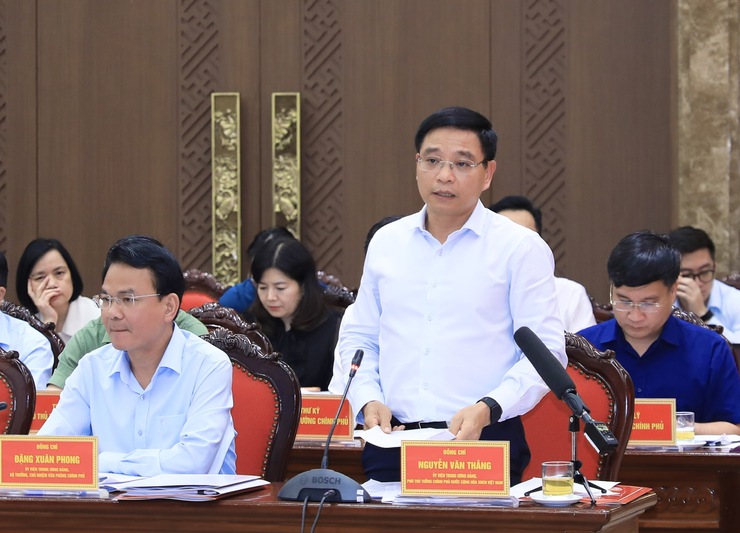 Deputy Prime Minister Nguyen Van Thang speaks at the meeting.
Thang emphasized that the central government has high expectations and ambitious goals for Hanoi. The capital must strive for breakthroughs while simultaneously addressing a range of long-standing challenges that cannot be resolved overnight.
While expressing support for Hanoi's proposed solutions, he highlighted several priorities.
First, he stressed that traditional growth drivers remain crucial to Hanoi's development and urged the city to make every effort to achieve 100% of the disbursement of public investment.
Second, Hanoi should accelerate the resolution of delayed and stalled projects to unlock resources for production and business activities.
Third, the city should strongly promote science, technology, innovation, and digital transformation as new engines of growth.
Maximizing initiative, creativity, and autonomy
Speaking at the meeting, Permanent Deputy Prime Minister Pham Gia Tuc highly praised Hanoi's unique role and position, as well as the achievements it has recorded in recent years.
He noted that Hanoi has taken focused and determined action to address long-standing bottlenecks and pressing issues, including traffic congestion, urban flooding, land clearance, and implementation of key infrastructure projects. Many of these projects will generate benefits not only for the capital but also for the wider metropolitan region.
Hanoi has also been one of the country's leading localities in implementing Project 06 on digital government and public services. The city has gradually developed a modern urban governance model, applying artificial intelligence in public administration, city management, traffic monitoring, smart healthcare, and comprehensive data digitization.
In addition, Hanoi has actively worked to remove obstacles facing long-delayed projects, creating significant new resources that can contribute to the city's goal of achieving double-digit economic growth.
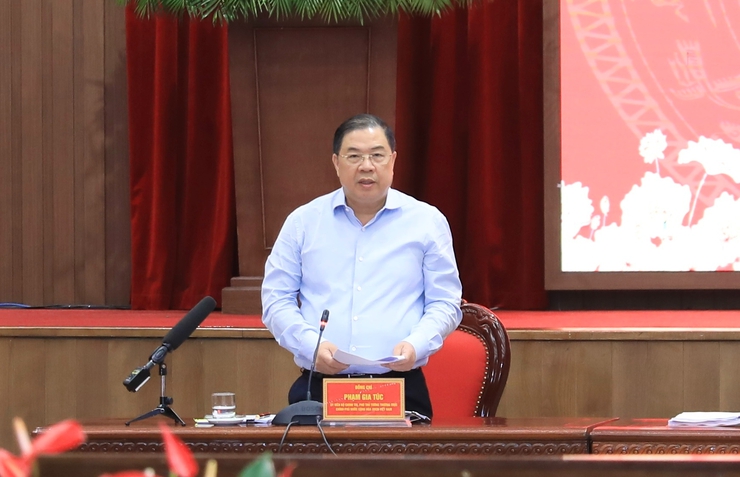 Permanent Deputy Prime Minister Pham Gia Tuc addresses the meeting.
Key directions for the coming period
Looking ahead, Tuc highlighted several priorities.
First, Hanoi should continue effectively implementing resolutions issued by the Party Central Committee, the Politburo, the National Assembly, and the Government, particularly guidance provided by the General Secretary and the President during recent meetings with city leaders.
He stressed the need to fully leverage the initiative, creativity, and autonomy granted under Politburo Resolution No. 02 on the development of the capital in the new era. The revised Capital Law has created new mechanisms to mobilize resources and support development, helping Hanoi become a truly decisive, innovative, and responsible capital.
The city should also accelerate the transformation of its growth model. Services already account for a large share of the economy, reflecting trends seen in developed countries. Hanoi should continue strengthening public investment and attracting foreign direct investment, particularly in high-tech sectors.
Regarding exports, he emphasized the importance of advancing industrialization and modernization while adopting a science- and technology-driven growth model, including the development of the semiconductor industry. Hanoi should also introduce measures to stimulate consumer demand and increase production of goods and services for residents and visitors.
For the second half of 2026, the Permanent Deputy Prime Minister urged the city to carefully review the potential of each sector and agency and adopt more decisive measures, noting that Hanoi's growth will play an important role in the country's overall economic performance.
He also called for faster development of modern industrial parks that maximize economic value through advanced technologies and attract major investors. At the same time, Hanoi should promote investment in modern commercial and service models, including outlet shopping centers and the nighttime economy.
The city should also plan wholesale agricultural markets linked to logistics centers to strengthen connections between Hanoi, neighboring provinces, and international markets.
On public investment, Hanoi was urged to focus on disbursement, particularly for strategic infrastructure projects such as ring roads.
"Transportation must lead the way so that new urban areas and industries can follow," Tuc said.
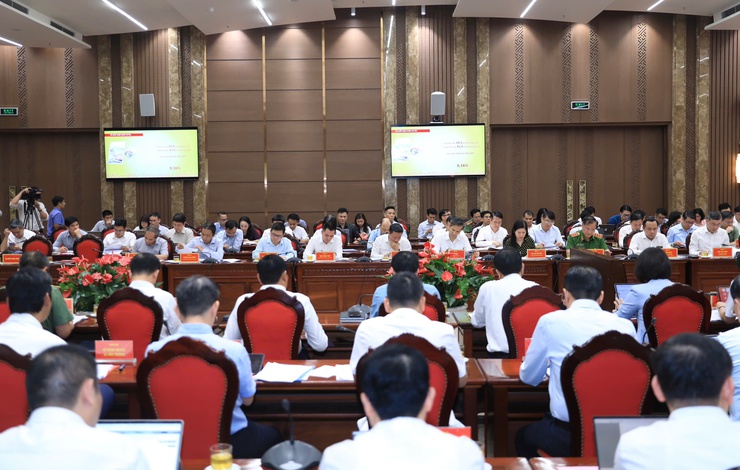 Delegates attend the meeting.
The Permanent Deputy Prime Minister also emphasized the importance of rental housing and social housing development. Demand for housing among public employees and workers remains extremely high, and expanding this sector would both support economic growth and improve social welfare.
In addition, he called on Hanoi to continue implementing Project 06, accelerate science and technology development, and advance comprehensive digital transformation in order to become a smart city and a leading innovation center in Asia.
Hanoi should introduce policies to attract talent and highly skilled workers. At the same time, it should continue addressing environmental challenges and traffic congestion and develop a roadmap for relocating universities from the city center to ease pressure on urban infrastructure.
Regarding administrative reform, he noted that under the revised Capital Law, Hanoi should take the lead in creating a more favorable business environment capable of attracting major domestic and international investors.
"Hanoi must always serve as the nation's center and a leading engine of development," he emphasized.