Speaking at the ceremony, Ho Trung Nghia, Chairman of the An Khanh Commune People's Committee, said An Khanh is an ancient land rich in revolutionary and cultural traditions, known for its craft villages, folk festivals, temples, pagodas and shrines, as well as many recognized historical and cultural sites.
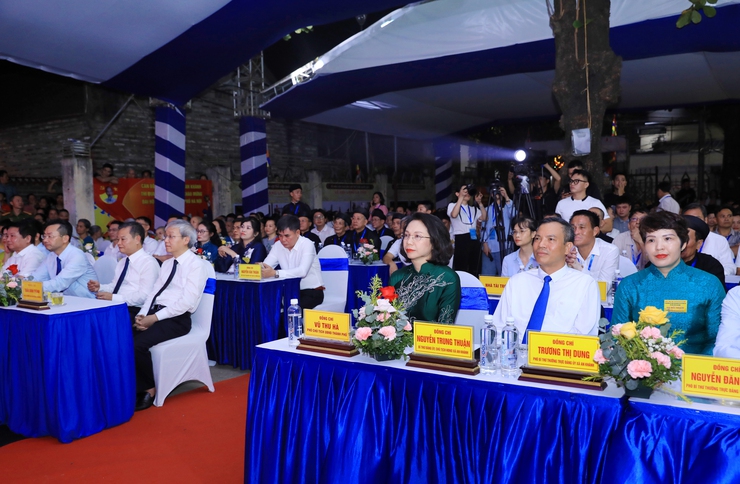
Overview of the event.
The commune currently preserves 81 cultural and historical relics, including 21 national-level sites, 12 city-level sites, and 48 inventoried sites.
In addition to its tangible heritage, An Khanh is home to an extensive collection of intangible cultural assets, with a total of 18 heritage elements such as the Ngai Cau "ca tru" singing art, the rice paper-making craft of Ngu Cau Village, and the traditional bone-setting practice of the Nguyen The family. The commune also hosts 11 traditional festivals that have been recognized as city-level cultural heritage.
The La Phu Village Festival is one of the oldest and most distinctive local traditions, reflecting the deep spiritual beliefs and cultural identity of the people of La Phu and Dong Nhan in An Khanh Commune. The festival honors and commemorates the village's tutelary deity, Tinh Quoc Tam Lang Dai Vuong, a general under King Hung Due Vuong.
According to legend, during the reign of the 18th Hung King, King Due Vuong ruled a peaceful and prosperous nation.
The deity was born into a noble family known for helping the poor and earning great respect among locals. By age three, he had learned humility; by age seven, he began formal studies and quickly excelled. By sixteen, he had mastered both literature and martial arts. After his parents passed away when he was twenty-five, he observed three full years of filial mourning.
At 28, he was chosen by the king for his exceptional talent and integrity, appointed as a military commander, and stationed at La Nuoc (later known as La Phu). Soon after, internal unrest broke out as the Thuc Kingdom invaded Vietnam.
The king appointed him to lead the vanguard army. With his strategic brilliance and courage, he quickly defeated the invaders and returned triumphantly to the capital.
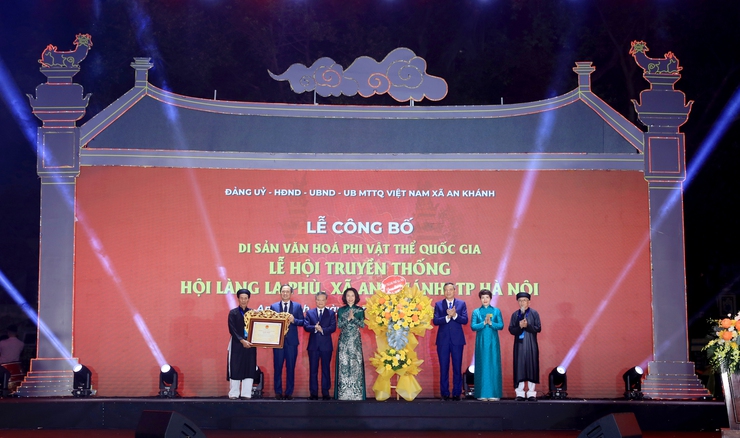
Delegates at the event.
In recognition of his service, the king conferred upon him the title of Que Cong Dai Vuong. After some years, he passed away peacefully, and since then, the 14th day of the first lunar month has been observed as his death anniversary.
The La Phu Village Festival is held annually from the 6th to the 15th day of the first lunar month, with a major festival every five years and smaller ones in other years.
The community has preserved the festival's cultural, historical, and spiritual values through well-organized rituals and preparations, maintaining traditional ceremonies that embody solemnity and respect. The event fulfills all the criteria for national intangible heritage recognition.
After a thorough nomination process, on June 27, 2025, the Ministry of Culture, Sports and Tourism issued Decision No. 2226/QD-BVHTTDL officially recognizing the La Phu Village Traditional Festival as part of the National Intangible Cultural Heritage List.
Chairman Ho Trung Nghia emphasized that the festival, held annually to honor Tinh Quoc Tam Lang Dai Vuong, allows later generations and the people of An Khanh to express gratitude to their ancestors, foster national pride, and remind everyone of their responsibility to preserve and promote their inherited traditions.
He added that safeguarding and revitalizing the festival is not only a way to maintain cultural identity but also to inspire the younger generation through education, develop sustainable cultural and festival tourism, and strengthen community unity.
In the coming years, the commune will continue collecting, researching, and documenting the festival, preserving its authentic elements, especially its rituals and setting. Authorities will strictly prevent any distortion, commercialization, or superstitious practices, while developing a digital database to preserve and pass down the heritage for future generations.