Reporting to the supervisory team, Nguyen Gia Hien, Secretary of the Party Committee and Chairman of the Commune People's Council, said the commune has achieved or surpassed most of its socio-economic targets. Budget revenue is estimated at VND 11.65 billion (US$466,000), or 122.3 percent of the annual plan, while budget expenditure stands at VND 347.8 billion (US$13.91 million), or 128.7 percent. The economic structure continues to shift in a positive direction, and cultural and social indicators have also improved.
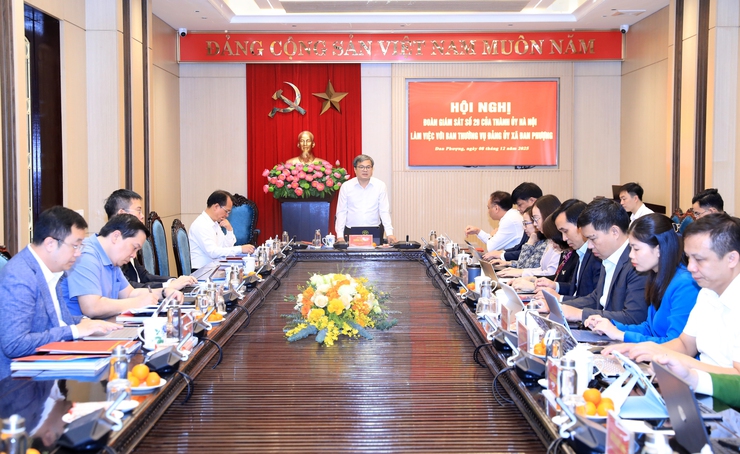
Overview of the meeting.
In 2025, Dan Phuong Commune implemented the two-tier local administration model and received a significant number of public investment projects from the commune.
The capital plan for 2025, including the 2024 carryover, totals VND822.683 billion (US$32.91 million) for 98 projects. After review, the adjusted plan stands at VND648.558 billion (US$25.94 million) for 99 projects. As of November 30, 2025, the commune has disbursed VND354.924 billion (US$14.20 million), equivalent to 54.73 percent of the adjusted plan, and aims to reach about 99.8 percent by January 31, 2026.
The commune has 19 projects requiring compensation, support and resettlement, covering a total clearance area of 274,482.6 square meters. This includes 199,029.3 square meters involving 1,085 households, and 75,435.3 square meters managed by the commune. To date, 162,136.4 square meters, or about 59 percent, has been cleared.
To accelerate progress, the Party Committee established a site clearance steering committee, chaired by the Secretary of the Party Committee, and issued operating regulations with monthly meetings. The commune has publicized policies, unit prices and land origins, and held direct dialogues with residents. Compensation and support payments total VND121.537 billion (US$4.86 million). For major projects such as Ring Road 4, the political system has worked in unison, encouraging households to comply while strictly addressing delays to meet the city's handover schedule.
Dan Phuong Commune has received 392 projects from the locality, including 211 completed, 50 under construction, and 93 in preparation. Some projects have been delayed for many years, requiring adjustments to investment policies, planning or total investment—issues that have caused waste and public concern.
The Party Committee and the Commune People’s Committee have directed a comprehensive review of all projects to assess planning conformity, investment efficiency and constraints relating to land, funding and administrative procedures. Projects are being categorized for accelerated implementation, adjustment or proposed cancellation.
For off-budget projects, such as the Binh Minh garden villa urban area and the Son Ha complex, the commune has reported to the city to review investor capacity and legal compliance, and to withdraw approvals for investors that are delayed or lack capacity.
For slow-moving public investment projects, the commune works with investors and contractors to determine underlying causes, such as land issues, planning changes, design modifications or weak contractor capacity. It proposes adjustments to capital plans, total investment and timelines, or replacement of contractors when necessary, while strengthening inspections and requiring progress commitments from project leaders.
Digital transformation is regarded as a strategic task. Training sessions have drawn more than 2,500 participants, representing nearly 95 percent of intended beneficiaries. The commune has invested in equipment for the public service center and digitized more than 91.8 percent of administrative records. Several digital models—such as Happy with AI, the digital education ecosystem and mobile literacy—have shown early results, helping residents become more familiar with digital services.
From July 1 to November 30, 2025, the one-stop service unit received 6,733 cases, processed 6,683, and completed 6,385 on time or ahead of schedule, achieving a 99 percent satisfaction rate. Resident feedback mainly focuses on improving software functionality, reducing repetitive declarations and enhancing data connectivity.
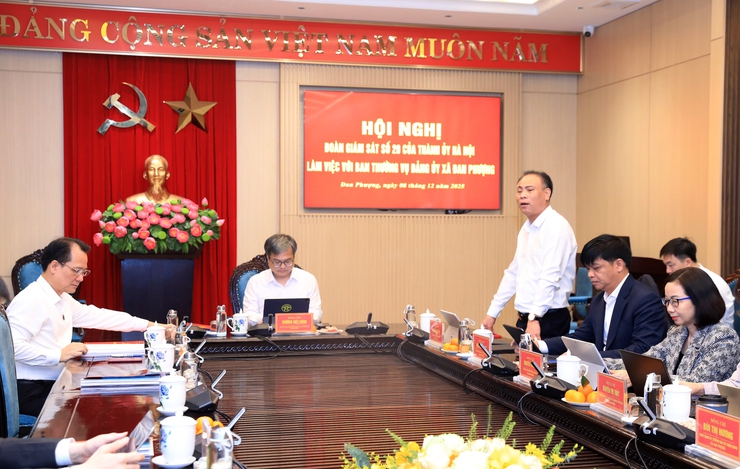
Overview of the meeting.
According to the Secretary of the Party Committee, rapid urbanization has created challenges such as land clearance obstacles, land and construction violations, localized congestion, environmental pollution, food safety concerns, sidewalk encroachment, security issues in border areas and overcrowded schools and health stations. The commune has taken coordinated measures, reviewed site clearance records for 128 households of former Song Phuong Commune and monitored construction violations in Dong Thap to maintain order.
The commune has organized environmental cleanups, unclogged drainage, cleared vegetation and carried out Green Sunday activities and clean and safe road campaigns. It has assigned local associations to manage community streets and improved waste collection while addressing illegal dumping.
Food safety is ensured through regular and unannounced inspections of collective kitchens and food establishments with strict penalties for violations and public guidance from the health station. Urban order and traffic safety have been strengthened through patrols, enforcement against sidewalk encroachment and improved parking and signage.
Social welfare policies have been implemented fully and on time with 100 percent of eligible residents receiving benefits and 99 percent of payments made via bank accounts. Indicators for social insurance and unemployment insurance have met or exceeded targets.
After hearing discussions from supervisory team members and the commune's responses, Vice Chairman of the City People's Committee Truong Viet Dung acknowledged and praised the efforts and achievements of Dan Phuong Commune.
He emphasized that the main goal of the supervision is to identify shortcomings and work with the commune to resolve them toward creating a more effective governance model that enables Dan Phuong to make breakthroughs and contribute to the capital's development. He outlined a strategic development roadmap with three phases.
Phase one focuses on removing all bottlenecks, with priority given to resolving outstanding issues in site clearance and land procedures. Commune leaders must work decisively and follow each case closely to create clean land for development.
Phase two is about accelerating progress and creating value by filling all industrial clusters, attracting investment and generating jobs while elevating local specialties such as Dien grapefruit. He encouraged building strong brands and bringing products onto e-commerce platforms and modern retail channels to increase value.
Phase three aims for double-digit growth based on innovative governance, strong application of technology and digital transformation with AI integration. Growth will depend on productivity and resource optimization rather than traditional inputs.
He said Hanoi is working to revise the Capital Law, Resolution 15 of the Politburo and a new special mechanism resolution that will offer more policy room for development. Later this month the city will introduce a new digital workspace, a mobile intelligent operations center and an AI assisted decision-making system to help commune leaders work efficiently anywhere and at any time.
He asked Dan Phuong Commune to prepare a concise proposal outlining clear goals and deliverables so the city can support them. He said that if the commune truly wants to make breakthroughs in line with the city's development momentum, it has every opportunity to do so and stressed that now is the golden time to act.