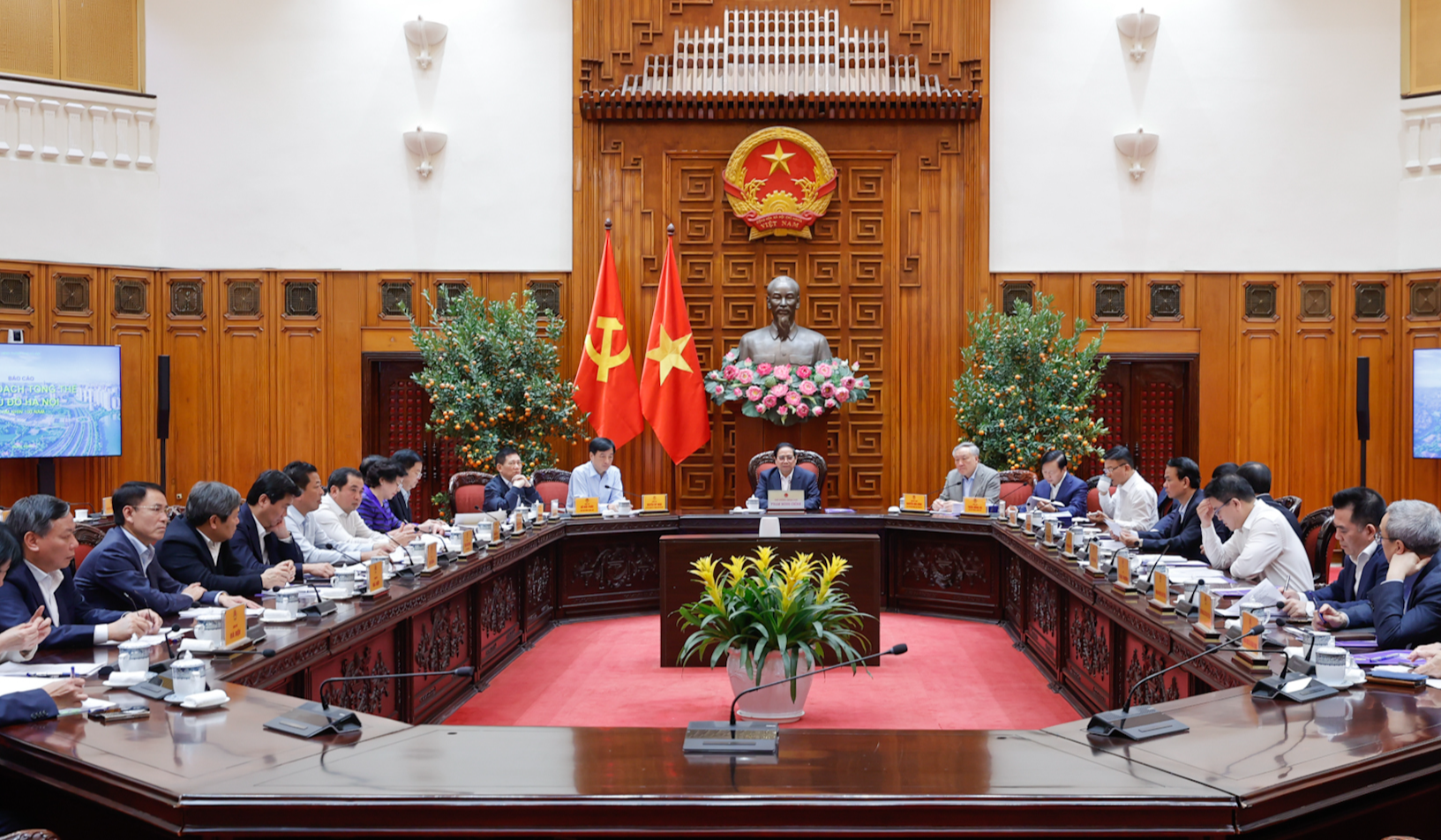
 Prime Minister Pham Minh Chinh chairs the Government Standing Committee meeting with Hanoi city leaders to continue reviewing and providing feedback on the Hanoi Capital Master Plan with a 100-year vision.
Hanoi Implements Three Major Strategic Tasks
On March 14, at the Government headquarters, Prime Minister Pham Minh Chinh chaired a meeting of the Government Standing Committee to review and provide opinions on the Hanoi Capital Master Plan.
After hearing reports from leaders of the Hanoi People’s Committee, as well as opinions from ministries, agencies, and Deputy Prime Ministers, the Government Standing Committee welcomed, commended, and highly appreciated Hanoi for continuing to uphold and promote its traditions and achievements, and for proactively, urgently, and effectively implementing three key strategic tasks with both immediate and long-term significance, guided by a forward-looking vision and a bold approach.
These tasks include the development of a Politburo Resolution on building and developing the Capital in the new era; the drafting of amendments to the Capital Law for submission to the National Assembly; and the preparation of the Hanoi Capital Master Plan with a 100-year vision.
Although completed within a short period, these draft documents were carefully prepared, with strong intellectual input and practical relevance, reflecting high determination and great effort. At the same time, land clearance for Hanoi's projects has been accelerated with public support, helping advance major projects, remove bottlenecks, and support double-digit economic growth.
The Hanoi Capital Master Plan is very important for the development of the capital, the capital region, the Red River Delta, and the entire country. Therefore, it must reflect long-term vision, intelligence, culture, identity, people, society, and Vietnam's development in the new era.
Hanoi will continue reviewing, specifying, and incorporating all relevant resolutions and conclusions of the Central Committee, the Politburo, and the Secretariat, especially Politburo Resolution No. 02-NQ/TW on building and developing the Hanoi Capital in the new era, as well as directives from General Secretary To Lam. The city will also incorporate appropriate feedback from ministries, agencies, and Deputy Prime Ministers to finalize the master plan for submission to competent authorities.
The philosophy of the Hanoi Capital Master Plan is to place people at the center and as the main driver, aiming for a strong, civilized, prosperous, and happy city rich in cultural identity, modern in development, and built with a 100-year vision.
The development model includes multi-polar, multi-layered, multi-center, and multi-directional urban development linked with digital, green, clean, and beautiful development, harmonizing people, culture, society, and nature, with the concept of "villages within the city and the city within villages," preserving and promoting Hanoi's unique cultural heritage.
Key breakthroughs include urban redevelopment, rural modernization, smart services, and advanced industry aligned with global trends, while still preserving Hanoi's cultural identity.
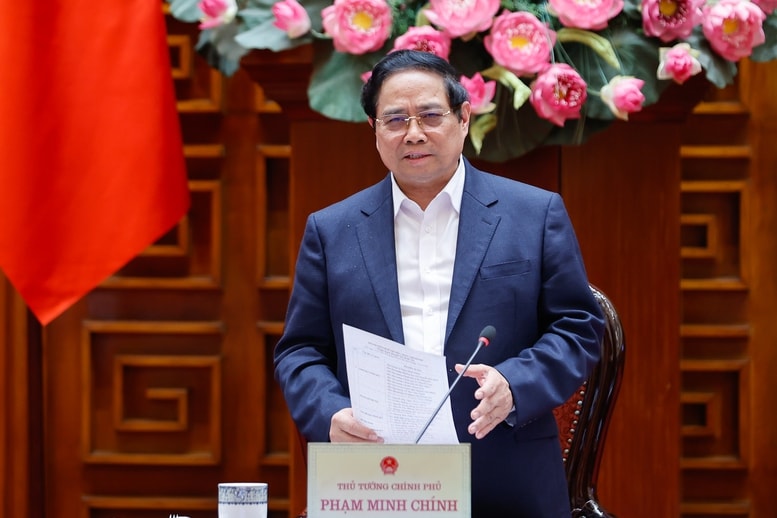 The Prime Minister emphasized that the Hanoi Capital Master Plan is very important for the development of the capital, the region, and the country.
Focus on Clarifying Several Key Issues
The Government Standing Committee requested Hanoi People's Committee to study and further clarify several issues, including planning for low-altitude economic space, gradually expanding to high-altitude and space economy; underground space planning, including underground infrastructure for electricity, water, telecommunications, and transport, especially metro systems; reviewing sectors and optimizing land use, especially in southern Hanoi, Xuan Mai, Ba Vi, Son Tay, and Soc Son.
The plan includes nine new growth poles and urban redevelopment; development orientation for the West Lake central area linked with population redistribution to ensure harmony and infrastructure capacity; and designing direct connections between the nine new growth poles with modern planning, open space, long-term vision, especially development along both sides of the Red River.
The plan also includes development of a secure and resilient capital, taking into account electronic warfare and high-tech warfare scenarios, especially in the Ba Dinh central administrative and political area.
The Government Standing Committee also requested assessment of the potential and competitive advantages of proposing a second airport for Hanoi compared with nearby airports, and studying airport economy development linked with free trade zones and modern logistics services.
Regional ecosystem connectivity between the capital and surrounding provinces will also be strengthened, especially in socio-economic development, culture, infrastructure sharing, environment, waste treatment, and cemeteries, in line with adjustments to the Red River Delta regional plan and the Northern Midlands and Mountainous regional plan.
The plan will promote modern, intelligent, multimodal transport connectivity between regions and among the nine growth poles and major centers to address traffic congestion.
The plan must also ensure disaster prevention, climate change adaptation, Red River water management, water resource protection, restoration of rivers, and solutions for environmental pollution, flooding, and traffic congestion. Strict land-use indicators must be ensured, especially green space ratios in the urban core, in line with green and digital development standards.
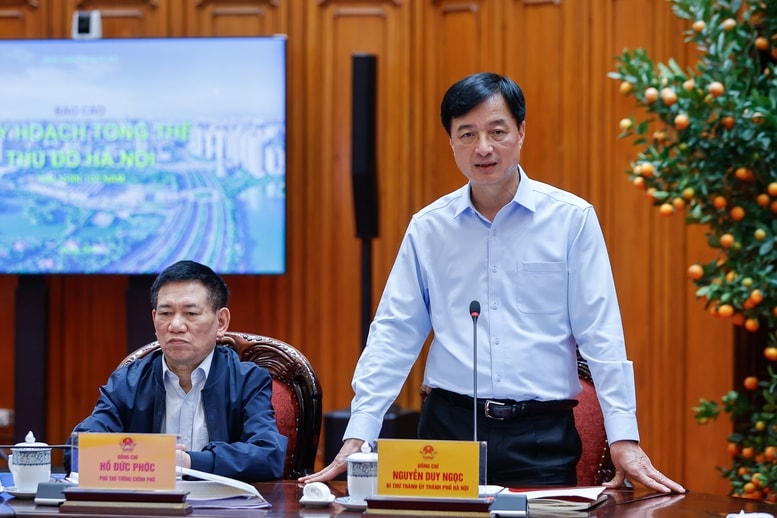 Hanoi Party Secretary Nguyen Duy Ngoc speaks at the meeting.
The plan must preserve and promote Hanoi's cultural heritage, including the Old Quarter and historical and cultural sites, while planning development space and leading the development of cultural and entertainment industries, and strengthening regional tourism linkages to create valuable cultural tourism product chains.
Urban governance must be strict and sustainable, with smart urban management according to approved plans, minimizing arbitrary adjustments that could undermine the long-term master plan, especially protecting ecological zones, green corridors, and green buffer zones at ring roads, gateways, and boundaries of the central area.
The city should diversify funding sources from citizens, businesses, and society while optimizing state resources, promoting public-private partnerships such as build-transfer, build-operate-transfer, public investment with private management, TOD development models, bond issuance, and social housing funds. Investment priorities must be clearly defined to create the greatest spillover effects. Internal resources, including people, nature and culture, should be the fundamental, strategic, and long-term foundation, while external resources such as finance, technology, governance, and training should serve as important leverage and breakthroughs for successful implementation of the master plan.
The city must review major issues with inter-regional and inter-sector impacts and decide within its authority, while issues beyond its authority must be reported to competent authorities before approval.
In addition, Hanoi will study international experience and consider building a Planning Exhibition Center to publicly display the capital's plans, monitor planning implementation, promote investment, and serve as a tourism product for the city, contributing to modernization and digitalization of planning.
Regarding Hanoi's proposals, specifically the Vietnam National Village for Ethnic Culture and Tourism, the Government Standing Committee requested Hanoi People's Committee to coordinate with the Ministry of Culture, Sports and Tourism and relevant agencies to study and submit proposals to competent authorities to ensure effective management, conservation, and operation of the site, especially ensuring stable livelihoods for ethnic communities living there. Deputy Prime Minister Mai Van Chinh was assigned to oversee and submit the proposal to the Government in March 2026.
Regarding Ba Vi National Park, Hanoi People's Committee will coordinate with the Ministry of Home Affairs, the Ministry of Agriculture and Environment, Phu Tho Provincial People's Committee, and relevant agencies to study and submit proposals to competent authorities in accordance with current law, ensuring strict protection, conservation, and effective use of Ba Vi National Park, with unified management under a single authority. Deputy Prime Minister Pham Thi Thanh Tra was assigned to oversee this matter.
Regarding the national railway line (Yen Vien – Ngoc Hoi section), Hanoi People's Committee will coordinate with the Ministry of Construction and relevant agencies to conduct detailed studies and impact assessments for submission to competent authorities. Deputy Prime Minister Tran Hong Ha was assigned to oversee this issue.
Regarding specific standards and technical regulations, Hanoi People's Committee will coordinate with the Ministry of Construction and relevant agencies to develop technical standards and regulations that both meet local specific requirements and ensure national connectivity and applicability across the country.