The workshop was chaired by Tran The Cuong, Member of the Standing Committee of the Hanoi Party Committee and Permanent Vice Chairman of the Hanoi People’s Council. It was attended by representatives of the Vietnam Fatherland Front, leaders of the People’s Council committees, officials from various departments and agencies, consulting units, as well as domestic and international experts and scientists in planning and architecture.
In his opening remarks, Tran The Cuong, Permanent Vice Chairman of the Hanoi People's Council, said the preparation of the Hanoi Capital Master Plan now has a full political, legal, and practical foundation.
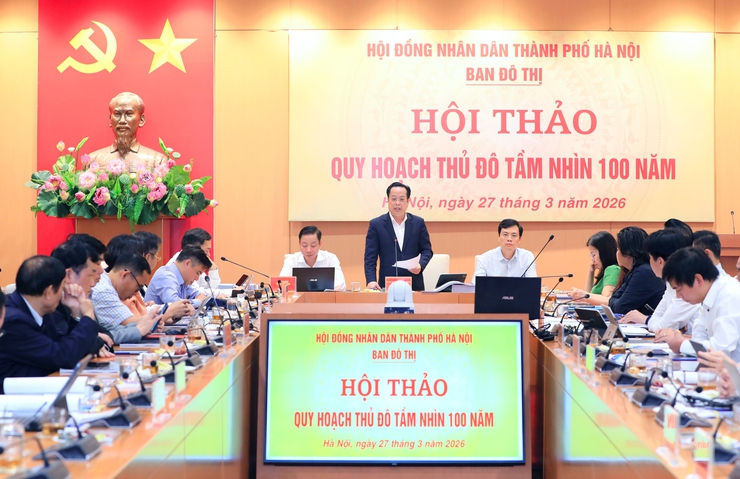 Tran The Cuong, Permanent Vice Chairman of the Hanoi People's Council, chairs the workshop.
On March 17, 2026, the Politburo issued Resolution No. 02. Together with the Hanoi Capital Master Plan with a 100-year vision, which has already received comments from the Government Standing Committee, and the amended Capital Law, which is expected to be reviewed by the National Assembly, these form three foundational pillars for the capital's development in the coming period.
On that basis, Cuong stressed: "The Hanoi Capital Master Plan is of special importance, not only for Hanoi, but also for the Capital Region, the Red River Delta, and the country as a whole. The plan must reflect a long-term vision, crystallize intelligence, culture, and identity, and at the same time place people at the center and as the subject of the development process."
Under current regulations, the Hanoi People's Council will review and approve the plan. The Hanoi Capital Master Plan with a 100-year vision is expected to be submitted at the first session of the 17th Hanoi People's Council, term 2026–2031.
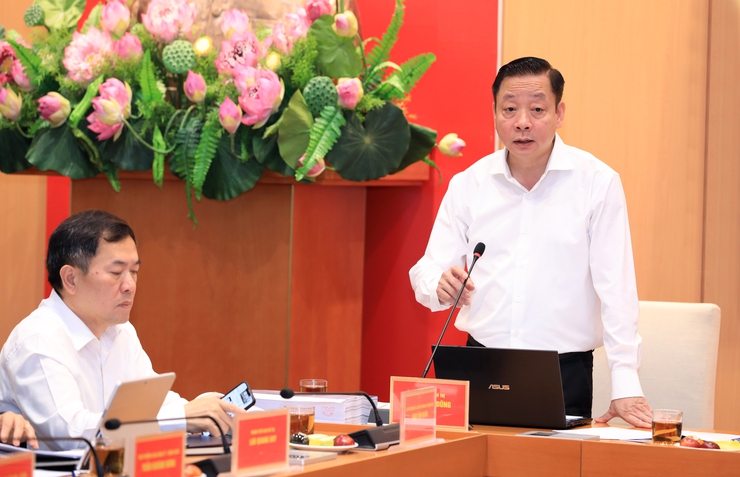 Tran Hop Dung, Head of the Urban Affairs Committee of the Hanoi People's Council, moderates the discussion.
Emphasizing the role of expert opinions, Cuong said the Hanoi People's Council always listens carefully to voters, the public, and scientists to ensure that its decisions are of high quality and closely aligned with reality.
Presenting a summary report on the progress of preparing the Hanoi Capital Master Plan with a 100-year vision, Nguyen Trong Ky Anh, Director of the Department of Planning and Architecture, said the planning process is being carried out on the basis of three important pillars: Politburo Resolution No. 02, the Capital Law, and the policy directions of the Central authorities and the Government.
Accordingly, the Department of Planning and Architecture was assigned to organize the preparation of the plan from the beginning of 2026, building on previously approved plans to ensure continuity and consistency in urban management and development. The city has mobilized both domestic and international consulting units and has also established an appraisal council to review and finalize the plan.
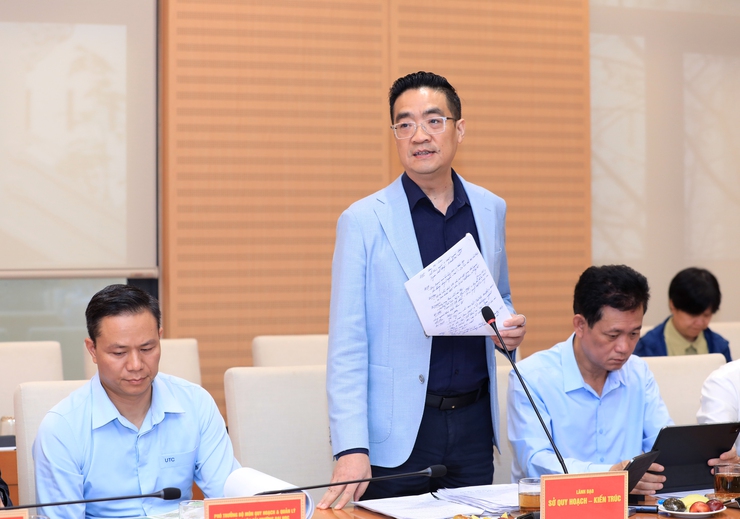 Nguyen Trong Ky Anh, Director of the Department of Planning and Architecture, presents a summary report on the progress of preparing the Hanoi Capital Master Plan with a 100-year vision.
The implementation process has also closely followed major policy directions, emphasizing the need to develop the capital in an outstanding and sustainable way, with people at the center, while preserving cultural values, identity, and a long-term vision.
Notably, by March 26, the appraisal council had met and provided comments on the plan. At the same time, broad public consultation with organizations, experts, and local communities collected more than 13,700 comments.
According to Anh, the comments focused on five major groups of issues: development of the Red River spatial corridor; heritage preservation and key areas; transport and energy infrastructure planning; social welfare; and climate change adaptation and flood prevention.
First, on the development direction for the Red River spatial corridor, most comments proposed building a scenic boulevard corridor linked with renovation and upgrading of existing residential areas. However, local communities also expressed concern over the scale of site clearance, about 2,100 hectares, especially relocation plans, population redistribution, and the impact on livelihoods, security, and social order.
Second, on key areas and heritage preservation, comments focused on the historic inner city and riverfront areas along the Red River such as Tu Lien, Nhat Tan, and Quang Ba. Residents requested a review of the legal status of existing structures and stressed that heritage preservation should be flexible and linked to actual use, avoiding rigid conversion into museum models and ensuring the preservation of the "villages within the city" identity.
Third, on transport and energy infrastructure planning, comments recommended optimizing investment resources and limiting road expansion in the inner city because of high costs. Instead, priority should be given to developing backbone infrastructure in outer areas to support population redistribution. Suggestions also included developing ecological transport, electric vehicles, and urban development based on the TOD model.
Fourth, on social equity and welfare, residents focused on compensation and resettlement support mechanisms that should move closer to market prices and prioritize on-site resettlement. They also called for full social impact assessments, especially for large-scale urban redevelopment projects.
Fifth, on climate change adaptation and hydrological safety, comments focused on maintaining flood discharge corridors, especially along the Red River and the city's internal rivers. Long-term solutions proposed included retention lakes, water storage spaces, and integrated green and water systems to reduce flooding and improve the urban environment.
These comments will be received and studied to further finalize the plan, ensuring quality, feasibility, and public consensus before submission to competent authorities for review and decision.
At the workshop, experts affirmed that the Hanoi Capital Master Plan is highly important for the development of the capital, the Capital Region, the Red River Delta, and the country as a whole. Therefore, it must reflect long-term vision, intelligence, culture, identity, people, society, and Vietnam's development in the new era, with people at the center and as the main subject of development.
Noting that traffic congestion, environmental pollution, and transport costs are major issues facing Hanoi, experts said the plan must include the development of public transport, with urban rail as the core and central element.
Many participants also said the plan's philosophy of placing people at the center, shifting planning from a purely physical model to a welfare-based model, is highly humane and appropriate, in line with approaches used in advanced countries. The ambitious goal is justified, but the current plan has yet to answer how happiness should be measured and by what standards. Therefore, a standardized measurement framework is needed for independent verification and comparison with other cities. Another view raised at the workshop was that the plan should turn the historic inner city into a creative complex through adaptive reuse of vacant buildings. A roadmap is needed to make creative use of these structures as urban development expands into other areas.
In his concluding remarks, Cuong expressed sincere appreciation for the dedicated contributions of experts, scientists, and delegates at the workshop. He asked relevant agencies to urgently incorporate all comments and finalize the planning dossier to ensure quality and timely submission to the Hanoi People's Council for review and approval. At the same time, departments and agencies were asked to proactively review and explain issues where differing opinions remain, thereby improving feasibility and consensus during implementation.