New approaches and initiatives lay the groundwork for long-term development
On behalf of the Government, Prime Minister Le Minh Hung praised the efforts and achievements of Hanoi's Party organization, government, and people, describing them as important contributions to the country's overall development.
Reviewing Hanoi's socio-economic performance, the Prime Minister noted that the city's average GRDP growth during 2021-2025 reached 6.57%. In the first quarter of 2026, GRDP expanded by 7.87%, exceeding the national average. Beyond growth in scale, Hanoi's economic structure has also shifted in a positive direction, aligning with Party policies and resolutions adopted by the Hanoi Party Congress, thereby improving both the quality and sustainability of growth.
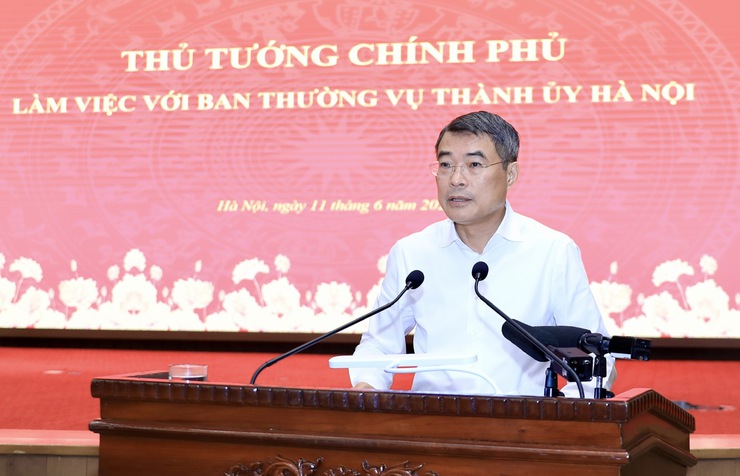 Prime Minister Le Minh Hung delivers concluding remarks.
The Prime Minister also acknowledged Hanoi's strong implementation of resolutions and conclusions issued by the Party Central Committee, the Politburo, the National Assembly, the Government, and directives from the General Secretary, while actively advancing implementation of the Capital Law.
He highlighted a number of innovative approaches adopted by the city in land clearance, major infrastructure development, preparation of the Capital Master Plan with a 100-year vision, and efforts to resolve long-delayed projects. These initiatives, he said, have created an important foundation for Hanoi's long-term development.
In particular, Hanoi has emerged as one of the country's leading localities in implementing Resolution No. 57-NQ/TW on science, technology, innovation, and digital transformation. The city has expanded online public services, promoted data-driven governance, and effectively operated the two-tier local government model.
Vast development potential remains underutilized
Despite these positive results, Prime Minister Le Minh Hung said Hanoi must candidly recognize the challenges and limitations it still faces.
According to the Prime Minister, the capital retains enormous development potential that has yet to be fully and effectively utilized. Before seeking additional mechanisms, resources, or support from the central government, Hanoi should make the most of its existing strengths and opportunities and convert them into practical resources for development.
One of Hanoi's greatest advantages is the special framework provided under the Capital Law.
"Hanoi is one of the few localities empowered both to design policies and to implement them. This is an exceptionally favorable condition for creating development breakthroughs," the Prime Minister said.
However, he emphasized that for the new mechanisms to become effective when they take effect on July 1, 2026, Hanoi must continue refining its policy framework to ensure that reforms are both ambitious and practical.
Review bottlenecks in every sector
Although Hanoi recorded GRDP growth of 7.87% in the first quarter of 2026, Prime Minister Le Minh Hung noted that this remains below the city's growth scenario and the level needed to achieve its annual growth target of 11%.
As a result, the city faces considerable pressure in the second half of the year, particularly given its role as one of the country's most important growth engines. Failure to meet its growth target would have a direct impact on national economic performance.
The Prime Minister drew particular attention to limitations in mobilizing social resources, especially from the private sector. He urged Hanoi to carefully identify bottlenecks in every industry and sector and introduce timely support measures, as these sectors directly contribute to economic growth.
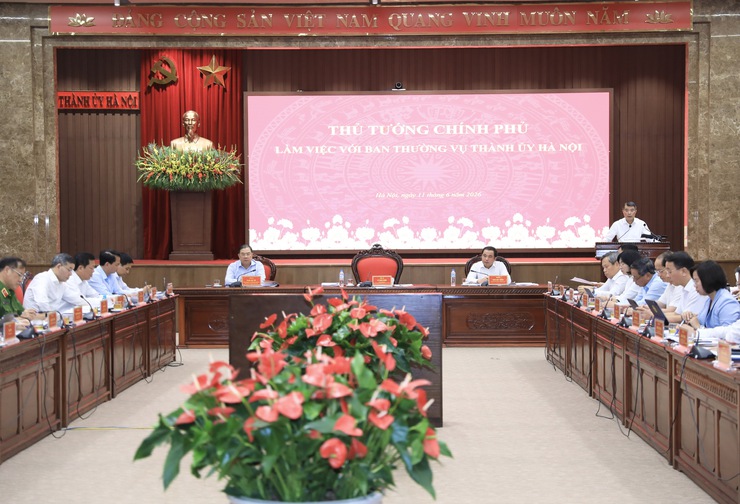 Overview of the meeting.
Hanoi should strive for breakthroughs in attracting a new generation of foreign direct investment linked to technology transfer, development of strategic technology products, and stronger connections between foreign-invested enterprises and domestic supply chains.
At the same time, the city should continue making significant improvements to its investment and business environment, reform the working methods of state agencies, and create more favorable conditions for domestic and foreign businesses and investors.
The Prime Minister also pointed out that several public investment projects remain behind schedule due to difficulties related to land clearance, land-use planning, resettlement housing, and construction material supplies.
Against this backdrop, he called on Hanoi to continue fulfilling its role as a national leader by proactively and effectively mobilizing all available resources, implementing the special mechanisms granted under the Capital Law, creating institutional breakthroughs, attracting investment, and strengthening competitiveness.
The city should clearly distinguish between tasks within its authority and those requiring central government involvement. For matters beyond its authority, Hanoi should promptly propose solutions to the Government and Prime Minister so that ministries and agencies can take the lead in resolving them.
The Prime Minister also encouraged Hanoi to commission research projects and strategic technology products that directly support city governance as well as business and production activities across the capital.
Higher ambitions for greater contributions
Prime Minister Le Minh Hung expressed broad agreement with the groups of tasks and solutions proposed by Hanoi.
He said that the current system of policies, guidelines, resolutions, conclusions, and legal frameworks issued by the Party, National Assembly, Government, and other competent authorities is now relatively comprehensive and provides favorable conditions for the city's development.
As the nation's political and administrative center and a major hub for economic, cultural, scientific, and technological activities, Hanoi should set higher development goals and standards to contribute more significantly to national progress.
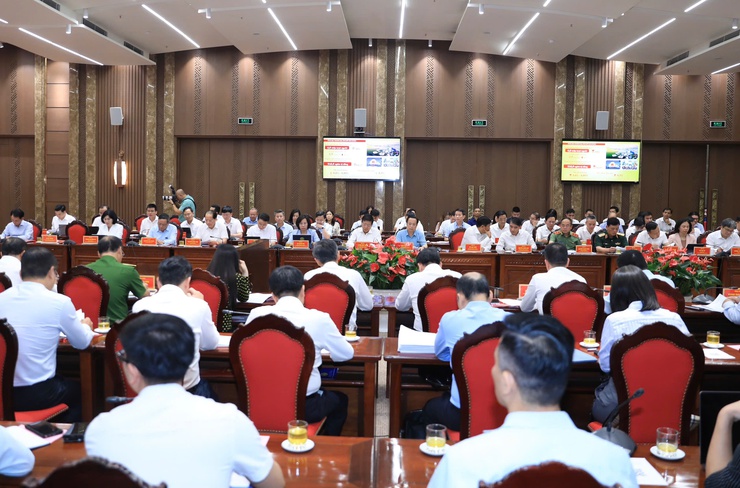 Delegates attend the meeting.
Looking ahead, the Prime Minister urged Hanoi to continue translating Party policies into concrete action programs and implementation plans, with particular attention to effective implementation of the Capital Law.
He called on the city to proactively study, propose, and implement breakthrough policies authorized under the law to create a more open and development-oriented institutional environment. He also emphasized the importance of close coordination with central ministries and agencies during policy design and implementation to ensure consistency, practicality, and effectiveness.
Another key priority is strengthening regional cooperation between Hanoi and neighboring provinces within the Capital Region and the Red River Delta, particularly in transport infrastructure, environmental protection, water resource management, air pollution control, and the development of production and supply chains for goods and services.
The Prime Minister instructed Hanoi to accelerate the implementation of tasks assigned under resolutions and conclusions issued by central authorities, especially Conclusion No. 18, which includes clearly defined deadlines.
To achieve the city's 11% growth target for 2026—and potentially exceed it—Hanoi should reassess its entire growth scenario for the second half of the year based on actual performance during the first five months and projected results for the first six months.
Specific targets should then be assigned to each department, sector, locality, and economic field.
The Prime Minister emphasized that all development targets must be clearly quantified and linked to specific responsibilities for both agencies and individual officials. Members of the Hanoi Party Committee Standing Board and Executive Committee should be assigned to directly oversee particular sectors, localities, departments, and communes or wards.
"We must fully exploit every remaining source of growth in 2026, focusing on manufacturing and processing industries, trade and services, banking, insurance, construction, and support for production and business activities," he said.
The city should also maintain a balance between supply and demand for goods and production inputs, strengthen oversight of local macroeconomic conditions, particularly prices, markets, and supplies of raw materials and fuel, and implement decisive measures to stabilize prices, especially for essential goods and production inputs.
Prime Minister Le Minh Hung reaffirmed that, as the nation's capital, Hanoi must continue serving as a pioneer and growth leader, making ever-greater contributions to national economic development and generating spillover benefits for the Capital Region, the Red River Delta, and the country as a whole.
Regarding Hanoi's proposals, the Prime Minister noted that the city had submitted five specific recommendations. He expressed general agreement in principle with the proposals and instructed ministries and agencies to review them and address issues within their authority, while promptly reporting matters requiring higher-level approval.