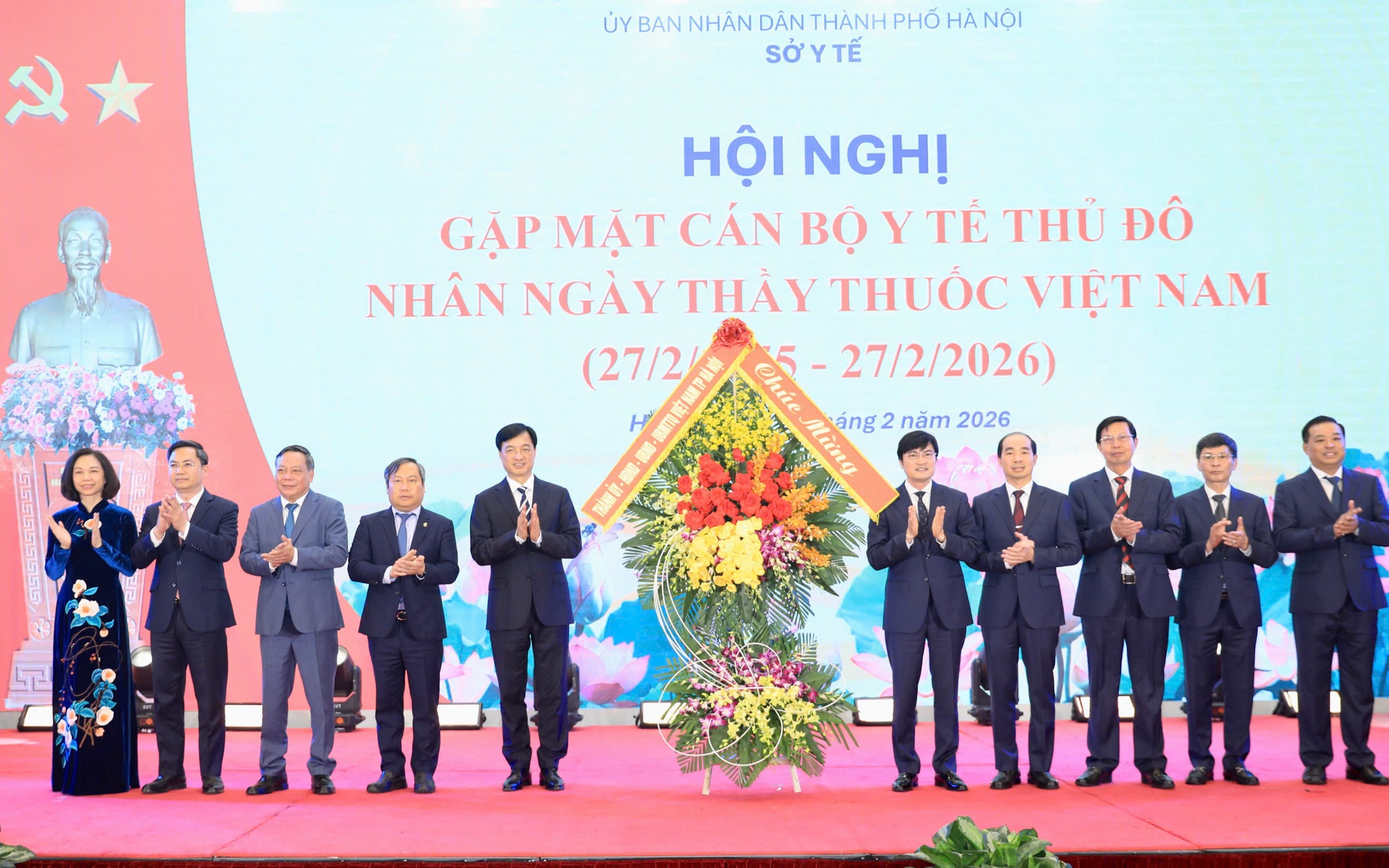
 Hanoi Party Secretary Nguyen Duy Ngoc and city leaders present flowers to congratulate the Department of Health.
Attending the conference were Politburo member and Hanoi Party Secretary Nguyen Duy Ngoc; Party Central Committee member, Deputy Secretary of the Hanoi Party Committee and Chairman of the Hanoi People’s Committee Vu Dai Thang; and Deputy Head of the National Assembly Committee for Public Aspirations and Oversight Tran Thi Nhi Ha.
Also present were Deputy Minister of Health Nguyen Thi Lien Huong; Deputy Secretary of the Hanoi Party Committee Nguyen Van Phong; Member of the Standing Committee of the Hanoi Party Committee and Head of its Organization Commission Ha Minh Hai; and Vice Chairwoman of the Hanoi People’s Committee Vu Thu Ha.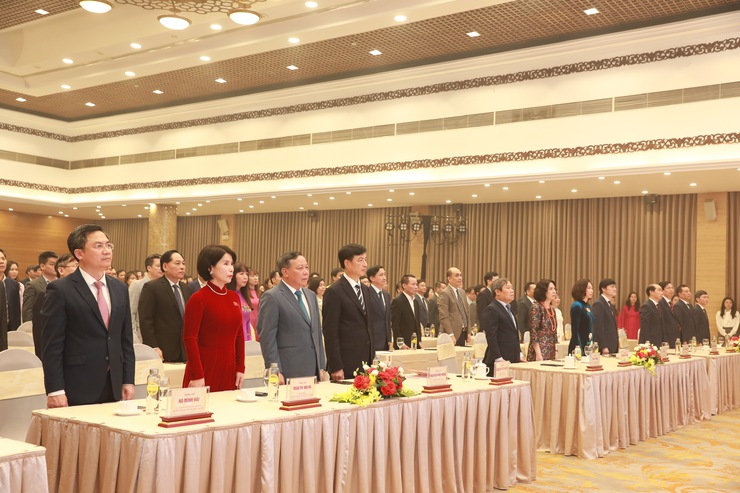 Delegates listen to the historic letter of President Ho Chi Minh sent to the National Conference of Health Officials in 1955.
In his opening remarks, Director of the Hanoi Department of Health Nguyen Trong Dien said that over the past 71 years, under the leadership of the Hanoi Party Committee, the People’s Council, the People’s Committee, and the Ministry of Health, the city’s healthcare sector has achieved significant milestones, contributing to the capital’s socio-economic development.
Entering a new phase of development, the sector has adopted the action motto “Pioneering – Connecting – Breakthrough for a capital healthcare system that is integrated, modern, smart and humane,” as the overarching orientation guiding all policies and development solutions.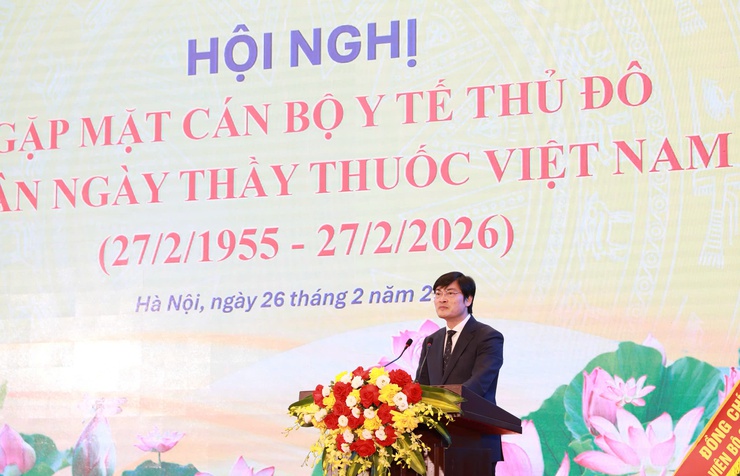 Director of the Hanoi Department of Health Nguyen Trong Dien delivers the opening speech.
The sector aims to pioneer innovation, accelerate digital transformation, and apply scientific and technological advances; strengthen linkages among municipal departments, central hospitals, and public and private healthcare facilities, as well as expand public–private partnerships at home and abroad; and make breakthroughs in service quality, system governance, and human resource development toward a patient-centered and humane healthcare system.
Dien emphasized that 2026 will be a pivotal year in achieving key targets, with the capital’s healthcare sector set to resolutely implement Politburo Resolution No. 72-NQ/TW and Action Program No. 06 of the Hanoi Party Committee.
The sector will also integrate relevant central resolutions to advance digital transformation, improve public health, optimize the healthcare system, foster a strong sectoral culture, and enhance international integration.
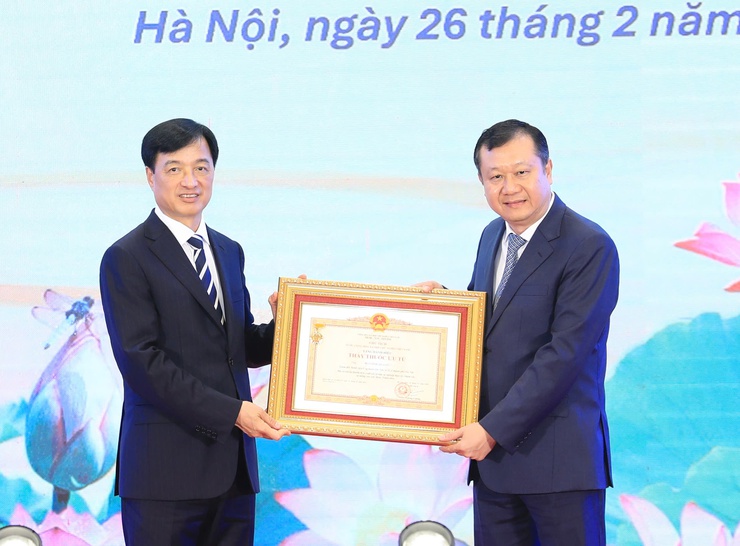 Hanoi Party Secretary Nguyen Duy Ngoc presents the “Excellent Physician” title to Dr. Bui Vinh Quang.
In the context of implementing the capital’s 100-year master plan and the revised Law on the Capital, the healthcare sector is proactively restructuring toward a modern and sustainable system, building a core-satellite hospital network and strengthening preventive healthcare and grassroots medical stations. It also identifies a key role in addressing food safety bottlenecks through chain-based management, traceability and digital transformation.
On this occasion, Dien called on all healthcare staff to continue innovating, being creative and dedicated to realizing the goal of building an integrated, modern, smart and humane healthcare system for the capital.
Speaking at the conference, on behalf of city leaders, Hanoi Party Chief Nguyen Duy Ngoc congratulated healthcare officials, doctors and staff of the capital as well as collectives and individuals honored for their contributions to protecting and improving public health.
He stressed that Hanoi is not only the political and administrative center of the country but also a leading hub for science, education, healthcare and international exchange. With a large population, high density, rapid urbanization and population aging, ensuring social security and healthcare places increasing pressure on the healthcare system.
According to Ngoc, under the direction of central authorities, the Ministry of Health and the city, the capital’s healthcare sector has achieved positive and comprehensive results. The healthcare system has been improved in a synchronized and modern direction. Digital transformation has been gradually implemented, forming the foundation for a smart healthcare ecosystem.
Capacity for disease prevention and control has been strengthened, with preventive and grassroots healthcare receiving increasing attention. Medical examination and treatment have seen clear improvements as procedures have been streamlined, waiting times reduced and service attitudes become more professional. Many advanced techniques have been mastered and effectively implemented, helping reduce pressure on central hospitals and enhance the professional standing of Hanoi’s healthcare sector.
Ngoc assessed that the implementation of action programs of the Hanoi Party Committee is creating an important foundation for faster and more sustainable development of the healthcare sector. Large-scale healthcare projects and models linking hospitals, universities and research institutes are expected to open new development directions, gradually bringing Hanoi’s healthcare to regional and international standards.
“The capital’s healthcare sector must build a synchronized, modern and high-quality system, with disease prevention and primary healthcare as the foundation, specialized healthcare and international integration as the driving force and science, technology and digital transformation as the breakthrough,” he emphasized.
Entering a new development phase, Ngoc requested the sector shape long-term development thinking aligned with the capital’s overall master plan, placing science, technology, innovation and high-quality human resources at the center. Healthcare workers must uphold medical ethics and continuously update their knowledge. Patient satisfaction must be the measure of service quality, while encouraging innovation and a spirit of daring to think and act for the common good.
He said Hanoi is oriented toward deploying new healthcare models to improve public health efficiency, including strengthening linkages between central hospitals and grassroots facilities, building a synchronized digital health data system, developing care and rehabilitation centers, applying smart devices in elderly care and promoting high-quality medical tourism.
“All tasks must be implemented under the ‘six clear’ principle: clear people, clear tasks, clear timelines, clear responsibilities, clear products and clear authority, ensuring substantive progress and tangible effectiveness,” Ngoc stressed.
He also required enhanced safety at healthcare facilities, considering this a key condition for improving medical service quality and building a friendly and professional healthcare image.
In addition, Hanoi aims to strengthen the linkage between education and healthcare to build a human development ecosystem for the capital toward 2035 with a vision to 2045. School healthcare will be implemented proactively to prevent diseases, care for physical and mental health and detect health issues early among students.
“This is not only a management requirement but also a political commitment and demonstration of the healthcare sector’s implementation capacity before the Party organization, authorities and people of the city,” Ngoc emphasized.
On the occasion of the 71st anniversary of Vietnamese Doctors’ Day, he expressed confidence that the capital’s healthcare sector will continue to uphold its tradition, solidarity and innovation and follow President Ho Chi Minh’s teaching that “A good physician must be like a loving mother,” contributing to building an increasingly civilized, modern and happy Hanoi.
Ngoc also expressed his appreciation to the Ministry of Health, central agencies, and both public and private healthcare institutions for their support to Hanoi, and called for continued close coordination to further develop the capital’s healthcare sector in the new period.