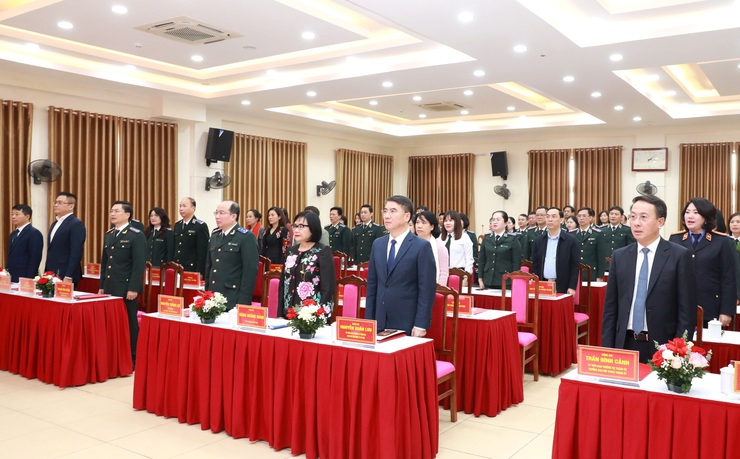
Attending the conference were Deputy Minister of Justice Dang Hoang Oanh; Nguyen Xuan Luu, a member of the Standing Committee of the Hanoi Party Committee and Vice Chairman of the Hanoi People’s Committee, who also serves as head of the city’s Civil Judgment Enforcement Steering Committee; and Tran Dinh Canh, a member of the Standing Committee of the Hanoi Party Committee and Head of the Party Committee’s Internal Affairs Commission.
Also present were Nguyen Thang Loi, Director General of the Department of Civil Judgment Enforcement Management; Pham Van Dung, Director of the Hanoi Civil Judgment Enforcement Agency; and representatives of relevant agencies.
Overview of the event.
Recovering VND5.87 trillion in corruption and economic crime cases
Reports at the conference showed that in 2025, despite a persistently high volume of cases and enforcement amounts, and the execution of many particularly serious and complex corruption and economic crime cases involving multiple parties, the Hanoi Civil Judgment Enforcement Agency implemented comprehensive solutions and achieved notable results, meeting and exceeding assigned targets.
Specifically, the agency handled 67,779 cases in total, including 45,430 newly accepted cases. After excluding cases transferred for enforcement under regulations, the total number of cases subject to enforcement was 66,495. Of the 46,576 cases eligible for enforcement, 39,430 were completed, achieving a rate of 84.66 percent. This marked an increase of 1.02 percentage points compared with 2024 and exceeded assigned targets by 0.76 percentage points.
Delegates at the event.
In terms of enforcement value, the total amount subject to enforcement reached VND107.93 trillion (US$4.32 billion), of which VND44.89 trillion (US$1.80 billion) was eligible for enforcement.
The agency successfully enforced VND25.10 trillion (US$1.00 billion), achieving a rate of 55.91 percent, up 6.58 percentage points year on year and 4.01 percentage points above the assigned target.
Regarding asset recovery in corruption and economic crime cases, the agency organized enforcement for 3,208 cases, with a total enforcement value of VND15.77 trillion (US$631 million). Of the 3,043 cases eligible for enforcement, 2,901 were completed, recovering VND5.87 trillion (US$235 million). These results made an important contribution to anti-corruption and anti-negativity efforts.
Stronger digital application and organizational reform
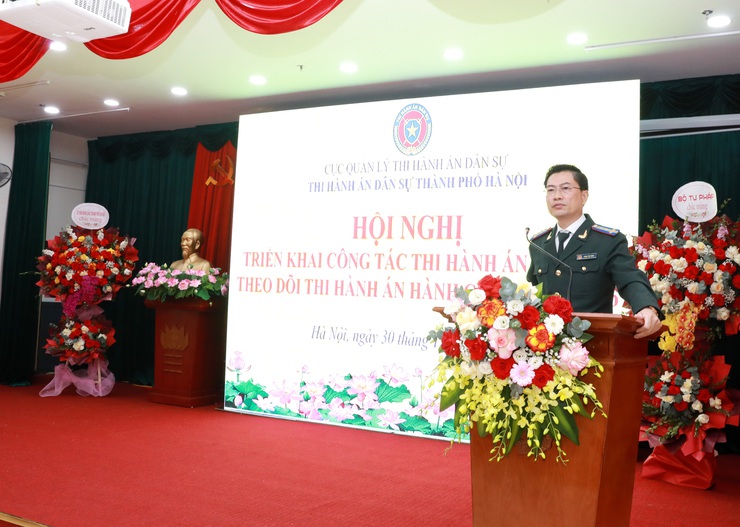
Director of the Hanoi Civil Judgment Enforcement Agency Pham Van Dung.
In 2025, the application of information technology saw clear progress, especially in handling large and complex cases involving many parties. These efforts helped standardize data, shorten processing and payment timelines, and enhance transparency.
Solutions such as electronic receipts, professional software, electronic document processing, and digital signatures were rolled out in a coordinated manner, gradually digitizing workflows and improving management efficiency and inter-agency coordination.
In enforcement by coercive measures, the agency issued coercive enforcement decisions in 819 cases, of which 550 were successfully carried out in strict compliance with legal procedures, while ensuring security, public order, and social safety.
Delegates at the event.
In line with the policy to streamline the political system, from July 1, 2025, the Hanoi Civil Judgment Enforcement Agency has operated under a new organizational model comprising six professional departments and 12 regional enforcement units, with a total staff of 399.
Operations have remained stable and uninterrupted, while enforcement officers and civil servants continue to receive training aligned with their positions.
Focused tasks for 2026
In 2026, the agency will continue to implement comprehensive solutions to improve civil judgment enforcement and administrative judgment monitoring. It will strictly implement directives from the central government, the Hanoi Party Committee, and the Ministry of Justice.
Key priorities include renewing management and operational methods under the new organizational model, strengthening administrative discipline, and tightening control over enforcement processes, especially asset seizure, valuation, auction, and the collection and disbursement of enforcement funds.
The agency will also focus on reducing backlog cases, resolving long-standing and high-value complex cases, improving verification effectiveness, and strengthening inspection, self-inspection, citizen reception, and the handling of complaints and denunciations.
Violations will be handled strictly, with stronger measures to prevent corruption and misconduct. At the same time, emulation movements will be promoted to build a disciplined, ethical, and professional enforcement workforce.
Delegates at the event.
Six priority task groups highlighted
In her remarks, Deputy Minister of Justice Dang Hoang Oanh praised the Hanoi Civil Judgment Enforcement Agency for its encouraging results in 2025, particularly given the large volume of cases and enforcement values. Many major and complex cases under the monitoring of the Central Steering Committee were resolved conclusively.
She said these results reflected the strong efforts of officers and civil servants, as well as close leadership from the Hanoi Party Committee, the People’s Council, and the People’s Committee, and effective coordination among departments and agencies.
For the period ahead, she urged the agency to strictly implement directives from Deputy Prime Minister Ho Quoc Dung and to focus decisively on six priority task groups.
First, fully implement guidance from the Ministry of Justice and the national civil judgment enforcement conference, and build detailed work plans from the start of the year, with clear tasks, timelines, responsibilities, and accountability. Top priority should be given to asset recovery in corruption and economic crime cases and banking and credit-related cases under central oversight.
Second, strengthen leadership and direction, enhance the responsibility of heads of units, and promptly support units with large workloads and high enforcement values, while addressing long-standing shortcomings without delay or avoidance.
Third, resolve conclusively cases where assets have been auctioned but not yet handed over, and address outstanding banking and credit cases, treating these as key tasks and pursuing solutions to the end to uphold the authority of the law.
Fourth, further strengthen inter-agency coordination, proactively reporting to the city’s Civil Judgment Enforcement Steering Committee to ensure timely direction on major and complex cases and asset recovery in corruption and economic crime cases.
Fifth, reinforce discipline and professional ethics, strengthen prevention of corruption and misconduct in enforcement activities, especially in organization and fund collection and disbursement, and strictly and promptly handle violations.
Sixth, continue comprehensive digital transformation, promote administrative reform, and apply information technology toward building a modern, transparent electronic enforcement agency, while ensuring integrated data sharing and connectivity with related systems.
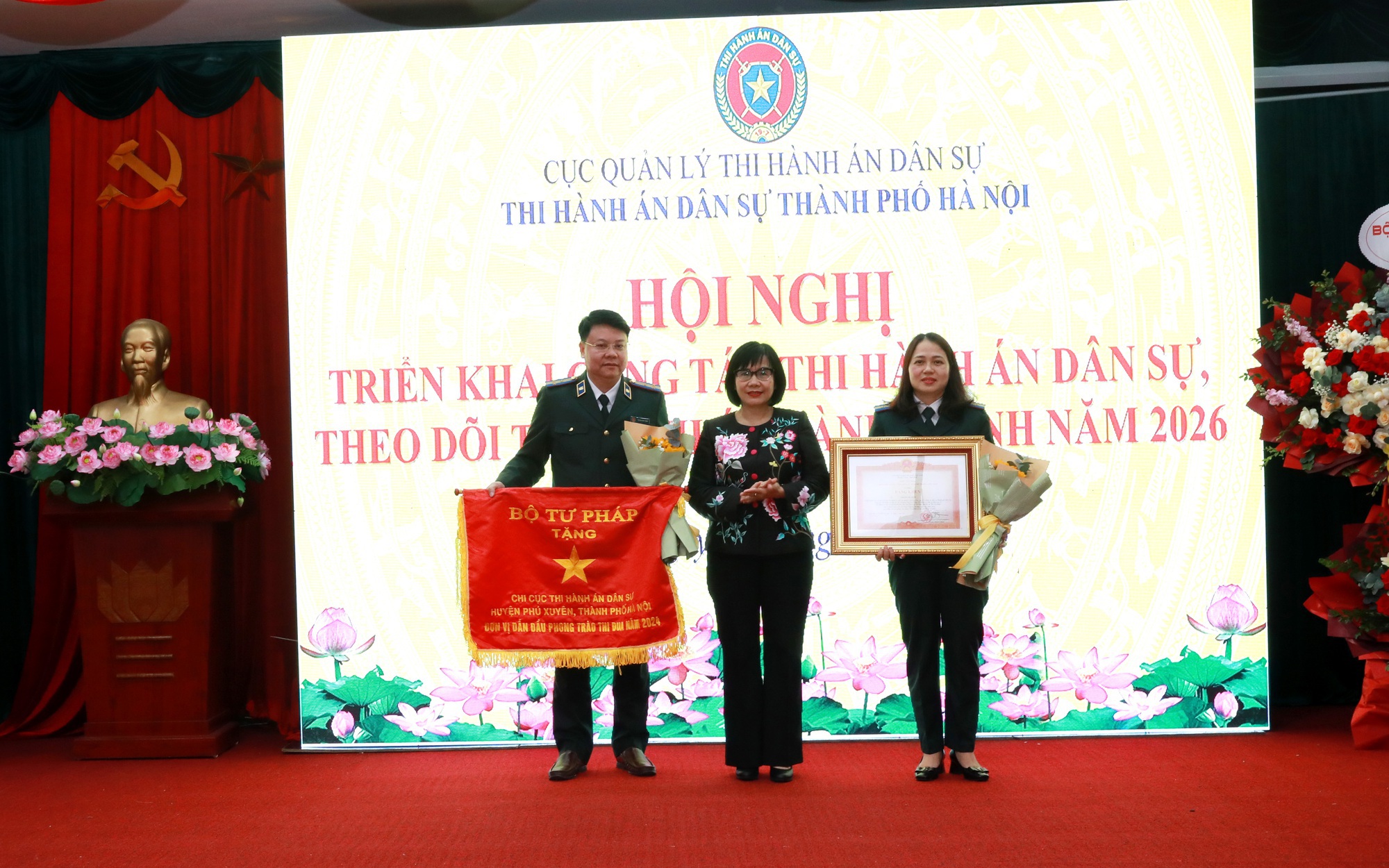
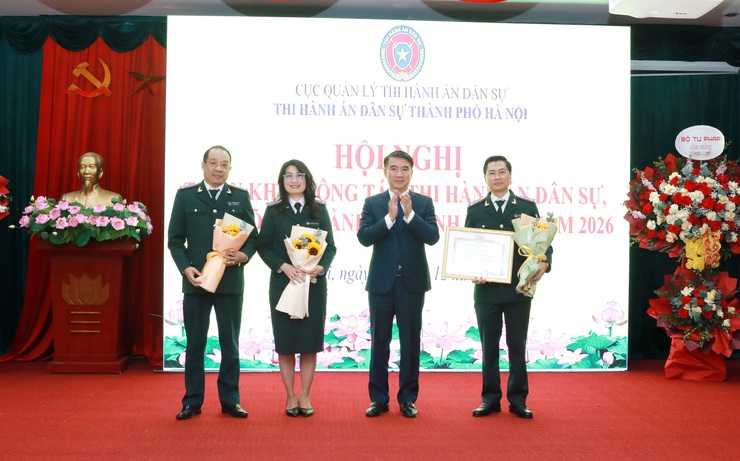
At the conference, Deputy Minister Dang Hoang Oanh awarded a Prime Minister’s Certificate of Merit to one individual and the Justice Sector Emulation Flag for 2025 to one collective in recognition of outstanding achievements.
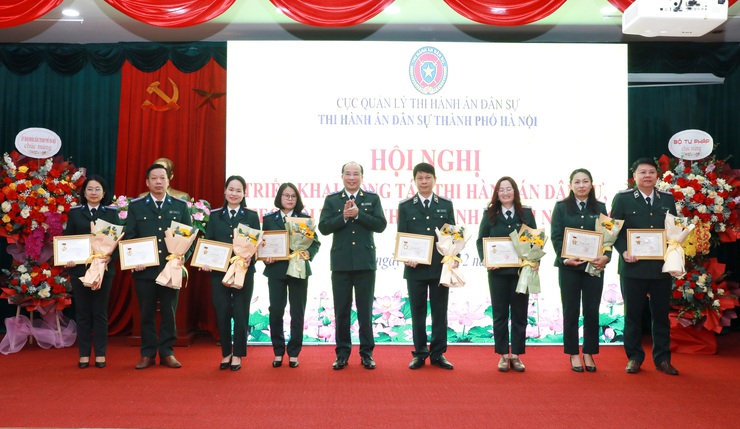
Director General Nguyen Thang Loi presented Justice Sector Medals to several individuals. On this occasion, Vice Chairman of the Hanoi People’s Committee Nguyen Xuan Luu awarded a commendation from the Standing Committee of the Hanoi Party Committee to the Hanoi Civil Judgment Enforcement Agency.