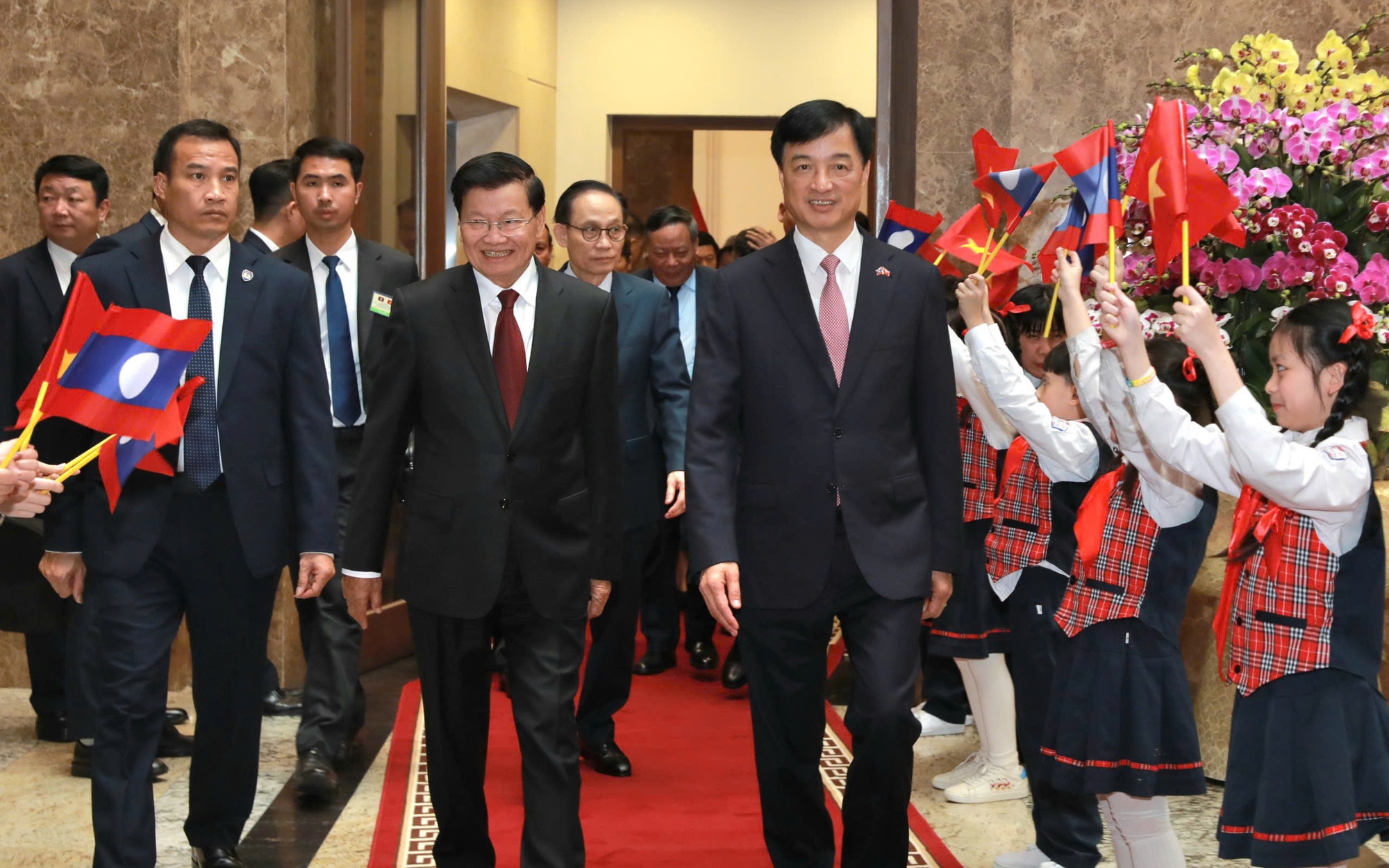
Welcoming ceremony for Thongloun Sisoulith, General Secretary of the Lao People's Revolutionary Party and President of the Lao People's Democratic Republic.
Attending the conference were Nguyen Duy Ngoc, a Politburo member and Secretary of the Hanoi Party Committee; Le Hoai Trung, a Politburo member and Minister of Foreign Affairs; Party Central Committee members Vu Dai Thang, Deputy Secretary of the Hanoi Party Committee and Chairman of the Hanoi People's Committee; Nguyen Van Phong, Standing Deputy Secretary of the Hanoi Party Committee; Nguyen Trong Dong, Deputy Secretary of the Hanoi Party Committee, members of the Standing Committee of the Hanoi Party Committee and representatives of central agencies and the city.
The Lao delegation also included Vilay Lakhamphong, a Politburo member and Standing Member of the Secretariat of the Lao People's Revolutionary Party; Anouphap Tounalom, a Party Central Committee member, Secretary of the Vientiane Capital Party Committee and Chairman of the Vientiane Capital People's Council; Thongsavanh Phomvihane, Minister of Foreign Affairs; senior Lao officials and Khamphao Ernthavanh, Ambassador of Laos to Viet Nam.
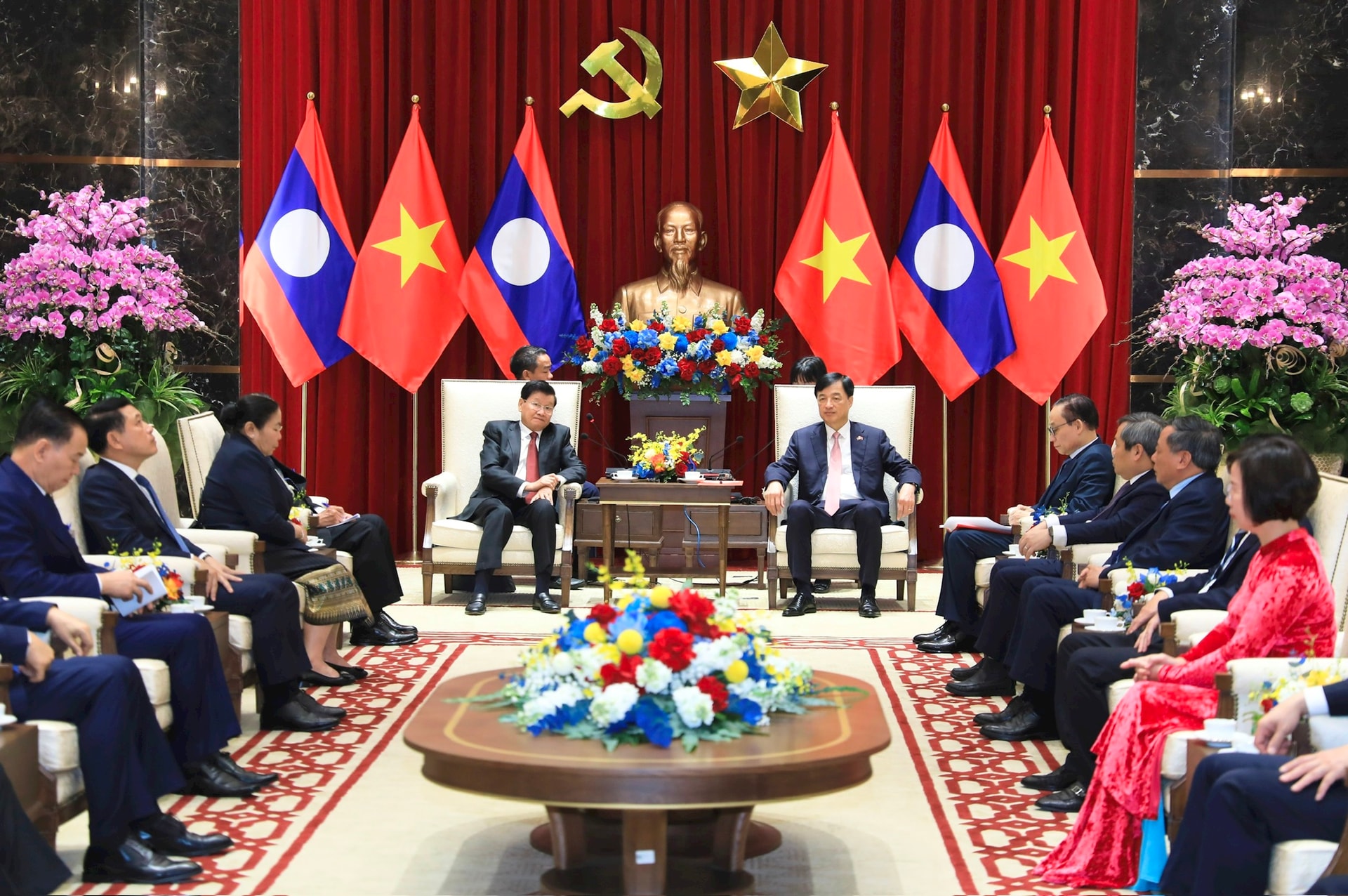 Leaders of Hanoi receive the Lao delegation.
Speaking at the conference, General Secretary and President Thongloun Sisoulith praised the major, comprehensive and historically significant achievements attained by the Vietnamese people over 80 years of nation building and development, particularly the outstanding results of the 40-year Doi Moi process and the 13th Party Congress term. He warmly congratulated Vietnam on the success of the 14th National Congress of the Communist Party of Vietnam.
General Secretary and President Thongloun Sisoulith expressed confidence that, under the leadership of the Vietnam Communist Party headed by General Secretary To Lam, Vietnam would continue to uphold its proud traditions, successfully implement the Resolution of the 14th Party Congress and achieve its two 100-year development goals.
He thanked municipal Party Chief Ngoc and the leaders of the capital for their warm, respectful and thoughtful reception of the high-level Lao delegation in a spirit of close fraternal ties.
Reviewing key milestones in Hanoi's history, Thongloun Sisoulith commended the capital's recent achievements in development and construction, noting that these experiences offer valuable models and lessons for Lao cities in the time ahead. On this occasion, he also shared personal and cherished memories associated with Hanoi.
At the conference, Ngoc congratulated Laos on the successful conclusion of the 12th National Congress of the Lao People's Revolutionary Party.
He affirmed that the Party organization, authorities and people of Hanoi firmly believe that, under the leadership of Thongloun Sisoulith and the newly elected Central Committee of the Lao People's Revolutionary Party, Laos would continue to achieve new and even greater accomplishments, successfully implement the Resolution of the 12th Party Congress and build a peaceful, independent, democratic, unified and prosperous Lao nation in line with socialist goals.
Ngoc expressed his sincere thanks to Thongloun Sisoulith and the high-level Lao delegation for visiting and working in Hanoi and noted the positive results achieved by the city's Party organization, authorities and people in recent years.
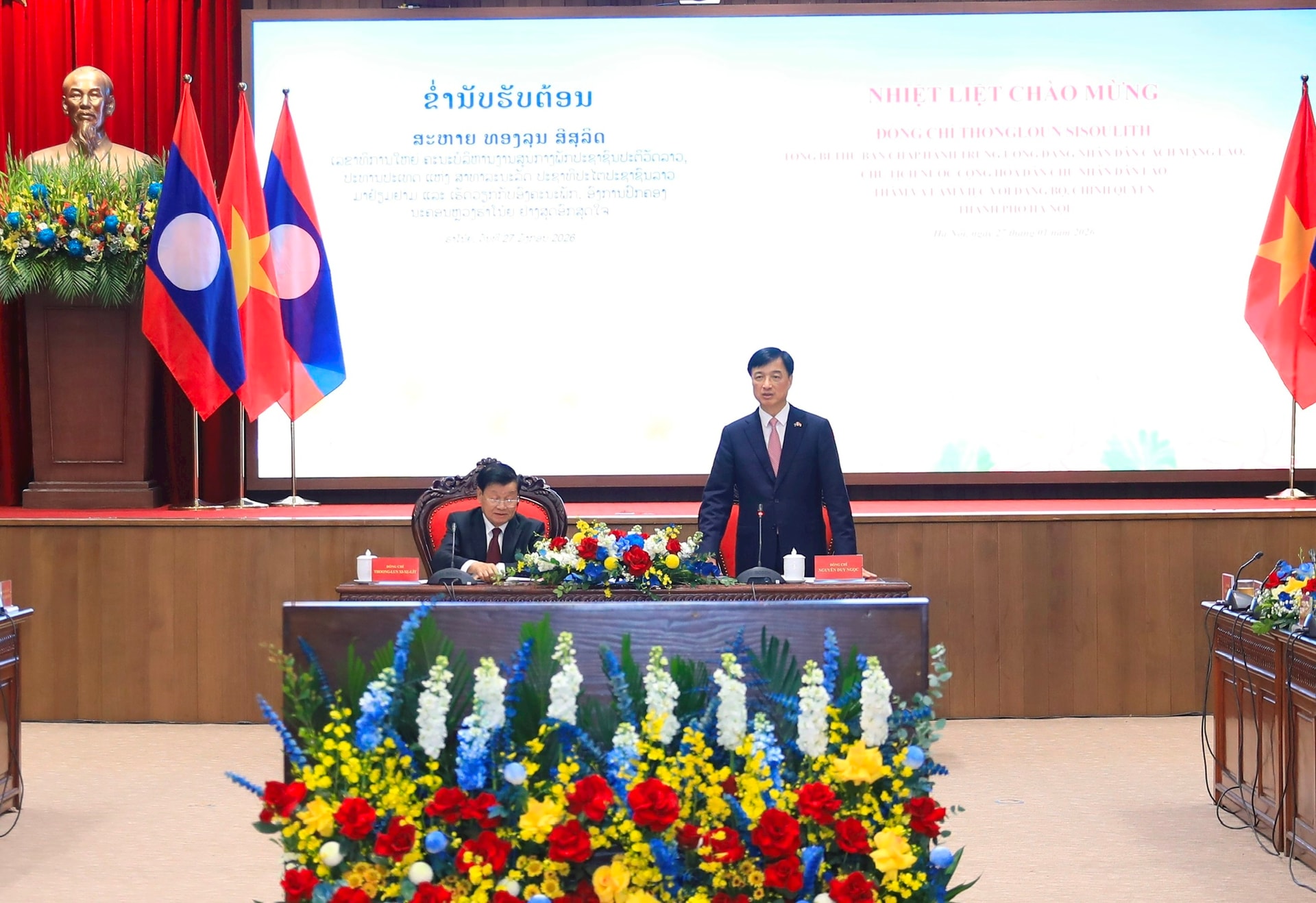 Hanoi Party Secretary Nguyen Duy Ngoc speaks at the meeting.
Referring to Thongloun Sisoulith's memories of Hanoi, Ngoc said these reflections serve as both reminders and motivation for generations of the capital's residents to work together for continued development.
He affirmed that, as the capital, Hanoi would always give high priority to the relationship and remain a reliable partner, ready to share practical experience with Lao counterparts, thereby further concretizing the special Vietnam–Laos cooperation in the new period.
Ngoc expressed confidence that, on the foundation of the two countries' long-standing traditional ties and deep political trust, the outcomes of this visit would make a positive contribution to nurturing and developing the special Vietnam–Laos relationship.
He said the visit would open up more practical and effective avenues of cooperation between Hanoi and Lao localities. Hanoi and Vientiane, he added, would continue to strengthen economic linkages and multi-sector cooperation in line with the orientation and spirit agreed by the two General Secretaries during their talks on January 26.
At the conference, Vice Secretary of the Hanoi Party Committee Nguyen Van Phong briefed the Lao delegation on Hanoi's orientations for implementing the Resolution of the 14th National Congress of the Communist Party of Viet Nam.
As part of the program, delegates visited an exhibition showcasing products from Hanoi's traditional craft villages.
Earlier, on January 26, 2026, as part of official welcoming activities for the high-level Lao Party and State delegation, Hanoi Party Secretary Nguyen Duy Ngoc and his Vientiane counterpart Anouphap Tounalom signed a Memorandum of Understanding on cooperation between the Party organization and authorities of Hanoi, Socialist Republic of Vietnam and the Party organization and authorities of Vientiane Capital, Lao PDR for the 2026–2030 period, witnessed by the two countries' General Secretaries.
Building on previous cooperation between the two capitals, the new memorandum further specifies and expands areas of cooperation across multiple sectors, from the city level to the grassroots level, ensuring greater depth and alignment with the development orientations of both capitals.
In political and external affairs, the two sides will continue delegation exchanges, cooperation in Party building and political system strengthening and enhanced communication on the special Vietnam–Laos relationship. They will also coordinate activities marking the 65th anniversary of diplomatic relations and the 50th anniversary of the Treaty of Friendship and Cooperation in 2027.
In economic cooperation, the two capitals will promote collaboration in investment promotion, innovation, digital transformation, industry, trade, agriculture and environmental protection, while sharing information, facilitating investment and connecting businesses.
In education, culture and social affairs, the two sides will strengthen cooperation in cadre training, scholarship support, cultural exchanges and healthcare assistance. Agencies and socio-political organizations from both sides will expand practical and effective cooperation, professional exchanges and mutual support.