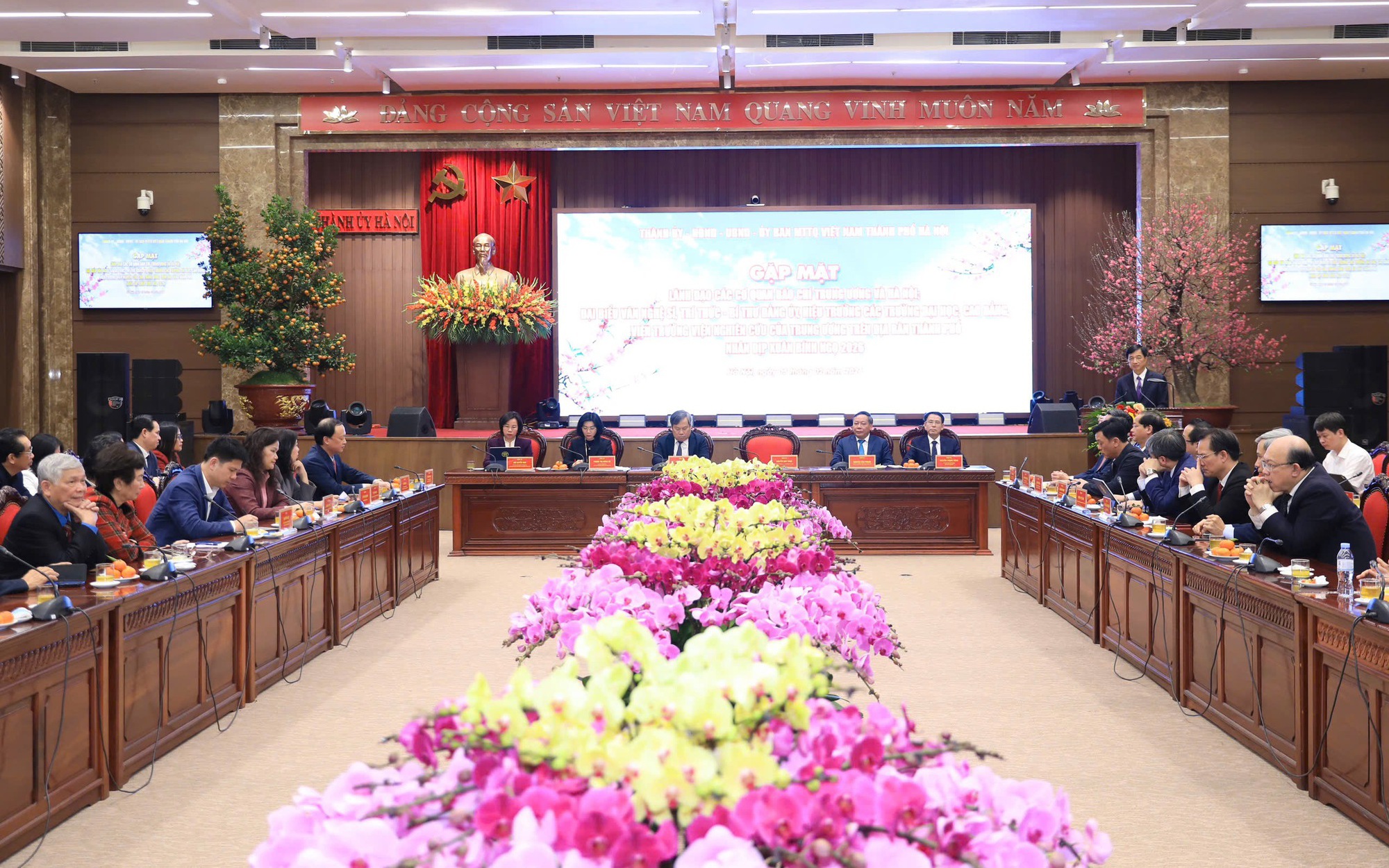
 Overview of the meeting.
The meeting was chaired by Politburo member and Hanoi Party Secretary Nguyen Duy Ngoc; Party Central Committee member, Deputy Secretary of the Hanoi Party Committee and Chairman of the Hanoi People's Committee Vu Dai Thang; Party Central Committee member and Deputy Secretary of the Hanoi Party Committee Nguyen Trong Dong; Standing Deputy Secretary of the Hanoi Party Committee Nguyen Van Phong; Deputy Secretary of the Hanoi Party Committee and Chairwoman of the Hanoi People's Council Phung Thi Hong Ha; and Standing Committee member of the Hanoi Party Committee and Chairwoman of the Vietnam Fatherland Front Committee of Hanoi Bui Huyen Mai.
Attending from central agencies were Party Central Committee members Duong Trung Y, Editor in Chief of the Communist Review, and Do Tien Sy, Director General of the Voice of Vietnam; Deputy Head of the Central Commission for Publicity, Education and Mass Mobilization Vu Thanh Mai; Deputy Minister of Foreign Affairs Le Thi Thu Hang; and Deputy Director General of the Vietnam News Agency Nguyen Thi Su, among others.
Also present were members of the Standing Committee of the Hanoi Party Committee, leaders of the People's Council and People's Committee and 228 delegates representing central and city press agencies, artists, intellectuals and prominent figures as well as Party secretaries and presidents of universities and colleges and leaders of central academies based in Hanoi.
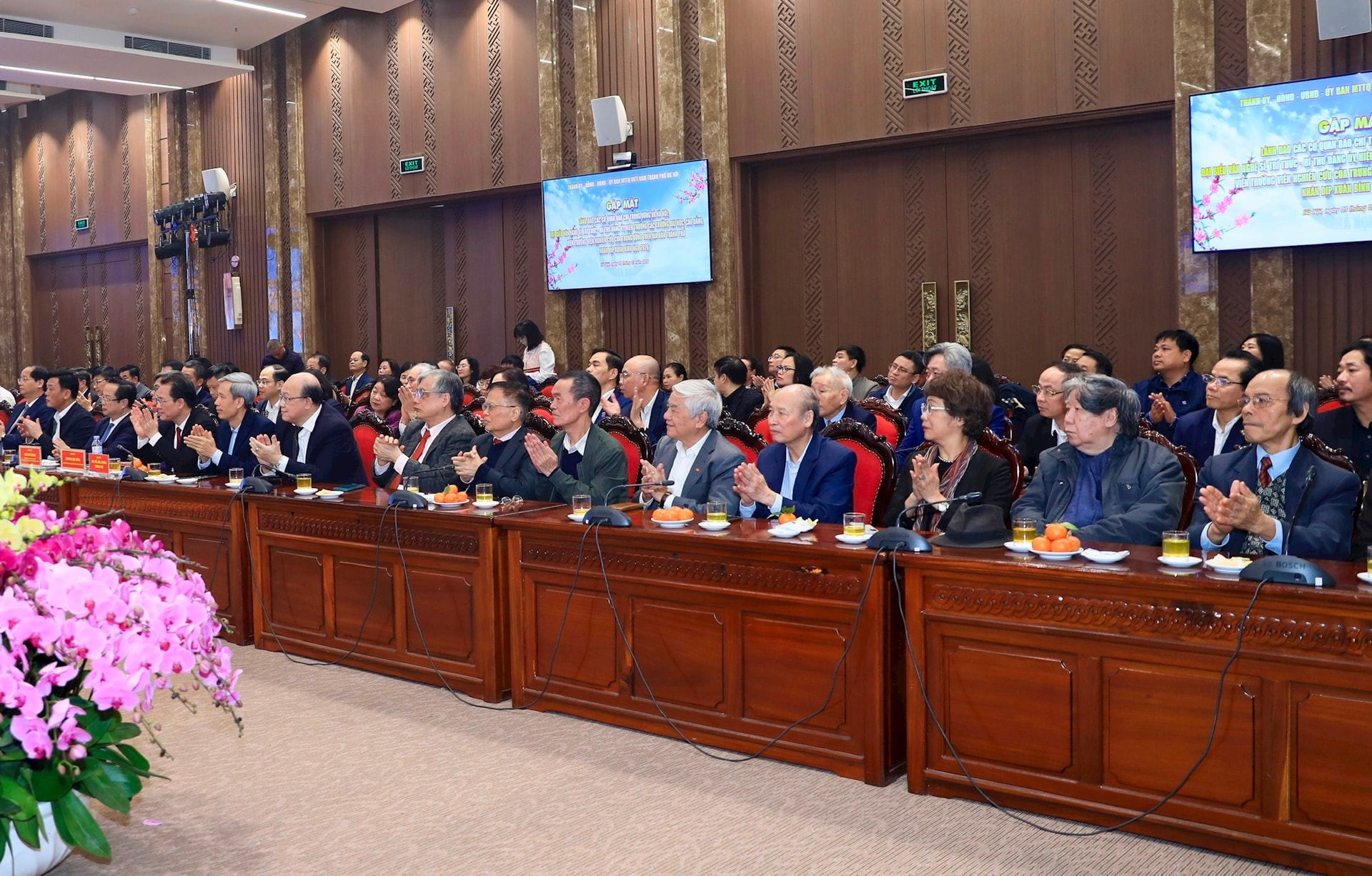 Delegates attend the meeting.
Speaking at the meeting, delegates expressed recognition, consensus and high expectations for the vision and political determination of the Hanoi Party Committee in shaping the capital's development in the coming period, particularly its pioneering spirit, people-centered approach and emphasis on culture.
Doctor Nguyen Viet Chuc, former Vice Chairman of the National Assembly Committee for Culture, Education, Youth, Adolescents and Children, shared his joy and optimism at Hanoi's recent positive changes, noting in particular the city's efforts to gradually address long-standing shortcomings and stagnation.
He described this as a welcome sign that reflects the determination and responsibility of the current city leadership.
Chuc praised the city's focus on major programs for the people and for culture. He said these development orientations not only address immediate issues but also aim to build a capital worthy of its thousand-year heritage.
For Hanoi to make breakthroughs, it must take the lead and dare to tackle difficult and unprecedented tasks. He emphasized the need for in-depth and substantive engagement with leading experts in each field to build social consensus and achieve real effectiveness.
Chairman of the Hanoi Association of Literature and Arts Tran Quoc Chiem congratulated Hanoi on its achievements in 2025 and on the success of the 14th National Party Congress and the 18th Hanoi Party Congress, describing them as key political events that have laid a solid foundation for the capital's continued comprehensive development.
In response to new demands in building and developing the capital, Chiem emphasized the responsibility of artists and intellectuals to continuously enhance political awareness, civic responsibility and professional integrity.
He said the cultural and artistic community sees itself as a force on the ideological and cultural front, ready to contribute talent and intellect to protect Hanoi's cultural values and accompany the city on its new development journey.
Professor and Doctor Le Anh Tuan, Party Secretary of Hanoi University of Science and Technology, expressed appreciation for Hanoi's strategic vision and political determination to develop the capital into a leading regional center for innovation and science and technology.
He noted that the capital's long-term master planning clearly reflects its development aspirations and pioneering responsibility in the new era.
Tuan said the action plan to implement Politburo Resolution No. 57 NQ TW dated December 22, 2024, on breakthroughs in science and technology development, innovation and national digital transformation in Hanoi was well structured with clear objectives, tasks, solutions, resources and timelines.
He highlighted that stronger participation by universities in city programs and projects demonstrates increasingly close links between Hanoi and training and research institutions, creating an important foundation for science and technology development and innovation.
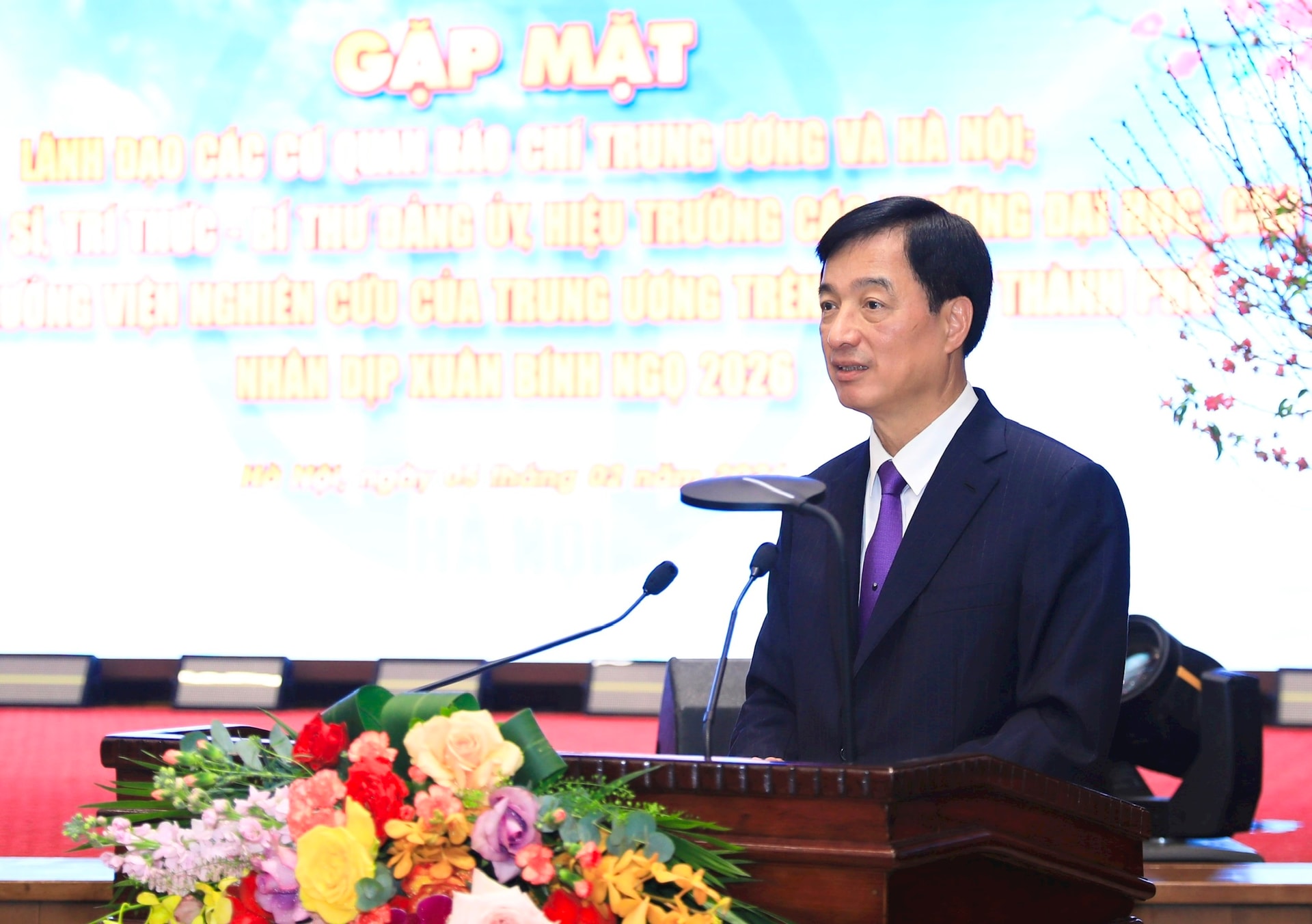 Hanoi Party Chief Nguyen Duy Ngoc speaks at the meeting.
In his remarks, Ngoc thanked central and Hanoi-based press agencies as well as scientists, intellectuals, experts and artists for their long-standing engagement and effective contributions to the capital's development.
He said their responsible and dedicated support has been an important resource underpinning major city decisions in recent years.
Ngoc said the city had carefully received the thoughtful and responsible opinions shared at the meeting and would study them for application in Hanoi's development in the new period.
Outlining Hanoi's development orientation, Ngoc stressed that the city has identified a three-pillar foundation comprising institutions, planning and development models.
On institutions, he noted that the Politburo and key leaders, including General Secretary To Lam, have worked directly with Hanoi and granted the city stronger and more thorough decentralization and delegation of authority.
This allows Hanoi to proactively develop and implement policies and take responsibility for creating development space toward a modern, civilized and happy capital with a 100-year vision. On that basis, the city will continue to institutionalize new mechanisms through amendments to Politburo Resolution 15 and revisions to the Capital Law 2024.
On planning, Ngoc said the city has identified seven major requirements, emphasizing a multi-layer, multi-level and multi-center planning approach. The goal is to fully tap the potential of underground space, low-level space and outer space while harmonizing heritage preservation with modern development.
Regarding development models, the city has identified science and technology, innovation and digital transformation as the main drivers. For this model to operate effectively, Ngoc said three key conditions are required, namely a sound legal framework, infrastructure and resources. He expressed hope that scientists, researchers and experts across fields would continue to accompany and contribute their intellect to the city.
Ngoc committed that the city would create the most favorable conditions for scientists, intellectuals and experts to effectively and substantively accompany Hanoi's development.
On the occasion of the approaching Lunar New Year of the Year of the Horse 2026, Ngoc extended wishes of health, happiness and success to journalists, scientists, researchers, experts and artists and expressed hope for even greater contributions and companionship from the intellectual and expert community to help generate new breakthroughs and development momentum for the capital in the coming period.