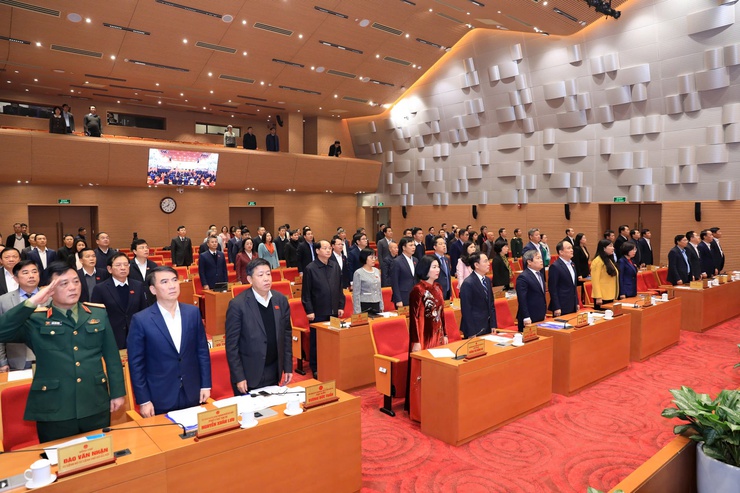
Delegates attend the session on January 27.
Attending the session were Party Central Committee members Vu Dai Thang, Deputy Secretary of the Hanoi Party Committee and Chairman of the Hanoi People's Committee; Nguyen Trong Dong, Deputy Secretary of the Hanoi Party Committee; Phung Thi Hong Ha, Deputy Secretary of the Hanoi Party Committee and Chairwoman of the Hanoi People's Council; Nguyen Ngoc Tuan, Deputy Head of the Hanoi National Assembly delegation; Bui Huyen Mai, a member of the Standing Committee of the Hanoi Party Committee and Chairwoman of the Hanoi Vietnam Fatherland Front Committee, along with city leaders and members of the Hanoi People's Council.
In her opening remarks, Ha said the 31st session of the Hanoi People's Council was held at a particularly significant time, immediately following the success of the 14th National Congress of the Communist Party of Vietnam and as the second thematic session of the council in January 2026.
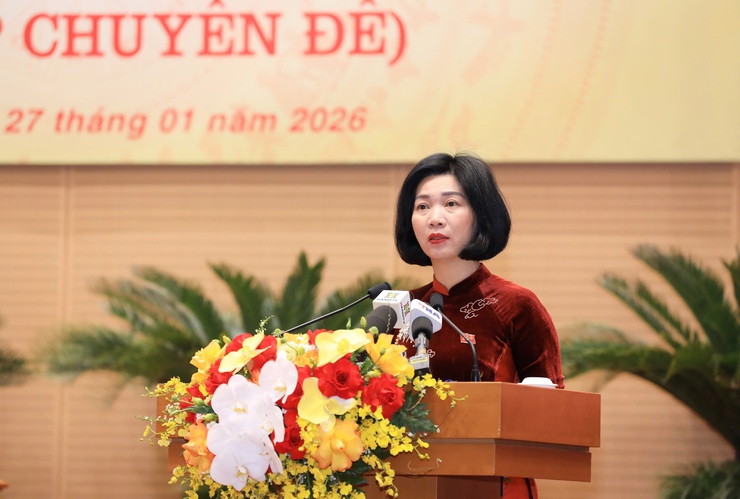 Phung Thi Hong Ha, Deputy Secretary of the Hanoi Party Committee and Chairwoman of the Hanoi People's Council, delivers the opening speech.
"This reflects the strong sense of urgency in the council's work from the very first days and months of the year, especially through supervision and oversight of tasks under the 2026 socio-economic development plan, including major and unprecedented issues that the city is currently focusing on," Ha emphasized.
With these requirements, the Hanoi People's Council convened the session to promptly specify and implement provisions of the law and National Assembly Resolution No. 258/2025/QH15 on piloting special mechanisms and policies for implementing large and important projects in the capital, as well as directives of the Hanoi Party Committee in support of the city's development.
According to the approved agenda, the session will review groups of issues submitted by the Hanoi People's Committee, including adjustments and supplements to the total funding of the 2026 public investment plan and the specification of criteria for compensation, support and resettlement under Resolution No. 258/2025/QH15 of the National Assembly.
"These are important legal tools to accelerate site clearance and the implementation of key projects," the chairwoman noted.
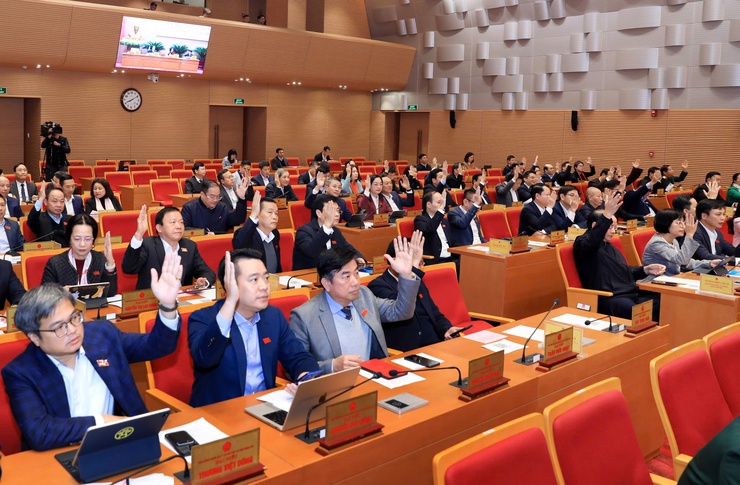
Members of the Hanoi People's Council vote to approve the session agenda.
In addition, the session will review major urban proposals such as adjustments to the Hanoi housing development program for the 2021–2030 period, the multi-purpose urban area proposal and notably the policy orientation for the project titled "Smart Hanoi City to 2030 with a Vision to 2045."
The session will also provide opinions on the capital's master plan with a 100-year vision and public-private partnership projects under build-transfer contracts, including the West Lake renovation project and the National Highway 1A corridor project.
It will also contribute opinions on amendments to the 2024 Capital Law. At the same time, the participants will consider decisions on several mechanisms and policies related to social security and human resources, including medical service pricing and regulations on attracting and retaining talented individuals in the city.
At this session, the Hanoi People's Council will also review personnel matters within its authority to ensure unified and effective leadership and direction of the city's administrative apparatus.
Ha stressed that the workload of the 31st session is substantial, with many complex and long-term issues. The swift review and adoption of important and urgent mechanisms and policies at this session represent a concrete step in implementing the Resolution of the 17th Hanoi Party Congress, related action programs and the spirit of the 14th National Party Congress. These efforts contribute to building the three pillars of the capital's development, institutions, planning and a new development model, linked to establishing a double-digit growth model in the new era with a 100-year vision and beyond.
To ensure the best possible outcomes, Ha urged members of the Hanoi People's Council to carefully study the submissions and appraisal reports prepared by the council's committees, engage in democratic and objective discussions and offer thoughtful input so that adopted resolutions are scientifically sound, legally compliant and closely aligned with the realities of people's lives.