After a focused, serious and responsible morning of work, the 4th plenary session of the Hanoi Party Committee's Executive Board completed its full agenda.
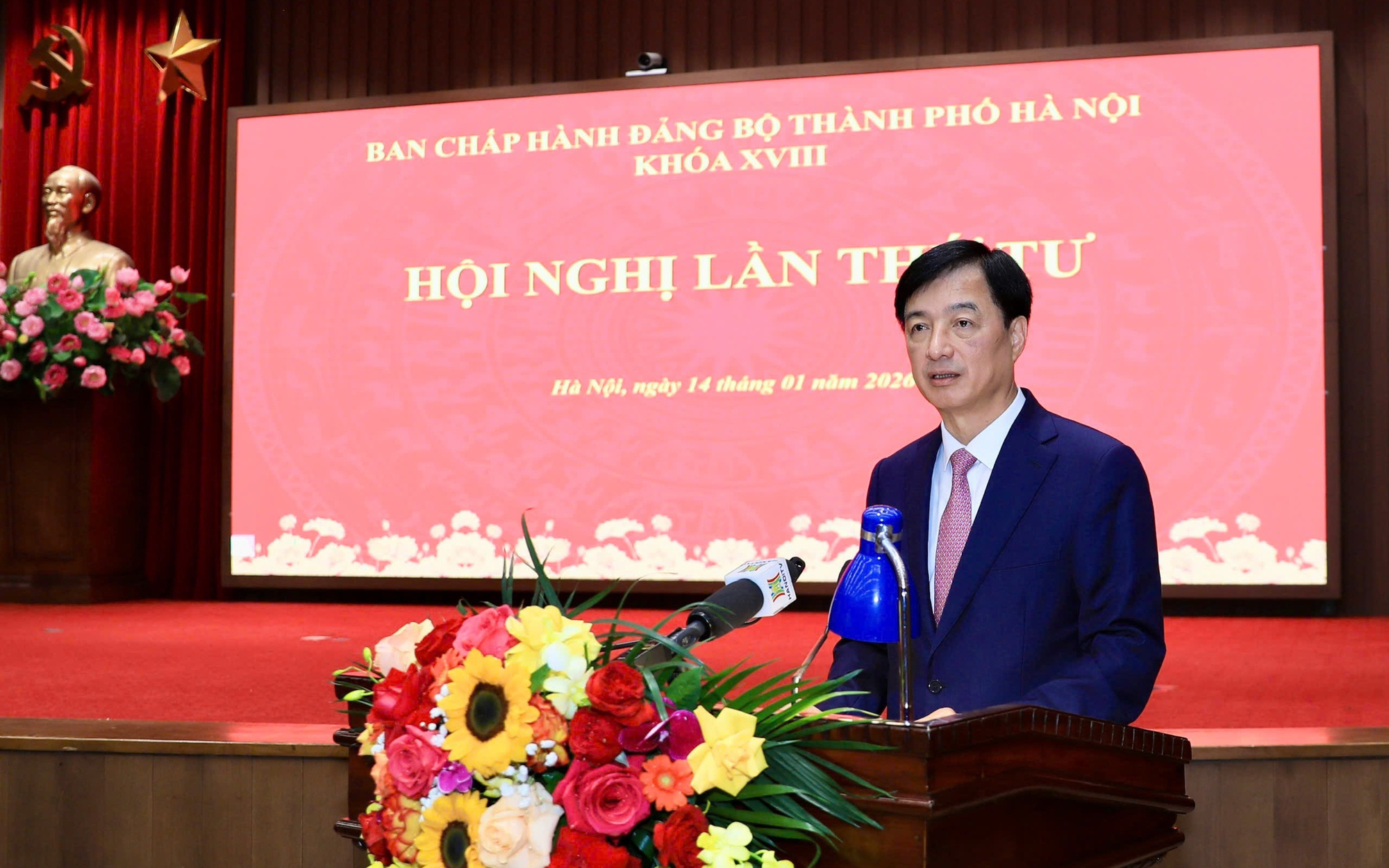
Hanoi Party Chief Nguyen Duy Ngoc at the meeting.
In his closing address, Ngoc emphasized the task of developing scenarios to mobilize resources and risk governance plans to ensure sustained double-digit growth over 20 consecutive years, in line with the capital master plan with a 100-year vision.
He also highlighted the goal of shaping the capital's development around the values of culture, identity and creativity with global connectivity.
First, regarding three key issues on institutions and the 100-year planning vision, the Executive Board basically agreed with the submissions and proposed reports of the Hanoi People's Committee. These include the proposal for a resolution to replace Politburo Resolution No. 15-NQ/TW dated May 5, 2022, the proposal to amend the Capital Law and the proposal to formulate the capital master plan with a 100-year vision.
The Hanoi Party Secretary requested that delegates thoroughly understand and concretize the General Secretary To Lam’s concluding notice from the January 10, 2026 working session with the Hanoi Party Committee’s Executive Board, translating it into concrete action programs and daily operations of party committees, agencies and units, and integrating it into the implementation of assigned political tasks from the very start of 2026.
He asked the Party Committee of the Hanoi People's Committee to continue reviewing each component to ensure that the directions on superior institutions in the draft new Resolution 15 and the amended Capital Law are consistent and aligned with the 100-year planning vision.
These efforts must closely follow domestic and global trends and forecasts with a long-term perspective and promptly update the spirit of newly issued strategic Politburo resolutions, especially the General Secretary's conclusions from the January 10, 2026 working session and the upcoming documents of the 14th National Party Congress.
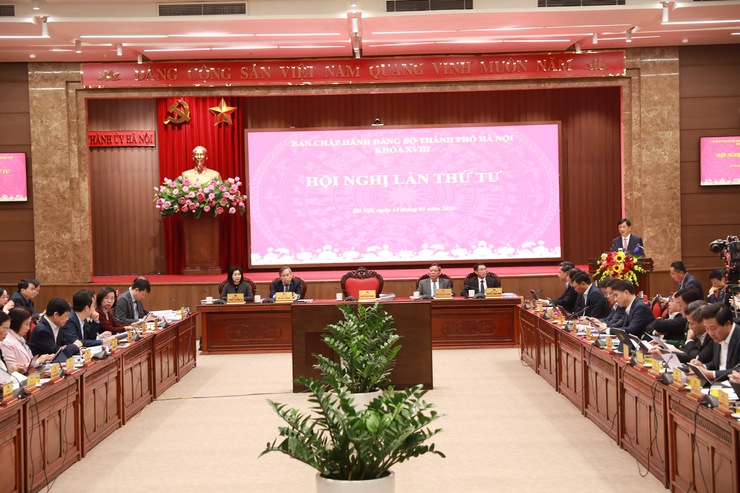
Overview of the meeting.
Ngoc required close coordination with the working schedules of central agencies to develop a backward timeline so submissions can be made to the National Assembly at its first session, expected in April 2026. Any difficulties or obstacles must be promptly reported to the Standing Board of the Hanoi Party Committee for resolution.
Regarding the capital master plan with a 100-year vision, he said the city will finalize it for social feedback and present it through 4D models so the public can clearly understand the planning content.
The plan must vividly reflect a multi-layered, multi-tiered, multi-polar and multi-center orientation capable of shaping the capital's development around culture, identity and creativity with global connectivity while harmoniously balancing preservation and development and clearly expressing the capital's cultural essence.
Ngoc assigned the Party Committee of the Hanoi People's Committee to urgently develop and issue a synchronized system of standards and technical norms for key sectors as a basis for both planning and immediate implementation.
Priority areas for early standard-setting, linked to the implementation of Resolution No. 57-NQ/TW and addressing five bottlenecks, include smart and sustainable urban areas, the urban railway system, digital infrastructure and green transition, digital transformation and the circular economy.
Second, regarding orientations for renewing the capital's socio-economic development model linked to establishing a double-digit growth model, the Hanoi Party Committee's Executive Board requested the Party Committee of the Hanoi People's Committee to continue refining the proposal.
The model should place science and technology, innovation, digital transformation and high-quality human resources at its core while developing resource mobilization scenarios and risk governance plans to ensure sustained double-digit growth over 20 years in line with the 100-year plan. This is intended to drive fast and sustainable development for the capital, the Capital Region and the country in the new era.
Ngoc requested that following the conference, delegates submit their comments to the Hanoi People’s Committee by January 20, 2026, for consolidation. Tasks should be clearly assigned along four pillars—the Party Committee, the People’s Council, the People’s Committee and the Fatherland Front—to clarify responsibilities and key issues.
These inputs are to be integrated into proposals to amend the Capital Law and refine the capital master plan with a 100-year vision, with the objective of ensuring that the city not only achieves growth of over 11% in 2026 but also sustains this momentum throughout the 2026–2030 period and lays a solid foundation for subsequent development stages.
The Executive Committee assigned the Party Committee of the Hanoi People’s Committee to immediately direct the establishment of a goal management system for regular review, monitoring and evaluation. This system is intended to ensure that every task and objective is implemented coherently across the four pillars of the political system, from the city level down to the grassroots.
A report on the establishment and operation of this system is to be submitted to the Standing Board and the Standing Committee of the Hanoi Party Committee by January 2026.
Third, regarding investment policy and the implementation of several investment projects under National Assembly Resolution No. 258/2025/QH15 dated December 11, 2025, Ngoc said the Executive Committee basically agreed on the investment policy for two projects.
These include the Medical and Elderly Healthcare Complex combined with Hanoi Medical University in Hoang Mai Ward and the Digital Technology and Mixed-Use Park Project in Phu Dien and Tay Tuu Wards.
The Party Committee of the Hanoi People's Committee and relevant city agencies must ensure all conditions are met so that once approved, the projects can be implemented immediately and completed on schedule without waste or prolonged delays.
Fourth, regarding the action plan to implement Politburo Resolution No. 57-NQ/TW dated December 22, 2024, in Hanoi in 2026, Ngoc requested the city's Steering Committee for Resolution 57 to absorb feedback from the conference, finalize the plan and issue it promptly for immediate implementation.
This will support the transformation of the capital's socio-economic development model and ensure science and technology, innovation and digital transformation truly become central drivers. The plan is expected to contribute to achieving growth of 11% or higher in 2026 and sustaining double-digit growth throughout the 2026–2030 period and beyond.
Emphasizing the two core missions of serving people, businesses and society and focusing on development facilitation, Ngoc required that all agreed tasks be accompanied by clear implementation roadmaps to ensure progress and timelines are met. Existing shortcomings and delays must be addressed immediately so that implementation is effective, substantive and on schedule.