Cuong stated that in the 2026–2031 term, Hanoi will continue to be among the localities with the largest number of elected deputies nationwide. The city is expected to elect 32 National Assembly deputies, including 15 introduced by central authorities and 17 introduced by the city; 125 deputies to the Hanoi People's Council; and 3,164 deputies to commune-level People's Councils across 126 communes and wards. The total number of voters in the city is 6,061,171.
He emphasized that identifying the election as a particularly important political task of the entire political system, the Hanoi Party Committee, People's Council, People's Committee, Election Commission and Vietnam Fatherland Front Committee of Hanoi have led and directed preparations with the spirit of being "one step ahead," acting proactively, urgently, synchronously and methodically while strictly complying with legal regulations.
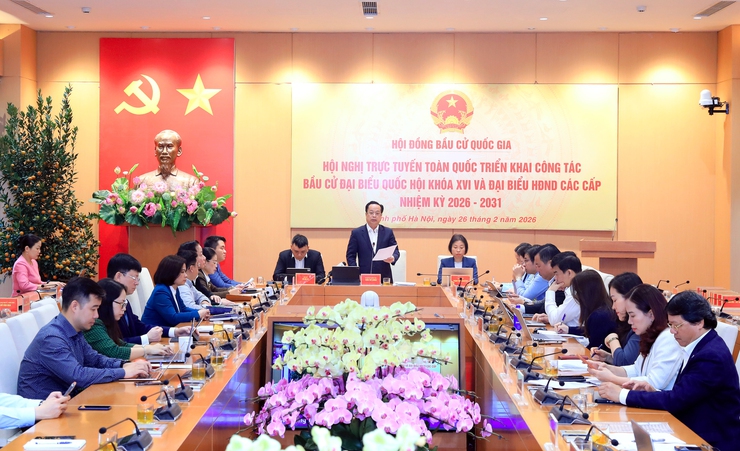 Delegates attend at the Hanoi bridge point.
Immediately after the central authorities issued guiding documents, Hanoi promptly established and consolidated election steering committees and election commissions at all levels, and issued 186 leadership, directive, and guidance documents to implement the work.
Implementation plans were developed in detail under the principle of “clear people, clear tasks, clear timelines, clear responsibilities, clear outputs, and clear authority,” ensuring that every stage and step had a clearly accountable focal point.
The Hanoi Election Commission was established with 37 members. All 126 communes and wards established their election commissions within the statutory deadline. The city also set up 11 election boards for National Assembly deputies, 31 election boards for city-level People's Council deputies, 831 election boards for commune-level People's Council deputies and 4,097 polling teams. Special attention has been paid to consolidating personnel in the case of changes to ensure continuity, stability and effectiveness of the election apparatus.
Regarding the receipt of candidate dossiers, as of 5 p.m. on February 1, 2026, the entire city had completed the process on schedule. For the 16th National Assembly, 55 dossiers were received, including 51 nominated candidates and four self-nominated candidates. For the Hanoi People’s Council, 248 dossiers were received, all of them nominated. For commune-level People’s Councils, 6,199 dossiers were received.
Following three rounds of consultations conducted in a democratic, objective and regulation-compliant manner, the city finalized the official lists of 39 candidates for the National Assembly, 205 candidates for the Hanoi People’s Council, and 5,271 candidates for commune-level People’s Councils.
The lists meet required standards and eligibility criteria, ensuring a balanced structure and appropriate representation, and pay due attention to the proportion of women, young candidates, and representatives of various social groups.
To improve the quality of election campaigning, on February 25 the Hanoi Election Commission held a meeting with candidates for the National Assembly and the Hanoi People's Council for the 2026–2031 term.
At the meeting, candidates were provided comprehensive information on the capital's socio-economic development and national defense and security situation and were guided to develop practical and realistic action programs clearly demonstrating their commitments to voters.
 Permanent Vice Chairman of the Hanoi People's Council Tran The Cuong presents his remarks at the conference.
At the same time, the city continues to review, compile, update and publicly post voter lists to ensure citizens' voting rights, especially for those working or studying away from their place of residence, the elderly, people with disabilities and residents in special areas. The settlement of petitions, complaints and denunciations related to the election has been conducted seriously, promptly and in accordance with legal procedures.
In parallel with organizational work, Cuong said Hanoi has paid special attention to ensuring resources for the election. The city has coordinated with the National Assembly Office to install and operate election software, promote information technology application and digital transformation and enhance accuracy, transparency and management efficiency.
Communication work has been implemented broadly and synchronously from the city to grassroots levels. The Information and Communication Subcommittee has developed a comprehensive plan and assigned specific responsibilities to each press agency and local cultural and information unit. Print and electronic newspapers, radio, television and official portals at all levels have simultaneously opened dedicated pages and sections to publicize the significance and importance of the election and reflect preparation progress and momentum in localities.
Digital platforms and social media are being effectively utilized to disseminate official information, guide public opinion and promptly counter false and distorted views related to the election. The atmosphere toward March 15, 2026 is spreading strongly across the capital, creating confidence and excitement among residents.
Ensuring security and safety has been identified as a critical task. Detailed plans have been developed to proactively grasp the situation, forecast potential complex developments, strengthen crime and social vice prevention and strictly control harmful information in cyberspace. Fire prevention and rescue plans at polling areas have been carefully reviewed and functional forces are ready on duty 24 hours a day.
Inspection and supervision have been strengthened through 16 working delegations of the Standing Committee of the Hanoi Party Committee and seven supervisory delegations of the Standing Committee of the Hanoi People's Council. Professional training for election personnel has been organized in diverse and flexible forms under a "hands-on guidance" approach, including scenario building and drills for hypothetical situations to improve grassroots officials' response capacity.
Regarding tasks from now until election day, Cuong affirmed that the city will closely follow central leadership and direction, proactively monitor public opinion and promptly resolve feedback, petitions, complaints and denunciations related to the election in accordance with the law.
The city will continue to review, compile, update, and publish voter lists to safeguard citizens’ voting rights; step up communication on the election; and strengthen training for election personnel, particularly at the grassroots level and among polling team members.
It will also develop detailed implementation scenarios, promptly address emerging issues at the grassroots level, enhance supervision and inspection, and promote the application of information technology and digital transformation in election work in accordance with regulations.
"Hanoi hopes to continue receiving the leadership and direction of the National Election Council. We firmly believe that with the engagement of the entire political system and the consensus of the people, the election of deputies to the 16th National Assembly and deputies to People's Councils at all levels for the 2026–2031 term in the capital will be successful and truly become a major festival of the people," said Cuong.
In particular, it will select deputies of outstanding quality, intellect and capability who genuinely represent the will and aspirations of voters, contributing to building a cultured, civilized and modern capital and a sustainably developing country in the new period," he added.